Updated · Equations updated; Diagrams updated; Sections updated; Examples or practice updated; Explanations expanded What changed?
- — Equations updated; Diagrams updated; Sections updated; Examples or practice updated; Explanations expanded
Inscribed Angles and Cyclicity
Section titled “Inscribed Angles and Cyclicity”An inscribed angle has its vertex on a circle and its sides along chords. It equals half the measure of the arc it intercepts, where the intercepted arc does not contain the vertex. A central angle subtending that same arc equals the full arc measure.
A quadrilateral is cyclic if all four vertices lie on one circle. In a convex cyclic quadrilateral, opposite angles sum to . Conversely, a convex quadrilateral with supplementary opposite angles is cyclic.
Example. Points occur in that order around a circle. If , find .
The angles are opposite angles of a convex cyclic quadrilateral, so
Angles subtending the same chord are equal when their vertices lie on the same side of that chord. If the vertices lie on opposite sides, the ordinary angles are supplementary. In longer proofs, directed angles modulo handle this orientation issue uniformly.
Example. In an acute triangle , let and be the feet of the altitudes from and onto and . Prove are concyclic.
Both and are right angles. Thus and lie on the circle with diameter , so all four points are concyclic.
Finding a hidden cyclic quadrilateral often creates a new pair of equal angles, which can lead to similarity.
Tangents and Tangent–Chord Angles
Section titled “Tangents and Tangent–Chord Angles”A tangent at is perpendicular to the radius . Tangent segments from the same external point have equal lengths because the right triangles formed with the center share a hypotenuse and a radius.
The angle between a tangent and a chord equals the inscribed angle subtending that chord in the corresponding opposite segment of the circle. Match the correct rays; supplementary angles can appear if a tangent ray is reversed.
Example. The angle between a tangent ray at and chord is . A point on the circle lies in the alternate segment corresponding to that angle. Find .
The tangent–chord theorem gives . Equivalently, the intercepted arc has measure , and the inscribed angle is half of it.
For a quadrilateral with an incircle tangent to all four sides, equal tangent lengths from each vertex imply that the sums of opposite side lengths are equal. This is Pitot’s necessary condition; the side equality alone is not a universal test for a given quadrilateral to have an incircle.
Power of a Point
Section titled “Power of a Point”For a circle with center and radius , the power of a point is
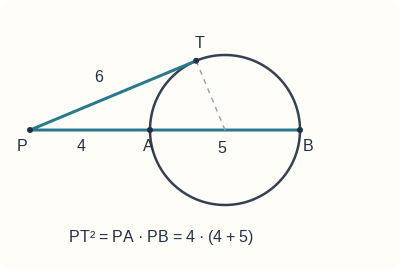
It is positive outside, zero on, and negative inside the circle. If a secant from an external point meets the circle first at and then at , then
A tangent gives . Thus two secants from the same external point satisfy . The farther distance is the full length from , not merely the chord length.
Example. A secant from external point meets a circle at in that order. If and , find the tangent length .
The full secant length is . Therefore
so .
For intersecting chords and meeting at an interior point , ordinary positive lengths satisfy . Both products equal , the negative of the signed power.
Example. Two chords intersect inside a circle at . If , , and , find .
The intersecting-chords relation gives , so .
Ptolemy’s Theorem
Section titled “Ptolemy’s Theorem”For a convex cyclic quadrilateral with vertices in circular order,
The left side multiplies the diagonals, while the right side adds the products of opposite sides. Cyclicity is required for equality; an arbitrary quadrilateral instead satisfies Ptolemy’s inequality.
Example. A cyclic quadrilateral has side lengths , , , and diagonal . Find .
Ptolemy gives
so .
When only the four side lengths and the area are involved, Brahmagupta’s formula gives
for a convex cyclic quadrilateral. For sides , the semiperimeter is eleven, so the area is .
Angles Made by Intersecting Chords and Secants
Section titled “Angles Made by Intersecting Chords and Secants”For two chords intersecting inside a circle, the angle between them is half the sum of the intercepted arcs of that angle and its vertical opposite. For two secants meeting outside, the angle is half the difference of the far and near intercepted arcs.
These formulas follow by introducing an auxiliary inscribed triangle and using either the exterior-angle theorem or the angle sum. The inside case adds two inscribed-angle contributions; the outside case subtracts one from the other. Drawing the intercepted arcs before substituting prevents a common sign error.
Example. Two chords intersect inside a circle. The arcs intercepted by an angle and its vertical opposite have measures eighty and one hundred forty degrees. Find the angle.
Its measure is half their sum:
The adjacent angle is seventy degrees. Using the outside-secant difference formula here would incorrectly give thirty degrees.
When tangents replace secants, treat the near and far endpoints as coinciding at the tangency point, or derive the angle through the perpendicular radii. In particular, the angle between two tangent rays from an external point is supplementary to the minor central angle between their tangency radii.
Chords, Distances from the Center, and Arc Choice
Section titled “Chords, Distances from the Center, and Arc Choice”A chord subtending an inscribed angle has length . The same chord is perpendicular to and bisected by the line joining its midpoint to the center. If the center-to-chord distance is and the chord length is , then
This converts a chord problem into a right triangle. It also proves that equal chords are equidistant from the center and that a longer chord lies closer to the center.
Example. Parallel chords of lengths sixteen and twelve lie on opposite sides of the center of a circle of radius ten. Find their separation.
Their distances from the center are and . Because they lie on opposite sides, their separation is .
If they lay on the same side, the separation would instead be two. The length data alone do not determine which configuration is intended.
An angle can subtend either the minor or major arc, depending on its vertex. Keep track of which arc excludes that vertex. Equal sine values can correspond to supplementary inscribed angles, so a length equation alone may not identify the orientation.
The Converse of Power of a Point
Section titled “The Converse of Power of a Point”Power relations can prove cyclicity as well as calculate lengths. Suppose segments and intersect at an interior point , with the two supporting lines distinct. If , then the four endpoints are concyclic.
To see this, draw the circle through and let it meet ray at . The chord relation gives . Cancel the positive factor to get , hence .
The location assumptions identify the correct second point. For external configurations, use signed distances or specify the endpoint order carefully.
Example. Segments cross at with . Prove their endpoints lie on a circle.
The two products are both thirty. The converse intersecting-chords theorem applies because lies inside both segments on distinct lines. Thus are concyclic.
Once cyclicity is established, angles subtending the same chord become available. A length product can therefore unlock an angle-chasing solution.
A Similarity Proof of Ptolemy
Section titled “A Similarity Proof of Ptolemy”The diagonal formula can be understood as splitting one diagonal into two pieces whose lengths are supplied by similar triangles.
Proof (Ptolemy’s theorem). Let be a convex cyclic quadrilateral in that order. Choose on diagonal so that .
Angles subtending chord give . Thus and
Subtracting the equal angles at gives . Also because both subtend chord . Hence , giving
Add and multiply by . The result is .
The constructed point is chosen to create two complementary similarities. In a difficult diagram, a useful auxiliary point often serves exactly this purpose: one part of a target segment accounts for one product, and the remainder accounts for the other.
Example. Find the ratio of a diagonal to a side in a regular pentagon.
Let the side length be and diagonal length . Four consecutive vertices form a cyclic quadrilateral with consecutive sides and both diagonals . Ptolemy gives
Thus satisfies . The positive root is , the golden ratio.
Diagonals from Four Cyclic Sides
Section titled “Diagonals from Four Cyclic Sides”Let consecutive sides be , and let . The cosine law in the two triangles sharing gives
because the opposite angles are supplementary. Eliminating the cosine yields
Rotating the side names gives
Their product recovers Ptolemy, which is a useful algebraic check on the formulas.
Example. A convex cyclic quadrilateral has consecutive side lengths two, three, four, five. Find the squares of its diagonals.
Substituting gives
The product of the diagonal lengths is twenty-three, agreeing with . The triangle inequalities for each diagonal are also satisfied, providing a geometric consistency check.
These formulas require the sides in circular order. Treating them as an unordered collection can attach the wrong products to the requested diagonal.
The Arc Midpoint and the Incenter
Section titled “The Arc Midpoint and the Incenter”If the internal angle bisector from meets the circumcircle again at , then is the midpoint of the arc not containing . The equal angles subtend equal chords .
A stronger relation is
where is the incenter. Since are collinear, . Meanwhile . Thus , and the equal-arc observation supplies .
This lemma is useful when an incenter appears together with the circumcircle: it produces a new circle centered at an arc midpoint through two vertices and the incenter. The proof explains why the midpoint must be the arc not containing ; choosing the other arc changes the angle-bisector relation.
Planning a Circle Configuration
Section titled “Planning a Circle Configuration”Before calculating, identify which points are known to share each circle. A single right angle can identify a diameter circle; equal angles may suggest a cyclic quadrilateral; equal powers may identify a radical axis. These observations often turn a crowded diagram into a small sequence of standard steps.
For a numerical problem, decide whether the unknown is best controlled by an angle, a product, or a diagonal relation. For a proof, work backward from the desired conclusion: cyclicity suggests an angle or power criterion, tangency suggests a radius perpendicular or tangent–chord angle, and a length product suggests similarity or power of a point.
Keep positive lengths separate from signed powers. An interior chord product is positive even though the point’s signed power is negative. Consistent signs prevent an otherwise valid algebraic relation from being used in the wrong configuration.
Deriving Brahmagupta’s Area Formula
Section titled “Deriving Brahmagupta’s Area Formula”Let consecutive sides of a convex cyclic quadrilateral be . Splitting along the diagonal joining the vertices adjacent to angle gives
because are supplementary. The two cosine-law equations for the shared diagonal give
Substituting yields
Factoring this difference of squares produces , proving Brahmagupta’s formula.
For consecutive sides six, seven, eight, nine, the semiperimeter is fifteen and the area is .
The supplementary-angle step is where cyclicity enters. Four side lengths alone do not determine an arbitrary quadrilateral’s area, so the formula cannot be applied merely because all four sides are known. In a contest solution, establish the cyclic condition before using the side-only area expression.