All practice problems and solutions for AP Precalculus , organized by unit. Worked examples stay on the unit pages.
Auto-collected from the practice sections of each unit’s notes (scripts/build_practice.py). Edit the source notes, not this page.
Full notes →
The taxicab distance between points ( x 1 , y 1 ) (x_1, y_1) ( x 1 , y 1 ) ( x 2 , y 2 ) (x_2, y_2) ( x 2 , y 2 ) ∣ x 1 − x 2 ∣ + ∣ y 1 − y 2 ∣ \lvert x_1 - x_2 \rvert + \lvert y_1 - y_2 \rvert ∣ x 1 − x 2 ∣ + ∣ y 1 − y 2 ∣ P P P P P P 20 20 20
Solve for x x x x 4 − 13 x 2 + 36 = 0 x^4 - 13x^2 + 36 = 0 x 4 − 13 x 2 + 36 = 0
Simplify x 4 256 + x 3 32 + 5 x 2 16 + x + 4 + 16 x − 8 4 x − 7 − 24 + 2 ( x 2 16 + x 4 + 2 ) ( − 2 + 2 4 x − 7 ) \sqrt{\frac{x^4}{256} + \frac{x^3}{32} + \frac{5x^2}{16} + x + 4 + 16x - 8\sqrt{4x-7} - 24 + 2(\frac{x^2}{16} + \frac{x}{4} + 2)(-2 + 2\sqrt{4x-7})} 256 x 4 + 32 x 3 + 16 5 x 2 + x + 4 + 16 x − 8 4 x − 7 − 24 + 2 ( 16 x 2 + 4 x + 2 ) ( − 2 + 2 4 x − 7 )
Solve for x x x 1 x − 1 + 2 x 2 − 1 = 3 x + 1 \dfrac{1}{x-1} + \dfrac{2}{x^2-1} = \dfrac{3}{x+1} x − 1 1 + x 2 − 1 2 = x + 1 3
Solve for x x x R \mathbb{R} R 9 x − 10 ⋅ 3 x + 9 = 0 9^x - 10\cdot 3^x + 9 = 0 9 x − 10 ⋅ 3 x + 9 = 0
Solve for x x x R \mathbb{R} R 2 x + 3 + x + 1 = 3 \sqrt{2x+3} + \sqrt{x+1} = 3 2 x + 3 + x + 1 = 3
Solve for x x x R \mathbb{R} R 3 x + 1 x − 2 > 2 \dfrac{3x+1}{x-2} > 2 x − 2 3 x + 1 > 2
Solve for x x x R \mathbb{R} R ∣ x − 2 ∣ + ∣ x + 4 ∣ ≤ 10 \lvert x - 2\rvert + \lvert x + 4\rvert \le 10 ∣ x − 2 ∣ + ∣ x + 4 ∣ ≤ 10
Solve for x x x R \mathbb{R} R ∣ x 2 − 9 ∣ ≤ 5 \lvert x^{2} - 9\rvert \le 5 ∣ x 2 − 9 ∣ ≤ 5
Solve in R \mathbb{R} R ( x − 1 ) 2 ( x − 4 ) ( x + 2 ) < 0 (x-1)^{2}(x-4)(x+2) < 0 ( x − 1 ) 2 ( x − 4 ) ( x + 2 ) < 0
Solve in R \mathbb{R} R x 3 − 5 x 2 + 6 x ≥ 0 x^{3} - 5x^{2} + 6x \ge 0 x 3 − 5 x 2 + 6 x ≥ 0
Solve in R \mathbb{R} R x 2 − 4 x 2 + x ≤ 0 \dfrac{x^{2} - 4}{x^{2} + x} \le 0 x 2 + x x 2 − 4 ≤ 0 R ( x ) Q ( x ) ≤ 0 \dfrac{R(x)}{Q(x)} \le 0 Q ( x ) R ( x ) ≤ 0
Solve in R \mathbb{R} R 4 − x 2 ≥ x \sqrt{4 - x^{2}} \ge x 4 − x 2 ≥ x x < 0 x < 0 x < 0 x ≥ 0 x \ge 0 x ≥ 0
Solve in R \mathbb{R} R x 2 + 5 ≤ x + 2 \sqrt{x^{2} + 5} \le x + 2 x 2 + 5 ≤ x + 2
Determine the symmetries of both graphs: f ( x ) = x 2 x 2 + 1 f(x)=\dfrac{x^2}{x^2+1} f ( x ) = x 2 + 1 x 2 g ( x ) = x ∣ x ∣ g(x)=x\lvert x\rvert g ( x ) = x ∣ x ∣ y y y x x x
(Bonus, Markov equations)
Our goal is to find all positive integer solutions ( x , y ) (x,y) ( x , y )
x 2 + y 2 + 1 = 3 x y . x^2+y^2+1=3xy. x 2 + y 2 + 1 = 3 x y . This is a small version of a famous family of Diophantine equations (equations with positive integer solutions) known as Markov equations.
( A ) (A) ( A ) y = 1 y=1 y = 1
( B ) (B) ( B ) x x x x x x x ′ x' x ′
( C ) (C) ( C ) ( x , y ) (x,y) ( x , y ) x ≥ y ≥ 2 x\ge y\ge 2 x ≥ y ≥ 2 x ′ x' x ′ x ′ < y x'<y x ′ < y
( D ) (D) ( D ) 1 1 1
( E ) (E) ( E )
We want integer points ( x , y ) (x,y) ( x , y )
∣ x ∣ + ∣ y ∣ ≤ 20. \lvert x \rvert +\lvert y \rvert \le 20. ∣ x ∣ + ∣ y ∣ ≤ 20. For distance 0 0 0 1 1 1
For each distance r ≥ 1 r\ge 1 r ≥ 1
∣ x ∣ + ∣ y ∣ = r \lvert x \rvert +\lvert y \rvert =r ∣ x ∣ + ∣ y ∣ = r has 4 r 4r 4 r
1 + ∑ r = 1 20 4 r = 1 + 4 ( 20 ⋅ 21 2 ) = 1 + 840 = 841. 1+\sum_{r=1}^{20}4r
=1+4\left(\frac{20\cdot 21}{2}\right)
=1+840
=841. 1 + r = 1 ∑ 20 4 r = 1 + 4 ( 2 20 ⋅ 21 ) = 1 + 840 = 841. Thus
841 . \boxed{841}. 841 .
Let u = x 2 u=x^2 u = x 2
x 4 − 13 x 2 + 36 = 0 x^4-13x^2+36=0 x 4 − 13 x 2 + 36 = 0 becomes
u 2 − 13 u + 36 = 0. u^2-13u+36=0. u 2 − 13 u + 36 = 0. Factor:
( u − 9 ) ( u − 4 ) = 0. (u-9)(u-4)=0. ( u − 9 ) ( u − 4 ) = 0. So u = 9 u=9 u = 9 u = 4 u=4 u = 4 u = x 2 u=x^2 u = x 2
x 2 = 9 or x 2 = 4. x^2=9
\quad\text{or}\quad
x^2=4. x 2 = 9 or x 2 = 4. Therefore
x = − 3 , − 2 , 2 , 3 . \boxed{x=-3,-2,2,3}. x = − 3 , − 2 , 2 , 3 .
Let
A = x 2 16 + x 4 + 2 and B = − 2 + 2 4 x − 7 . A=\frac{x^{2}}{16}+\frac{x}{4}+2
\qquad\text{and}\qquad
B=-2+2\sqrt{4x-7}. A = 16 x 2 + 4 x + 2 and B = − 2 + 2 4 x − 7 . The first five terms under the square root are exactly A 2 A^2 A 2
( x 2 16 + x 4 + 2 ) 2 = x 4 256 + x 3 32 + 5 x 2 16 + x + 4. \left(\frac{x^{2}}{16}+\frac{x}{4}+2\right)^2
=\frac{x^4}{256}+\frac{x^3}{32}+\frac{5x^2}{16}+x+4. ( 16 x 2 + 4 x + 2 ) 2 = 256 x 4 + 32 x 3 + 16 5 x 2 + x + 4. The next three terms are exactly B 2 B^2 B 2
( − 2 + 2 4 x − 7 ) 2 = 16 x − 8 4 x − 7 − 24. \left(-2+2\sqrt{4x-7}\right)^2
=16x-8\sqrt{4x-7}-24. ( − 2 + 2 4 x − 7 ) 2 = 16 x − 8 4 x − 7 − 24. The remaining term is 2 A B 2AB 2 A B
A 2 + B 2 + 2 A B = ( A + B ) 2 . A^2+B^2+2AB=(A+B)^2. A 2 + B 2 + 2 A B = ( A + B ) 2 . Thus the original expression is
( A + B ) 2 = ∣ A + B ∣ . \sqrt{(A+B)^2}=\lvert A+B\rvert. ( A + B ) 2 = ∣ A + B ∣ . Now
A + B = x 2 16 + x 4 + 2 4 x − 7 . A+B=\frac{x^2}{16}+\frac{x}{4}+2\sqrt{4x-7}. A + B = 16 x 2 + 4 x + 2 4 x − 7 . The domain requires 4 x − 7 ≥ 0 4x-7\ge 0 4 x − 7 ≥ 0 x ≥ 7 4 x\ge \frac74 x ≥ 4 7 A + B ≥ 0 A+B\ge 0 A + B ≥ 0
x 2 16 + x 4 + 2 4 x − 7 . \boxed{\frac{x^2}{16}+\frac{x}{4}+2\sqrt{4x-7}}. 16 x 2 + 4 x + 2 4 x − 7 .
The denominators show that
x ≠ 1 , x ≠ − 1. x\ne 1,\qquad x\ne -1. x = 1 , x = − 1. Start with
1 x − 1 + 2 x 2 − 1 = 3 x + 1 . \frac{1}{x-1}+\frac{2}{x^2-1}=\frac{3}{x+1}. x − 1 1 + x 2 − 1 2 = x + 1 3 . Factor x 2 − 1 = ( x − 1 ) ( x + 1 ) x^2-1=(x-1)(x+1) x 2 − 1 = ( x − 1 ) ( x + 1 ) ( x − 1 ) ( x + 1 ) (x-1)(x+1) ( x − 1 ) ( x + 1 )
x + 1 + 2 = 3 ( x − 1 ) . x+1+2=3(x-1). x + 1 + 2 = 3 ( x − 1 ) . Solve:
x + 3 = 3 x − 3 ⟹ 6 = 2 x ⟹ x = 3. x+3=3x-3
\quad\Longrightarrow\quad
6=2x
\quad\Longrightarrow\quad
x=3. x + 3 = 3 x − 3 ⟹ 6 = 2 x ⟹ x = 3. Since 3 3 3
x = 3 . \boxed{x=3}. x = 3 .
Let
u = 3 x . u=3^x. u = 3 x . Then 9 x = ( 3 x ) 2 = u 2 9^x=(3^x)^2=u^2 9 x = ( 3 x ) 2 = u 2
9 x − 10 ⋅ 3 x + 9 = 0 9^x-10\cdot 3^x+9=0 9 x − 10 ⋅ 3 x + 9 = 0 becomes
u 2 − 10 u + 9 = 0. u^2-10u+9=0. u 2 − 10 u + 9 = 0. Factor:
( u − 1 ) ( u − 9 ) = 0. (u-1)(u-9)=0. ( u − 1 ) ( u − 9 ) = 0. Thus u = 1 u=1 u = 1 u = 9 u=9 u = 9 u = 3 x u=3^x u = 3 x
3 x = 1 ⟹ x = 0 , 3^x=1
\quad\Longrightarrow\quad
x=0, 3 x = 1 ⟹ x = 0 , or
3 x = 9 ⟹ x = 2. 3^x=9
\quad\Longrightarrow\quad
x=2. 3 x = 9 ⟹ x = 2. Therefore
x = 0 , 2 . \boxed{x=0,2}. x = 0 , 2 .
The domain requires
2 x + 3 ≥ 0 and x + 1 ≥ 0 , 2x+3\ge 0
\qquad\text{and}\qquad
x+1\ge 0, 2 x + 3 ≥ 0 and x + 1 ≥ 0 , so x ≥ − 1 x\ge -1 x ≥ − 1
2 x + 3 + x + 1 = 3. \sqrt{2x+3}+\sqrt{x+1}=3. 2 x + 3 + x + 1 = 3. Isolate one radical:
2 x + 3 = 3 − x + 1 . \sqrt{2x+3}=3-\sqrt{x+1}. 2 x + 3 = 3 − x + 1 . Square both sides:
2 x + 3 = 9 − 6 x + 1 + x + 1. 2x+3=9-6\sqrt{x+1}+x+1. 2 x + 3 = 9 − 6 x + 1 + x + 1. Simplify:
x − 7 = − 6 x + 1 . x-7=-6\sqrt{x+1}. x − 7 = − 6 x + 1 . Then
7 − x = 6 x + 1 . 7-x=6\sqrt{x+1}. 7 − x = 6 x + 1 . Square again:
( 7 − x ) 2 = 36 ( x + 1 ) . (7-x)^2=36(x+1). ( 7 − x ) 2 = 36 ( x + 1 ) . Expand and solve:
x 2 − 14 x + 49 = 36 x + 36 x^2-14x+49=36x+36 x 2 − 14 x + 49 = 36 x + 36 x 2 − 50 x + 13 = 0. x^2-50x+13=0. x 2 − 50 x + 13 = 0. By the quadratic formula,
x = 50 ± 2500 − 52 2 = 25 ± 6 17 . x=\frac{50\pm\sqrt{2500-52}}{2}
=25\pm 6\sqrt{17}. x = 2 50 ± 2500 − 52 = 25 ± 6 17 . Check candidates in the original equation. The value 25 + 6 17 25+6\sqrt{17} 25 + 6 17 7 − x < 0 7-x<0 7 − x < 0 7 − x = 6 x + 1 7-x=6\sqrt{x+1} 7 − x = 6 x + 1 25 − 6 17 25-6\sqrt{17} 25 − 6 17
x = 25 − 6 17 . \boxed{x=25-6\sqrt{17}}. x = 25 − 6 17 .
Move everything to one side:
3 x + 1 x − 2 > 2 ⟹ 3 x + 1 x − 2 − 2 > 0. \frac{3x+1}{x-2}>2
\quad\Longrightarrow\quad
\frac{3x+1}{x-2}-2>0. x − 2 3 x + 1 > 2 ⟹ x − 2 3 x + 1 − 2 > 0. Combine into one rational expression:
3 x + 1 − 2 ( x − 2 ) x − 2 > 0. \frac{3x+1-2(x-2)}{x-2}>0. x − 2 3 x + 1 − 2 ( x − 2 ) > 0. Simplify:
x + 5 x − 2 > 0. \frac{x+5}{x-2}>0. x − 2 x + 5 > 0. The critical values are x = − 5 x=-5 x = − 5 x = 2 x=2 x = 2 ( − ∞ , − 5 ) (-\infty,-5) ( − ∞ , − 5 ) ( 2 , ∞ ) (2,\infty) ( 2 , ∞ ) x = − 5 x=-5 x = − 5 x = 2 x=2 x = 2
Thus
( − ∞ , − 5 ) ∪ ( 2 , ∞ ) . \boxed{(-\infty,-5)\cup(2,\infty)}. ( − ∞ , − 5 ) ∪ ( 2 , ∞ ) .
The expression
∣ x − 2 ∣ + ∣ x + 4 ∣ \lvert x-2\rvert+\lvert x+4\rvert ∣ x − 2 ∣ + ∣ x + 4 ∣ is the sum of the distances from x x x 2 2 2 x x x − 4 -4 − 4 x = − 4 x=-4 x = − 4 x = 2 x=2 x = 2
If x < − 4 x<-4 x < − 4
∣ x − 2 ∣ + ∣ x + 4 ∣ = − ( x − 2 ) − ( x + 4 ) = − 2 x − 2. \lvert x-2\rvert+\lvert x+4\rvert=-(x-2)-(x+4)=-2x-2. ∣ x − 2 ∣ + ∣ x + 4 ∣ = − ( x − 2 ) − ( x + 4 ) = − 2 x − 2. So
− 2 x − 2 ≤ 10 ⟹ x ≥ − 6. -2x-2\le 10
\quad\Longrightarrow\quad
x\ge -6. − 2 x − 2 ≤ 10 ⟹ x ≥ − 6. This gives [ − 6 , − 4 ) [-6,-4) [ − 6 , − 4 )
If − 4 ≤ x ≤ 2 -4\le x\le 2 − 4 ≤ x ≤ 2
∣ x − 2 ∣ + ∣ x + 4 ∣ = ( 2 − x ) + ( x + 4 ) = 6 , \lvert x-2\rvert+\lvert x+4\rvert=(2-x)+(x+4)=6, ∣ x − 2 ∣ + ∣ x + 4 ∣ = ( 2 − x ) + ( x + 4 ) = 6 , which is always at most 10 10 10 [ − 4 , 2 ] [-4,2] [ − 4 , 2 ]
If x > 2 x>2 x > 2
∣ x − 2 ∣ + ∣ x + 4 ∣ = ( x − 2 ) + ( x + 4 ) = 2 x + 2. \lvert x-2\rvert+\lvert x+4\rvert=(x-2)+(x+4)=2x+2. ∣ x − 2 ∣ + ∣ x + 4 ∣ = ( x − 2 ) + ( x + 4 ) = 2 x + 2. So
2 x + 2 ≤ 10 ⟹ x ≤ 4. 2x+2\le 10
\quad\Longrightarrow\quad
x\le 4. 2 x + 2 ≤ 10 ⟹ x ≤ 4. This gives ( 2 , 4 ] (2,4] ( 2 , 4 ]
[ − 6 , 4 ] . \boxed{[-6,4]}. [ − 6 , 4 ] .
Start with
∣ x 2 − 9 ∣ ≤ 5. \lvert x^2-9\rvert\le 5. ∣ x 2 − 9 ∣ ≤ 5. Rewrite this as a compound inequality:
− 5 ≤ x 2 − 9 ≤ 5. -5\le x^2-9\le 5. − 5 ≤ x 2 − 9 ≤ 5. Add 9 9 9
4 ≤ x 2 ≤ 14. 4\le x^2\le 14. 4 ≤ x 2 ≤ 14. Thus x 2 x^2 x 2 4 4 4 14 14 14
[ − 14 , − 2 ] ∪ [ 2 , 14 ] . \boxed{[-\sqrt{14},-2]\cup[2,\sqrt{14}]}. [ − 14 , − 2 ] ∪ [ 2 , 14 ] .
The inequality is already factored:
( x − 1 ) 2 ( x − 4 ) ( x + 2 ) < 0. (x-1)^2(x-4)(x+2)<0. ( x − 1 ) 2 ( x − 4 ) ( x + 2 ) < 0. The critical values are
x = − 2 , x = 1 , x = 4. x=-2,\quad x=1,\quad x=4. x = − 2 , x = 1 , x = 4. The root x = 1 x=1 x = 1 ( x − 1 ) 2 (x-1)^2 ( x − 1 ) 2 x = 1 x=1 x = 1 x = − 2 x=-2 x = − 2 x = 4 x=4 x = 4
A sign chart gives:
positive on ( − ∞ , − 2 ) (-\infty,-2) ( − ∞ , − 2 )
negative on ( − 2 , 1 ) (-2,1) ( − 2 , 1 )
negative on ( 1 , 4 ) (1,4) ( 1 , 4 )
positive on ( 4 , ∞ ) (4,\infty) ( 4 , ∞ )
Because the inequality is strict, none of the zeros are included. Thus
( − 2 , 1 ) ∪ ( 1 , 4 ) . \boxed{(-2,1)\cup(1,4)}. ( − 2 , 1 ) ∪ ( 1 , 4 ) .
Factor:
x 3 − 5 x 2 + 6 x = x ( x 2 − 5 x + 6 ) = x ( x − 2 ) ( x − 3 ) . x^3-5x^2+6x=x(x^2-5x+6)=x(x-2)(x-3). x 3 − 5 x 2 + 6 x = x ( x 2 − 5 x + 6 ) = x ( x − 2 ) ( x − 3 ) . Solve
x ( x − 2 ) ( x − 3 ) ≥ 0. x(x-2)(x-3)\ge 0. x ( x − 2 ) ( x − 3 ) ≥ 0. The critical values are 0 0 0 2 2 2 3 3 3
negative on ( − ∞ , 0 ) (-\infty,0) ( − ∞ , 0 )
positive on ( 0 , 2 ) (0,2) ( 0 , 2 )
negative on ( 2 , 3 ) (2,3) ( 2 , 3 )
positive on ( 3 , ∞ ) (3,\infty) ( 3 , ∞ )
Since the inequality is ≥ 0 \ge 0 ≥ 0
[ 0 , 2 ] ∪ [ 3 , ∞ ) . \boxed{[0,2]\cup[3,\infty)}. [ 0 , 2 ] ∪ [ 3 , ∞ ) .
The domain comes from the denominator:
x 2 + x = x ( x + 1 ) ≠ 0. x^2+x=x(x+1)\ne 0. x 2 + x = x ( x + 1 ) = 0. So
x ≠ 0 , x ≠ − 1. x\ne 0,\qquad x\ne -1. x = 0 , x = − 1. Factor the rational expression:
x 2 − 4 x 2 + x = ( x − 2 ) ( x + 2 ) x ( x + 1 ) . \frac{x^2-4}{x^2+x}
=\frac{(x-2)(x+2)}{x(x+1)}. x 2 + x x 2 − 4 = x ( x + 1 ) ( x − 2 ) ( x + 2 ) . There are no common factors, so the rational inequality is
( x − 2 ) ( x + 2 ) x ( x + 1 ) ≤ 0. \frac{(x-2)(x+2)}{x(x+1)}\le 0. x ( x + 1 ) ( x − 2 ) ( x + 2 ) ≤ 0. The critical values are − 2 , − 1 , 0 , 2 -2,-1,0,2 − 2 , − 1 , 0 , 2 − 1 -1 − 1 0 0 0
[ − 2 , − 1 ) and ( 0 , 2 ] . [-2,-1)
\quad\text{and}\quad
(0,2]. [ − 2 , − 1 ) and ( 0 , 2 ] . Thus
domain: x ≠ − 1 , 0 ; ( x − 2 ) ( x + 2 ) x ( x + 1 ) ≤ 0 ; [ − 2 , − 1 ) ∪ ( 0 , 2 ] . \boxed{\text{domain: }x\ne -1,0;\quad \frac{(x-2)(x+2)}{x(x+1)}\le 0;\quad [-2,-1)\cup(0,2]}. domain: x = − 1 , 0 ; x ( x + 1 ) ( x − 2 ) ( x + 2 ) ≤ 0 ; [ − 2 , − 1 ) ∪ ( 0 , 2 ] .
First find the domain:
4 − x 2 ≥ 0 ⟹ − 2 ≤ x ≤ 2. 4-x^2\ge 0
\quad\Longrightarrow\quad
-2\le x\le 2. 4 − x 2 ≥ 0 ⟹ − 2 ≤ x ≤ 2. Now solve
4 − x 2 ≥ x . \sqrt{4-x^2}\ge x. 4 − x 2 ≥ x . If x < 0 x<0 x < 0 [ − 2 , 0 ) [-2,0) [ − 2 , 0 )
If x ≥ 0 x\ge 0 x ≥ 0
4 − x 2 ≥ x 2 . 4-x^2\ge x^2. 4 − x 2 ≥ x 2 . Then
4 ≥ 2 x 2 ⟹ x 2 ≤ 2. 4\ge 2x^2
\quad\Longrightarrow\quad
x^2\le 2. 4 ≥ 2 x 2 ⟹ x 2 ≤ 2. With x ≥ 0 x\ge 0 x ≥ 0 0 ≤ x ≤ 2 0\le x\le \sqrt2 0 ≤ x ≤ 2
[ − 2 , 2 ] . \boxed{[-2,\sqrt2]}. [ − 2 , 2 ] .
The radical is always defined because
x 2 + 5 > 0 x^2+5>0 x 2 + 5 > 0 for all real x x x
x 2 + 5 ≥ 0 , \sqrt{x^2+5}\ge 0, x 2 + 5 ≥ 0 , we also need the right side to be nonnegative:
x + 2 ≥ 0 ⟹ x ≥ − 2. x+2\ge 0
\quad\Longrightarrow\quad
x\ge -2. x + 2 ≥ 0 ⟹ x ≥ − 2. Now square both sides:
x 2 + 5 ≤ ( x + 2 ) 2 . x^2+5\le (x+2)^2. x 2 + 5 ≤ ( x + 2 ) 2 . Expand:
x 2 + 5 ≤ x 2 + 4 x + 4. x^2+5\le x^2+4x+4. x 2 + 5 ≤ x 2 + 4 x + 4. Cancel x 2 x^2 x 2
5 ≤ 4 x + 4 ⟹ x ≥ 1 4 . 5\le 4x+4
\quad\Longrightarrow\quad
x\ge \frac14. 5 ≤ 4 x + 4 ⟹ x ≥ 4 1 . This already satisfies x ≥ − 2 x\ge -2 x ≥ − 2
[ 1 4 , ∞ ) . \boxed{\left[\frac14,\infty\right)}. [ 4 1 , ∞ ) .
For
f ( x ) = x 2 x 2 + 1 , f(x)=\frac{x^2}{x^2+1}, f ( x ) = x 2 + 1 x 2 , test f ( − x ) f(-x) f ( − x )
f ( − x ) = ( − x ) 2 ( − x ) 2 + 1 = x 2 x 2 + 1 = f ( x ) . f(-x)=\frac{(-x)^2}{(-x)^2+1}
=\frac{x^2}{x^2+1}
=f(x). f ( − x ) = ( − x ) 2 + 1 ( − x ) 2 = x 2 + 1 x 2 = f ( x ) . So f f f y y y f ( − x ) ≠ − f ( x ) f(-x)\ne -f(x) f ( − x ) = − f ( x ) x x x x x x
For
g ( x ) = x ∣ x ∣ , g(x)=x\lvert x\rvert, g ( x ) = x ∣ x ∣ , test g ( − x ) g(-x) g ( − x )
g ( − x ) = ( − x ) ∣ − x ∣ = − x ∣ x ∣ = − g ( x ) . g(-x)=(-x)\lvert -x\rvert=-x\lvert x\rvert=-g(x). g ( − x ) = ( − x ) ∣ − x ∣ = − x ∣ x ∣ = − g ( x ) . So g g g y y y g ( − x ) ≠ g ( x ) g(-x)\ne g(x) g ( − x ) = g ( x ) x x x
Therefore
f has y -axis symmetry only, and g has origin symmetry only . \boxed{f\text{ has }y\text{-axis symmetry only, and }g\text{ has origin symmetry only}}. f has y -axis symmetry only, and g has origin symmetry only .
We solve
x 2 + y 2 + 1 = 3 x y x^2+y^2+1=3xy x 2 + y 2 + 1 = 3 x y in positive integers.
For part (A), set y = 1 y=1 y = 1
x 2 + 2 = 3 x . x^2+2=3x. x 2 + 2 = 3 x . So
x 2 − 3 x + 2 = 0 ⟹ ( x − 1 ) ( x − 2 ) = 0. x^2-3x+2=0
\quad\Longrightarrow\quad
(x-1)(x-2)=0. x 2 − 3 x + 2 = 0 ⟹ ( x − 1 ) ( x − 2 ) = 0. Thus the solutions with y = 1 y=1 y = 1
( 1 , 1 ) and ( 2 , 1 ) . \boxed{(1,1)\text{ and }(2,1)}. ( 1 , 1 ) and ( 2 , 1 ) . By symmetry, ( 1 , 2 ) (1,2) ( 1 , 2 )
For part (B), treat the equation as a quadratic in x x x
x 2 − 3 y x + ( y 2 + 1 ) = 0. x^2-3yx+(y^2+1)=0. x 2 − 3 y x + ( y 2 + 1 ) = 0. If x x x x ′ x' x ′
x + x ′ = 3 y x+x'=3y x + x ′ = 3 y and
x x ′ = y 2 + 1. xx'=y^2+1. x x ′ = y 2 + 1. From the sum formula,
x ′ = 3 y − x . x'=\boxed{3y-x}. x ′ = 3 y − x . Because x x x y y y x ′ x' x ′ ( x ′ , y ) (x',y) ( x ′ , y ) x ′ x' x ′
For part (C), suppose ( x , y ) (x,y) ( x , y )
x ≥ y ≥ 2. x\ge y\ge 2. x ≥ y ≥ 2. We first show x ′ > 0 x'>0 x ′ > 0
x ′ = 3 y − x , x'=3y-x, x ′ = 3 y − x , it is enough to show x < 3 y x<3y x < 3 y x ≥ 3 y x\ge 3y x ≥ 3 y
x 2 − 3 x y + y 2 + 1 > 0 , x^2-3xy+y^2+1>0, x 2 − 3 x y + y 2 + 1 > 0 , which contradicts the equation rewritten as
x 2 − 3 x y + y 2 + 1 = 0. x^2-3xy+y^2+1=0. x 2 − 3 x y + y 2 + 1 = 0. Therefore x < 3 y x<3y x < 3 y x ′ > 0 x'>0 x ′ > 0
Now show x ′ < y x'<y x ′ < y x ≥ y ≥ 2 x\ge y\ge 2 x ≥ y ≥ 2
x = 3 y + 5 y 2 − 4 2 . x=\frac{3y+\sqrt{5y^2-4}}{2}. x = 2 3 y + 5 y 2 − 4 . Because y ≥ 2 y\ge 2 y ≥ 2
5 y 2 − 4 > y 2 , 5y^2-4>y^2, 5 y 2 − 4 > y 2 , so
5 y 2 − 4 > y . \sqrt{5y^2-4}>y. 5 y 2 − 4 > y . Thus
x > 3 y + y 2 = 2 y . x>\frac{3y+y}{2}=2y. x > 2 3 y + y = 2 y . Therefore
x ′ = 3 y − x < 3 y − 2 y = y . x'=3y-x<3y-2y=y. x ′ = 3 y − x < 3 y − 2 y = y . So every solution with x ≥ y ≥ 2 x\ge y\ge 2 x ≥ y ≥ 2
( x ′ , y ) (x',y) ( x ′ , y ) with 0 < x ′ < y ≤ x 0<x'<y\le x 0 < x ′ < y ≤ x
For part (D), repeat this step. Each time, the larger coordinate decreases to a smaller positive integer. A strictly decreasing sequence of positive integers cannot continue forever, so the descent must eventually stop.
It can only stop when the smaller coordinate is 1 1 1 ( 1 , 1 ) (1,1) ( 1 , 1 ) ( 2 , 1 ) (2,1) ( 2 , 1 ) ( 1 , 2 ) (1,2) ( 1 , 2 )
For part (E), reverse the descent. Starting with ( 1 , 1 ) (1,1) ( 1 , 1 )
new coordinate = 3 ( larger coordinate ) − ( smaller coordinate ) . \text{new coordinate}=3(\text{larger coordinate})-(\text{smaller coordinate}). new coordinate = 3 ( larger coordinate ) − ( smaller coordinate ) . This gives
( 1 , 1 ) , ( 1 , 2 ) , ( 2 , 5 ) , ( 5 , 13 ) , ( 13 , 34 ) , … (1,1),\ (1,2),\ (2,5),\ (5,13),\ (13,34),\ldots ( 1 , 1 ) , ( 1 , 2 ) , ( 2 , 5 ) , ( 5 , 13 ) , ( 13 , 34 ) , … and the swapped pairs.
Equivalently, define a sequence by
a 0 = 1 , a 1 = 1 , a n + 1 = 3 a n − a n − 1 . a_0=1,\qquad a_1=1,\qquad a_{n+1}=3a_n-a_{n-1}. a 0 = 1 , a 1 = 1 , a n + 1 = 3 a n − a n − 1 . Then all positive integer solutions are
( a n , a n + 1 ) and ( a n + 1 , a n ) for n ≥ 0 . \boxed{(a_n,a_{n+1})\text{ and }(a_{n+1},a_n)\quad\text{for }n\ge 0}. ( a n , a n + 1 ) and ( a n + 1 , a n ) for n ≥ 0 . The first few values are
a 0 = 1 , a 1 = 1 , a 2 = 2 , a 3 = 5 , a 4 = 13 , a 5 = 34. a_0=1,\quad a_1=1,\quad a_2=2,\quad a_3=5,\quad a_4=13,\quad a_5=34. a 0 = 1 , a 1 = 1 , a 2 = 2 , a 3 = 5 , a 4 = 13 , a 5 = 34. It remains to check that this sequence really gives solutions. If ( u , v ) (u,v) ( u , v )
u 2 + v 2 + 1 = 3 u v , u^2+v^2+1=3uv, u 2 + v 2 + 1 = 3 uv , then ( v , 3 v − u ) (v,3v-u) ( v , 3 v − u ) u u u 3 v − u 3v-u 3 v − u
X 2 − 3 v X + ( v 2 + 1 ) = 0. X^2-3vX+(v^2+1)=0. X 2 − 3 v X + ( v 2 + 1 ) = 0. Since ( 1 , 1 ) (1,1) ( 1 , 1 )
All positive integer solutions are ( 1 , 1 ) , ( 1 , 2 ) , ( 2 , 1 ) , ( 2 , 5 ) , ( 5 , 2 ) , ( 5 , 13 ) , ( 13 , 5 ) , … \boxed{\text{All positive integer solutions are }(1,1),(1,2),(2,1),(2,5),(5,2),(5,13),(13,5),\ldots} All positive integer solutions are ( 1 , 1 ) , ( 1 , 2 ) , ( 2 , 1 ) , ( 2 , 5 ) , ( 5 , 2 ) , ( 5 , 13 ) , ( 13 , 5 ) , …
Full notes →
Find the domain and range of f ( x ) = 9 − ( x − 2 ) 2 x − 2 f(x)=\frac{\sqrt{9-(x-2)^2}}{x-2} f ( x ) = x − 2 9 − ( x − 2 ) 2
Let f ( x ) = { x 2 − 4 x + 1 , x < 1 , a x + b , 1 ≤ x < 4 , x + c , x ≥ 4. f(x)=\begin{cases}x^2-4x+1, & x<1,\\ax+b, & 1\le x<4,\\\sqrt{x+c}, & x\ge 4.\end{cases} f ( x ) = ⎩ ⎨ ⎧ x 2 − 4 x + 1 , a x + b , x + c , x < 1 , 1 ≤ x < 4 , x ≥ 4. a a a b b b c c c x = 1 x=1 x = 1 x = 4 x=4 x = 4 3 3 3 [ 1 , 4 ] [1,4] [ 1 , 4 ]
Find the explicit form(s) for the relation ( x 2 + y 2 ) 2 = 4 ( x 2 − y 2 ) (x^2+y^2)^2=4(x^2-y^2) ( x 2 + y 2 ) 2 = 4 ( x 2 − y 2 )
Find the explicit form(s) for the relation y 2 − 2 x y + x 2 = 4 x + 4 y^2-2xy+x^2=4x+4 y 2 − 2 x y + x 2 = 4 x + 4
Let f ( x ) = ( x − 3 ) 2 + 2 f(x)=(x-3)^2+2 f ( x ) = ( x − 3 ) 2 + 2 x ≥ 3 x\ge 3 x ≥ 3 f − 1 ( x ) f^{-1}(x) f − 1 ( x ) f − 1 f^{-1} f − 1
Let f : [ − 2 , ∞ ) → [ − 4 , ∞ ) f:[-2,\infty)\to[-4,\infty) f : [ − 2 , ∞ ) → [ − 4 , ∞ ) f ( x ) = ( x + 2 ) 2 − 4 f(x)=(x+2)^2-4 f ( x ) = ( x + 2 ) 2 − 4 f f f
Simplify the difference quotient for f ( x ) = 2 x − 1 f(x)=\frac{2}{x-1} f ( x ) = x − 1 2 f ( x + h ) − f ( x ) h . \frac{f(x+h)-f(x)}{h}. h f ( x + h ) − f ( x ) .
The graph of y = f ( x ) y=f(x) y = f ( x ) [ − 4 , 6 ] [-4,6] [ − 4 , 6 ] [ − 2 , 5 ] [-2,5] [ − 2 , 5 ] g ( x ) = − 3 f ( x − 2 x + 1 ) + 7 g(x)=-3f(\frac{x-2}{x+1})+7 g ( x ) = − 3 f ( x + 1 x − 2 ) + 7
Find f − 1 ( 3 ) f^{-1}(3) f − 1 ( 3 ) f ( x ) = 3 x + 1 2 x + f ( x ) f(x)=\frac{3x+1}{2x+f(x)} f ( x ) = 2 x + f ( x ) 3 x + 1
Let h ( x ) = 4 − ∣ x − 1 ∣ . h(x)=\sqrt{4-\lvert x-1 \rvert}. h ( x ) = 4 − ∣ x − 1 ∣ . h h h y = x y=\sqrt{x} y = x
Let f ( x ) = 2 x + 5 f(x)=\sqrt{2x+5} f ( x ) = 2 x + 5 g ( x ) = 1 x − 3 g(x)=\frac{1}{x-3} g ( x ) = x − 3 1 ( f ∘ g ) ( x ) (f\circ g)(x) ( f ∘ g ) ( x ) ( g ∘ f ) ( x ) (g\circ f)(x) ( g ∘ f ) ( x )
Let f ( x ) = ∣ x − 2 ∣ + 1 f(x)=\lvert x-2\rvert+1 f ( x ) = ∣ x − 2 ∣ + 1 [ 2 , ∞ ) [2,\infty) [ 2 , ∞ ) [ 1 , ∞ ) [1,\infty) [ 1 , ∞ ) f f f f − 1 ( x ) f^{-1}(x) f − 1 ( x )
Let f ( x ) = { 2 x + a , x < 1 , x 2 + b , 1 ≤ x < 3 , c x − 1 , x ≥ 3. f(x)=\begin{cases}2x+a, & x<1,\\x^2+b, & 1\le x<3,\\cx-1, & x\ge 3.\end{cases} f ( x ) = ⎩ ⎨ ⎧ 2 x + a , x 2 + b , c x − 1 , x < 1 , 1 ≤ x < 3 , x ≥ 3. a a a b b b c c c f f f f ( 0 ) = 5 f(0)=5 f ( 0 ) = 5
Suppose f f f [ − 5 , 5 ] [-5,5] [ − 5 , 5 ] [ − 3 , 3 ] [-3,3] [ − 3 , 3 ] f ( 2 ) = − 1 f(2)=-1 f ( 2 ) = − 1 g ( x ) = 2 f ( x − 1 ) − 4 g(x)=2f(x-1)-4 g ( x ) = 2 f ( x − 1 ) − 4 g g g g ( 3 ) g(3) g ( 3 ) g ( − 1 ) g(-1) g ( − 1 )
Suppose f : A → B f:A\to B f : A → B g : B → C g:B\to C g : B → C f f f g g g g ∘ f g\circ f g ∘ f g ∘ f g\circ f g ∘ f C C C g g g C C C
(Bonus, Cauchy’s Functional Equation)
Consider a function Q ⟶ Q \mathbb{Q} \longrightarrow \mathbb{Q} Q ⟶ Q f ( x + y ) = f ( x ) + f ( y ) f(x+y)=f(x)+f(y) f ( x + y ) = f ( x ) + f ( y ) f ( x ) f(x) f ( x )
(A) Show that f ( 0 ) = 0 f(0) = 0 f ( 0 ) = 0 f ( − x ) = − f ( x ) f(-x) = -f(x) f ( − x ) = − f ( x ) f ( x ) f(x) f ( x )
(B) Prove that f ( n x ) = n f ( x ) f(nx) = nf(x) f ( n x ) = n f ( x ) n ∈ Z n \in \mathbb{Z} n ∈ Z n n n
(C) Prove that f ( x n ) = f ( x ) n f(\frac{x}{n}) = \frac{f(x)}{n} f ( n x ) = n f ( x )
(D) Determine all such functions f ( x ) f(x) f ( x )
(E) The solution in part (D) is the only solution for the rationals, but there exist infinitely more solutions for the reals! Why can’t your proof in steps (A) - (D) extend to real numbers?
The square root requires
9 − ( x − 2 ) 2 ≥ 0. 9-(x-2)^2\ge 0. 9 − ( x − 2 ) 2 ≥ 0. Thus
− 3 ≤ x − 2 ≤ 3 ⟹ − 1 ≤ x ≤ 5. -3\le x-2\le 3
\quad\Longrightarrow\quad
-1\le x\le 5. − 3 ≤ x − 2 ≤ 3 ⟹ − 1 ≤ x ≤ 5. The denominator also requires x ≠ 2 x\ne 2 x = 2
domain = [ − 1 , 2 ) ∪ ( 2 , 5 ] . \boxed{\text{domain}=[-1,2)\cup(2,5]}. domain = [ − 1 , 2 ) ∪ ( 2 , 5 ] . Let t = x − 2 t=x-2 t = x − 2
f ( x ) = 9 − t 2 t , t ∈ [ − 3 , 0 ) ∪ ( 0 , 3 ] . f(x)=\frac{\sqrt{9-t^2}}{t},
\qquad
t\in[-3,0)\cup(0,3]. f ( x ) = t 9 − t 2 , t ∈ [ − 3 , 0 ) ∪ ( 0 , 3 ] . For t > 0 t>0 t > 0 [ 0 , ∞ ) [0,\infty) [ 0 , ∞ ) t < 0 t<0 t < 0 ( − ∞ , 0 ] (-\infty,0] ( − ∞ , 0 ]
range = ( − ∞ , ∞ ) . \boxed{\text{range}=(-\infty,\infty)}. range = ( − ∞ , ∞ ) .
The average rate of change of the middle piece a x + b ax+b a x + b
a = 3. a=3. a = 3. The pieces connect at x = 1 x=1 x = 1
1 2 − 4 ( 1 ) + 1 = 3 ( 1 ) + b . 1^2-4(1)+1=3(1)+b. 1 2 − 4 ( 1 ) + 1 = 3 ( 1 ) + b . This gives
− 2 = 3 + b ⟹ b = − 5. -2=3+b
\quad\Longrightarrow\quad
b=-5. − 2 = 3 + b ⟹ b = − 5. The pieces connect at x = 4 x=4 x = 4
3 ( 4 ) − 5 = 4 + c . 3(4)-5=\sqrt{4+c}. 3 ( 4 ) − 5 = 4 + c . Thus
7 = 4 + c ⟹ 49 = 4 + c ⟹ c = 45. 7=\sqrt{4+c}
\quad\Longrightarrow\quad
49=4+c
\quad\Longrightarrow\quad
c=45. 7 = 4 + c ⟹ 49 = 4 + c ⟹ c = 45. Therefore
a = 3 , b = − 5 , c = 45 . \boxed{a=3,\qquad b=-5,\qquad c=45}. a = 3 , b = − 5 , c = 45 .
Let
u = y 2 . u=y^2. u = y 2 . Then
( x 2 + u ) 2 = 4 ( x 2 − u ) . (x^2+u)^2=4(x^2-u). ( x 2 + u ) 2 = 4 ( x 2 − u ) . Expand and collect terms:
x 4 + 2 x 2 u + u 2 = 4 x 2 − 4 u x^4+2x^2u+u^2=4x^2-4u x 4 + 2 x 2 u + u 2 = 4 x 2 − 4 u u 2 + ( 2 x 2 + 4 ) u + x 4 − 4 x 2 = 0. u^2+(2x^2+4)u+x^4-4x^2=0. u 2 + ( 2 x 2 + 4 ) u + x 4 − 4 x 2 = 0. Using the quadratic formula,
u = − ( 2 x 2 + 4 ) ± ( 2 x 2 + 4 ) 2 − 4 ( x 4 − 4 x 2 ) 2 . u=\frac{-(2x^2+4)\pm\sqrt{(2x^2+4)^2-4(x^4-4x^2)}}{2}. u = 2 − ( 2 x 2 + 4 ) ± ( 2 x 2 + 4 ) 2 − 4 ( x 4 − 4 x 2 ) . The discriminant simplifies:
( 2 x 2 + 4 ) 2 − 4 ( x 4 − 4 x 2 ) = 16 ( 2 x 2 + 1 ) . (2x^2+4)^2-4(x^4-4x^2)=16(2x^2+1). ( 2 x 2 + 4 ) 2 − 4 ( x 4 − 4 x 2 ) = 16 ( 2 x 2 + 1 ) . So
u = − ( x 2 + 2 ) ± 2 2 x 2 + 1 . u=-(x^2+2)\pm 2\sqrt{2x^2+1}. u = − ( x 2 + 2 ) ± 2 2 x 2 + 1 . Since u = y 2 u=y^2 u = y 2
y 2 = − ( x 2 + 2 ) + 2 2 x 2 + 1 y^2=-(x^2+2)+2\sqrt{2x^2+1} y 2 = − ( x 2 + 2 ) + 2 2 x 2 + 1 or
y 2 = − ( x 2 + 2 ) − 2 2 x 2 + 1 . y^2=-(x^2+2)-2\sqrt{2x^2+1}. y 2 = − ( x 2 + 2 ) − 2 2 x 2 + 1 . The second expression is always negative, so it gives no real branches. The real explicit forms are
y = − ( x 2 + 2 ) + 2 2 x 2 + 1 \boxed{y=\sqrt{-(x^2+2)+2\sqrt{2x^2+1}}} y = − ( x 2 + 2 ) + 2 2 x 2 + 1 and
y = − − ( x 2 + 2 ) + 2 2 x 2 + 1 . \boxed{y=-\sqrt{-(x^2+2)+2\sqrt{2x^2+1}}}. y = − − ( x 2 + 2 ) + 2 2 x 2 + 1 . For these branches to be real,
− ( x 2 + 2 ) + 2 2 x 2 + 1 ≥ 0. -(x^2+2)+2\sqrt{2x^2+1}\ge 0. − ( x 2 + 2 ) + 2 2 x 2 + 1 ≥ 0. This simplifies to x 2 ≤ 4 x^2\le 4 x 2 ≤ 4
[ − 2 , 2 ] . \boxed{[-2,2]}. [ − 2 , 2 ] .
Start with
y 2 − 2 x y + x 2 = 4 x + 4. y^2-2xy+x^2=4x+4. y 2 − 2 x y + x 2 = 4 x + 4. This equation is quadratic in y y y
y 2 − 2 x y + ( x 2 − 4 x − 4 ) = 0. y^2-2xy+(x^2-4x-4)=0. y 2 − 2 x y + ( x 2 − 4 x − 4 ) = 0. Using the quadratic formula with
a = 1 , b = − 2 x , c = x 2 − 4 x − 4 , a=1,\qquad b=-2x,\qquad c=x^2-4x-4, a = 1 , b = − 2 x , c = x 2 − 4 x − 4 , we get
y = − ( − 2 x ) ± ( − 2 x ) 2 − 4 ( 1 ) ( x 2 − 4 x − 4 ) 2 . y=\frac{-(-2x)\pm\sqrt{(-2x)^2-4(1)(x^2-4x-4)}}{2}. y = 2 − ( − 2 x ) ± ( − 2 x ) 2 − 4 ( 1 ) ( x 2 − 4 x − 4 ) . Simplify the discriminant:
( − 2 x ) 2 − 4 ( x 2 − 4 x − 4 ) = 4 x 2 − 4 x 2 + 16 x + 16 = 16 ( x + 1 ) . (-2x)^2-4(x^2-4x-4)
=4x^2-4x^2+16x+16
=16(x+1). ( − 2 x ) 2 − 4 ( x 2 − 4 x − 4 ) = 4 x 2 − 4 x 2 + 16 x + 16 = 16 ( x + 1 ) . So
y = 2 x ± 16 ( x + 1 ) 2 = 2 x ± 4 x + 1 2 . y=\frac{2x\pm\sqrt{16(x+1)}}{2}
=\frac{2x\pm 4\sqrt{x+1}}{2}. y = 2 2 x ± 16 ( x + 1 ) = 2 2 x ± 4 x + 1 . Thus the explicit branches are
y = x + 2 x + 1 y=x+2\sqrt{x+1} y = x + 2 x + 1 and
y = x − 2 x + 1 . y=x-2\sqrt{x+1}. y = x − 2 x + 1 . Both branches require
x + 1 ≥ 0 , x+1\ge 0, x + 1 ≥ 0 , so each branch has domain
[ − 1 , ∞ ) . \boxed{[-1,\infty)}. [ − 1 , ∞ ) . Therefore the relation is not one function of x x x
y = x + 2 x + 1 \boxed{y=x+2\sqrt{x+1}} y = x + 2 x + 1 and
y = x − 2 x + 1 \boxed{y=x-2\sqrt{x+1}} y = x − 2 x + 1 each with domain [ − 1 , ∞ ) [-1,\infty) [ − 1 , ∞ )
Start with
y = ( x − 3 ) 2 + 2. y=(x-3)^2+2. y = ( x − 3 ) 2 + 2. Switch x x x y y y
x = ( y − 3 ) 2 + 2. x=(y-3)^2+2. x = ( y − 3 ) 2 + 2. Then
x − 2 = ( y − 3 ) 2 . x-2=(y-3)^2. x − 2 = ( y − 3 ) 2 . Since the original domain is x ≥ 3 x\ge 3 x ≥ 3
y − 3 = x − 2 . y-3=\sqrt{x-2}. y − 3 = x − 2 . Therefore
f − 1 ( x ) = 3 + x − 2 . \boxed{f^{-1}(x)=3+\sqrt{x-2}}. f − 1 ( x ) = 3 + x − 2 . The domain of f − 1 f^{-1} f − 1 f f f
[ 2 , ∞ ) . \boxed{[2,\infty)}. [ 2 , ∞ ) . The range of f − 1 f^{-1} f − 1 f f f
[ 3 , ∞ ) . \boxed{[3,\infty)}. [ 3 , ∞ ) .
On [ − 2 , ∞ ) [-2,\infty) [ − 2 , ∞ )
Also,
f ( − 2 ) = − 4 , f(-2)=-4, f ( − 2 ) = − 4 , and as x → ∞ x\to\infty x → ∞ f ( x ) → ∞ f(x)\to\infty f ( x ) → ∞
[ − 4 , ∞ ) , [-4,\infty), [ − 4 , ∞ ) , which matches the codomain. So f f f
Since f f f
f is bijective . \boxed{f\text{ is bijective}}. f is bijective .
First,
f ( x + h ) = 2 x + h − 1 . f(x+h)=\frac{2}{x+h-1}. f ( x + h ) = x + h − 1 2 . So
f ( x + h ) − f ( x ) h = 2 x + h − 1 − 2 x − 1 h . \frac{f(x+h)-f(x)}{h}
=
\frac{\frac{2}{x+h-1}-\frac{2}{x-1}}{h}. h f ( x + h ) − f ( x ) = h x + h − 1 2 − x − 1 2 . Use a common denominator:
2 ( x − 1 ) − 2 ( x + h − 1 ) ( x + h − 1 ) ( x − 1 ) h . \frac{\frac{2(x-1)-2(x+h-1)}{(x+h-1)(x-1)}}{h}. h ( x + h − 1 ) ( x − 1 ) 2 ( x − 1 ) − 2 ( x + h − 1 ) . The numerator simplifies:
2 ( x − 1 ) − 2 ( x + h − 1 ) = − 2 h . 2(x-1)-2(x+h-1)=-2h. 2 ( x − 1 ) − 2 ( x + h − 1 ) = − 2 h . Thus
f ( x + h ) − f ( x ) h = − 2 h ( x + h − 1 ) ( x − 1 ) h = − 2 ( x + h − 1 ) ( x − 1 ) . \frac{f(x+h)-f(x)}{h}
=\frac{\frac{-2h}{(x+h-1)(x-1)}}{h}
=\boxed{\frac{-2}{(x+h-1)(x-1)}}. h f ( x + h ) − f ( x ) = h ( x + h − 1 ) ( x − 1 ) − 2 h = ( x + h − 1 ) ( x − 1 ) − 2 .
For the domain, the input to f f f [ − 4 , 6 ] [-4,6] [ − 4 , 6 ]
− 4 ≤ x − 2 x + 1 ≤ 6 , x ≠ − 1. -4\le \frac{x-2}{x+1}\le 6,
\qquad x\ne -1. − 4 ≤ x + 1 x − 2 ≤ 6 , x = − 1. Solve the two inequalities separately:
x − 2 x + 1 ≥ − 4 ⟹ 5 x + 2 x + 1 ≥ 0 , \frac{x-2}{x+1}\ge -4
\quad\Longrightarrow\quad
\frac{5x+2}{x+1}\ge 0, x + 1 x − 2 ≥ − 4 ⟹ x + 1 5 x + 2 ≥ 0 , so
x < − 1 or x ≥ − 2 5 . x<-1\quad\text{or}\quad x\ge -\frac25. x < − 1 or x ≥ − 5 2 . Also,
x − 2 x + 1 ≤ 6 ⟹ − 5 x − 8 x + 1 ≤ 0 , \frac{x-2}{x+1}\le 6
\quad\Longrightarrow\quad
\frac{-5x-8}{x+1}\le 0, x + 1 x − 2 ≤ 6 ⟹ x + 1 − 5 x − 8 ≤ 0 , so
x ≤ − 8 5 or x > − 1. x\le -\frac85\quad\text{or}\quad x>-1. x ≤ − 5 8 or x > − 1. Intersecting these gives
domain = ( − ∞ , − 8 / 5 ] ∪ [ − 2 / 5 , ∞ ) . \boxed{\text{domain}=(-\infty,-8/5]\cup[-2/5,\infty)}. domain = ( − ∞ , − 8/5 ] ∪ [ − 2/5 , ∞ ) . The range cannot be determined from only the information given. The inner function
x − 2 x + 1 \frac{x-2}{x+1} x + 1 x − 2 takes values in [ − 4 , 6 ] [-4,6] [ − 4 , 6 ] 1 1 1 f f f 1 1 1 f f f f f f [ − 2 , 5 ] [-2,5] [ − 2 , 5 ] 1 1 1
[ − 8 , 13 ] , [-8,13], [ − 8 , 13 ] , but that is an extra assumption. Therefore the correct conclusion from the stated information is
the range is not determined by the given data . \boxed{\text{the range is not determined by the given data}}. the range is not determined by the given data .
We want f − 1 ( 3 ) f^{-1}(3) f − 1 ( 3 ) x x x
f ( x ) = 3. f(x)=3. f ( x ) = 3. Use the given relation:
f ( x ) = 3 x + 1 2 x + f ( x ) . f(x)=\frac{3x+1}{2x+f(x)}. f ( x ) = 2 x + f ( x ) 3 x + 1 . Substitute f ( x ) = 3 f(x)=3 f ( x ) = 3
3 = 3 x + 1 2 x + 3 . 3=\frac{3x+1}{2x+3}. 3 = 2 x + 3 3 x + 1 . Then
3 ( 2 x + 3 ) = 3 x + 1 3(2x+3)=3x+1 3 ( 2 x + 3 ) = 3 x + 1 6 x + 9 = 3 x + 1 6x+9=3x+1 6 x + 9 = 3 x + 1 3 x = − 8. 3x=-8. 3 x = − 8. So
f − 1 ( 3 ) = − 8 3 . \boxed{f^{-1}(3)=-\frac83}. f − 1 ( 3 ) = − 3 8 .
For the domain, require
4 − ∣ x − 1 ∣ ≥ 0. 4-\lvert x-1\rvert\ge 0. 4 − ∣ x − 1 ∣ ≥ 0. Then
∣ x − 1 ∣ ≤ 4 , \lvert x-1\rvert\le 4, ∣ x − 1 ∣ ≤ 4 , so
− 4 ≤ x − 1 ≤ 4. -4\le x-1\le 4. − 4 ≤ x − 1 ≤ 4. Thus
domain = [ − 3 , 5 ] . \boxed{\text{domain}=[-3,5]}. domain = [ − 3 , 5 ] . The largest value occurs when ∣ x − 1 ∣ = 0 \lvert x-1\rvert=0 ∣ x − 1 ∣ = 0
h ( 1 ) = 4 = 2. h(1)=\sqrt4=2. h ( 1 ) = 4 = 2. The smallest value occurs when ∣ x − 1 ∣ = 4 \lvert x-1\rvert=4 ∣ x − 1 ∣ = 4
h ( − 3 ) = h ( 5 ) = 0. h(-3)=h(5)=0. h ( − 3 ) = h ( 5 ) = 0. Therefore
range = [ 0 , 2 ] . \boxed{\text{range}=[0,2]}. range = [ 0 , 2 ] . This is not a single basic transformation of y = x y=\sqrt{x} y = x
h ( x ) = { x + 3 , − 3 ≤ x ≤ 1 , 5 − x , 1 ≤ x ≤ 5. h(x)=
\begin{cases}
\sqrt{x+3}, & -3\le x\le 1,\\
\sqrt{5-x}, & 1\le x\le 5.
\end{cases} h ( x ) = { x + 3 , 5 − x , − 3 ≤ x ≤ 1 , 1 ≤ x ≤ 5. The graph is symmetric about x = 1 x=1 x = 1 ( − 3 , 0 ) (-3,0) ( − 3 , 0 ) ( 5 , 0 ) (5,0) ( 5 , 0 ) ( 1 , 2 ) (1,2) ( 1 , 2 )
First,
( f ∘ g ) ( x ) = f ( g ( x ) ) = 2 ( 1 x − 3 ) + 5 = 2 x − 3 + 5 . (f\circ g)(x)=f(g(x))
=\sqrt{2\left(\frac{1}{x-3}\right)+5}
=\sqrt{\frac{2}{x-3}+5}. ( f ∘ g ) ( x ) = f ( g ( x )) = 2 ( x − 3 1 ) + 5 = x − 3 2 + 5 . Combine the expression under the radical:
2 x − 3 + 5 = 2 + 5 x − 15 x − 3 = 5 x − 13 x − 3 . \frac{2}{x-3}+5
=\frac{2+5x-15}{x-3}
=\frac{5x-13}{x-3}. x − 3 2 + 5 = x − 3 2 + 5 x − 15 = x − 3 5 x − 13 . So
( f ∘ g ) ( x ) = 5 x − 13 x − 3 . (f\circ g)(x)=\sqrt{\frac{5x-13}{x-3}}. ( f ∘ g ) ( x ) = x − 3 5 x − 13 . For the domain, require x ≠ 3 x\ne 3 x = 3
5 x − 13 x − 3 ≥ 0. \frac{5x-13}{x-3}\ge 0. x − 3 5 x − 13 ≥ 0. The critical values are x = 13 5 x=\frac{13}{5} x = 5 13 x = 3 x=3 x = 3
domain of f ∘ g = ( − ∞ , 13 5 ] ∪ ( 3 , ∞ ) . \boxed{\text{domain of }f\circ g=\left(-\infty,\frac{13}{5}\right]\cup(3,\infty)}. domain of f ∘ g = ( − ∞ , 5 13 ] ∪ ( 3 , ∞ ) . Now
( g ∘ f ) ( x ) = g ( f ( x ) ) = 1 2 x + 5 − 3 . (g\circ f)(x)=g(f(x))
=\frac{1}{\sqrt{2x+5}-3}. ( g ∘ f ) ( x ) = g ( f ( x )) = 2 x + 5 − 3 1 . For the domain, require
2 x + 5 ≥ 0 2x+5\ge 0 2 x + 5 ≥ 0 and also
2 x + 5 − 3 ≠ 0. \sqrt{2x+5}-3\ne 0. 2 x + 5 − 3 = 0. The first condition gives x ≥ − 5 2 x\ge -\frac52 x ≥ − 2 5
2 x + 5 ≠ 3 ⟹ 2 x + 5 ≠ 9 ⟹ x ≠ 2. \sqrt{2x+5}\ne 3
\quad\Longrightarrow\quad
2x+5\ne 9
\quad\Longrightarrow\quad
x\ne 2. 2 x + 5 = 3 ⟹ 2 x + 5 = 9 ⟹ x = 2. Therefore
( g ∘ f ) ( x ) = 1 2 x + 5 − 3 \boxed{(g\circ f)(x)=\frac{1}{\sqrt{2x+5}-3}} ( g ∘ f ) ( x ) = 2 x + 5 − 3 1 with
domain of g ∘ f = [ − 5 2 , ∞ ) ∖ { 2 } . \boxed{\text{domain of }g\circ f=\left[-\frac52,\infty\right)\setminus\{2\}}. domain of g ∘ f = [ − 2 5 , ∞ ) ∖ { 2 } .
On the restricted domain [ 2 , ∞ ) [2,\infty) [ 2 , ∞ )
f ( x ) = ∣ x − 2 ∣ + 1 = x − 2 + 1 = x − 1. f(x)=\lvert x-2\rvert+1=x-2+1=x-1. f ( x ) = ∣ x − 2 ∣ + 1 = x − 2 + 1 = x − 1. This function is increasing on [ 2 , ∞ ) [2,\infty) [ 2 , ∞ )
Also, if x ≥ 2 x\ge 2 x ≥ 2
f ( x ) = x − 1 ≥ 1. f(x)=x-1\ge 1. f ( x ) = x − 1 ≥ 1. Every output y ≥ 1 y\ge 1 y ≥ 1 x = y + 1 x=y+1 x = y + 1 2 2 2 f f f [ 1 , ∞ ) [1,\infty) [ 1 , ∞ )
So f : [ 2 , ∞ ) → [ 1 , ∞ ) f:[2,\infty)\to[1,\infty) f : [ 2 , ∞ ) → [ 1 , ∞ )
To find the inverse, write
y = x − 1. y=x-1. y = x − 1. Then
x = y + 1. x=y+1. x = y + 1. Thus
f − 1 ( x ) = x + 1 \boxed{f^{-1}(x)=x+1} f − 1 ( x ) = x + 1 with domain [ 1 , ∞ ) [1,\infty) [ 1 , ∞ ) [ 2 , ∞ ) [2,\infty) [ 2 , ∞ )
If the domain is all real numbers, the function is not injective. For example,
f ( 1 ) = 2 and f ( 3 ) = 2. f(1)=2
\qquad\text{and}\qquad
f(3)=2. f ( 1 ) = 2 and f ( 3 ) = 2. Since two different inputs give the same output, the function does not have an inverse function on all of R \mathbb{R} R
Since f ( 0 ) = 5 f(0)=5 f ( 0 ) = 5 0 < 1 0<1 0 < 1
f ( 0 ) = 2 ( 0 ) + a = a . f(0)=2(0)+a=a. f ( 0 ) = 2 ( 0 ) + a = a . Thus
a = 5. a=5. a = 5. For continuity at x = 1 x=1 x = 1
2 ( 1 ) + a = 1 2 + b . 2(1)+a=1^2+b. 2 ( 1 ) + a = 1 2 + b . Substitute a = 5 a=5 a = 5
2 + 5 = 1 + b . 2+5=1+b. 2 + 5 = 1 + b . So
b = 6. b=6. b = 6. For continuity at x = 3 x=3 x = 3
3 2 + b = 3 c − 1. 3^2+b=3c-1. 3 2 + b = 3 c − 1. Substitute b = 6 b=6 b = 6
9 + 6 = 3 c − 1. 9+6=3c-1. 9 + 6 = 3 c − 1. Then
16 = 3 c , 16=3c, 16 = 3 c , so
c = 16 3 . c=\frac{16}{3}. c = 3 16 . Therefore
a = 5 , b = 6 , c = 16 3 . \boxed{a=5,\qquad b=6,\qquad c=\frac{16}{3}}. a = 5 , b = 6 , c = 3 16 .
The expression f ( x − 1 ) f(x-1) f ( x − 1 )
x − 1 ∈ [ − 5 , 5 ] . x-1\in[-5,5]. x − 1 ∈ [ − 5 , 5 ] . So
− 5 ≤ x − 1 ≤ 5. -5\le x-1\le 5. − 5 ≤ x − 1 ≤ 5. Add 1 1 1
− 4 ≤ x ≤ 6. -4\le x\le 6. − 4 ≤ x ≤ 6. Thus
domain of g = [ − 4 , 6 ] . \boxed{\text{domain of }g=[-4,6]}. domain of g = [ − 4 , 6 ] . Since f f f [ − 3 , 3 ] [-3,3] [ − 3 , 3 ] 2 f ( x − 1 ) 2f(x-1) 2 f ( x − 1 )
[ − 6 , 6 ] . [-6,6]. [ − 6 , 6 ] . Subtracting 4 4 4
range of g = [ − 10 , 2 ] . \boxed{\text{range of }g=[-10,2]}. range of g = [ − 10 , 2 ] . Now
g ( 3 ) = 2 f ( 3 − 1 ) − 4 = 2 f ( 2 ) − 4. g(3)=2f(3-1)-4=2f(2)-4. g ( 3 ) = 2 f ( 3 − 1 ) − 4 = 2 f ( 2 ) − 4. Since f ( 2 ) = − 1 f(2)=-1 f ( 2 ) = − 1
g ( 3 ) = 2 ( − 1 ) − 4 = − 6. g(3)=2(-1)-4=-6. g ( 3 ) = 2 ( − 1 ) − 4 = − 6. So
g ( 3 ) = − 6 . \boxed{g(3)=-6}. g ( 3 ) = − 6 . Also,
g ( − 1 ) = 2 f ( − 1 − 1 ) − 4 = 2 f ( − 2 ) − 4. g(-1)=2f(-1-1)-4=2f(-2)-4. g ( − 1 ) = 2 f ( − 1 − 1 ) − 4 = 2 f ( − 2 ) − 4. Because f f f
f ( − 2 ) = − f ( 2 ) = 1. f(-2)=-f(2)=1. f ( − 2 ) = − f ( 2 ) = 1. Therefore
g ( − 1 ) = 2 ( 1 ) − 4 = − 2. g(-1)=2(1)-4=-2. g ( − 1 ) = 2 ( 1 ) − 4 = − 2. So
g ( − 1 ) = − 2 . \boxed{g(-1)=-2}. g ( − 1 ) = − 2 .
First suppose f f f g g g g ∘ f g\circ f g ∘ f
( g ∘ f ) ( a ) = ( g ∘ f ) ( b ) . (g\circ f)(a)=(g\circ f)(b). ( g ∘ f ) ( a ) = ( g ∘ f ) ( b ) . This means
g ( f ( a ) ) = g ( f ( b ) ) . g(f(a))=g(f(b)). g ( f ( a )) = g ( f ( b )) . Since g g g
f ( a ) = f ( b ) . f(a)=f(b). f ( a ) = f ( b ) . Since f f f
a = b . a=b. a = b . Therefore
g ∘ f is injective . \boxed{g\circ f\text{ is injective}}. g ∘ f is injective . Now suppose g ∘ f g\circ f g ∘ f C C C c ∈ C c\in C c ∈ C a ∈ A a\in A a ∈ A
( g ∘ f ) ( a ) = c . (g\circ f)(a)=c. ( g ∘ f ) ( a ) = c . Equivalently,
g ( f ( a ) ) = c . g(f(a))=c. g ( f ( a )) = c . But f ( a ) f(a) f ( a ) B B B c ∈ C c\in C c ∈ C B B B f ( a ) f(a) f ( a ) c c c g g g
Therefore
g is surjective onto C . \boxed{g\text{ is surjective onto }C}. g is surjective onto C .
We are given
f ( x + y ) = f ( x ) + f ( y ) f(x+y)=f(x)+f(y) f ( x + y ) = f ( x ) + f ( y ) for rational inputs.
For part (A), set x = 0 x=0 x = 0 y = 0 y=0 y = 0
f ( 0 ) = f ( 0 + 0 ) = f ( 0 ) + f ( 0 ) . f(0)=f(0+0)=f(0)+f(0). f ( 0 ) = f ( 0 + 0 ) = f ( 0 ) + f ( 0 ) . Thus
f ( 0 ) = 0 . \boxed{f(0)=0}. f ( 0 ) = 0 . Now use 0 = x + ( − x ) 0=x+(-x) 0 = x + ( − x )
0 = f ( 0 ) = f ( x + ( − x ) ) = f ( x ) + f ( − x ) . 0=f(0)=f(x+(-x))=f(x)+f(-x). 0 = f ( 0 ) = f ( x + ( − x )) = f ( x ) + f ( − x ) . So
f ( − x ) = − f ( x ) . \boxed{f(-x)=-f(x)}. f ( − x ) = − f ( x ) . This shows that f f f
For part (B), if n n n
f ( n x ) = f ( x + x + ⋯ + x ⏟ n times ) = f ( x ) + f ( x ) + ⋯ + f ( x ) ⏟ n times = n f ( x ) . f(nx)=f(\underbrace{x+x+\cdots+x}_{n\text{ times}})
=\underbrace{f(x)+f(x)+\cdots+f(x)}_{n\text{ times}}
=nf(x). f ( n x ) = f ( n times x + x + ⋯ + x ) = n times f ( x ) + f ( x ) + ⋯ + f ( x ) = n f ( x ) . For n = 0 n=0 n = 0 f ( 0 ) = 0 f(0)=0 f ( 0 ) = 0 n n n
f ( n x ) = f ( − ( ∣ n ∣ x ) ) = − f ( ∣ n ∣ x ) = − ∣ n ∣ f ( x ) = n f ( x ) . f(nx)=f(-(\lvert n\rvert x))=-f(\lvert n\rvert x)=-\lvert n\rvert f(x)=nf(x). f ( n x ) = f ( − (∣ n ∣ x )) = − f (∣ n ∣ x ) = − ∣ n ∣ f ( x ) = n f ( x ) . Therefore
f ( n x ) = n f ( x ) for all n ∈ Z . \boxed{f(nx)=nf(x)\quad\text{for all }n\in\mathbb{Z}}. f ( n x ) = n f ( x ) for all n ∈ Z . For part (C), apply part (B) to x / n x/n x / n
f ( x ) = f ( n ⋅ x n ) = n f ( x n ) . f(x)=f\left(n\cdot\frac{x}{n}\right)=n f\left(\frac{x}{n}\right). f ( x ) = f ( n ⋅ n x ) = n f ( n x ) . Therefore
f ( x n ) = f ( x ) n . \boxed{f\left(\frac{x}{n}\right)=\frac{f(x)}{n}}. f ( n x ) = n f ( x ) . For part (D), let
c = f ( 1 ) . c=f(1). c = f ( 1 ) . For any rational number r = m n r=\frac{m}{n} r = n m
f ( r ) = f ( m n ) = f ( m ) n . f(r)=f\left(\frac{m}{n}\right)=\frac{f(m)}{n}. f ( r ) = f ( n m ) = n f ( m ) . By part (B),
f ( m ) = m f ( 1 ) = m c . f(m)=mf(1)=mc. f ( m ) = m f ( 1 ) = m c . So
f ( r ) = m c n = c r . f(r)=\frac{mc}{n}=cr. f ( r ) = n m c = cr . Thus every solution must have the form
f ( x ) = c x \boxed{f(x)=cx} f ( x ) = c x for some rational constant c c c f ( x ) = c x f(x)=cx f ( x ) = c x
f ( x + y ) = c ( x + y ) = c x + c y = f ( x ) + f ( y ) . f(x+y)=c(x+y)=cx+cy=f(x)+f(y). f ( x + y ) = c ( x + y ) = c x + cy = f ( x ) + f ( y ) . For part (E), the proof works over Q \mathbb{Q} Q 1 1 1 1 1 1 R \mathbb{R} R
Full notes →
Let f ( x ) = m x + b f(x)=mx+b f ( x ) = m x + b f ( a + b ) = f ( a ) + f ( b ) − 6 f(a+b)=f(a)+f(b)-6 f ( a + b ) = f ( a ) + f ( b ) − 6 a , b a,b a , b f ( 4 ) = 10 f(4)=10 f ( 4 ) = 10 f ( x ) f(x) f ( x ) x x x f f f ( 4 , 10 ) (4,10) ( 4 , 10 )
A quadratic function has x x x − 1 -1 − 1 5 5 5 ( 0 , 10 ) (0,10) ( 0 , 10 )
For h ( x ) = − 2 x 2 + 8 x + 10 h(x)=\sqrt{-2x^2+8x+10} h ( x ) = − 2 x 2 + 8 x + 10 h h h
Find the lowest-degree polynomial p ( x ) p(x) p ( x ) x = − 3 x=-3 x = − 3 2 2 2 x = 1 x=1 x = 1 3 3 3 p ( 0 ) = − 18 p(0)=-18 p ( 0 ) = − 18
For f ( x ) = − 1 2 ( x + 4 ) ( x − 1 ) 2 ( x − 3 ) 3 f(x)=-\dfrac12(x+4)(x-1)^2(x-3)^3 f ( x ) = − 2 1 ( x + 4 ) ( x − 1 ) 2 ( x − 3 ) 3 y y y
Find the lowest-degree polynomial with real coefficients, leading coefficient positive, zeros 2 2 2 2 2 2 − 1 -1 − 1 3 + i 3+i 3 + i f ( 0 ) = 100 f(0)=100 f ( 0 ) = 100
Factor P ( x ) = x 4 − 3 x 3 − 11 x 2 + 39 x − 18 P(x)=x^4-3x^3-11x^2+39x-18 P ( x ) = x 4 − 3 x 3 − 11 x 2 + 39 x − 18 P ( 3 ) = 0 P(3)=0 P ( 3 ) = 0
Use the Rational Root Theorem to list the possible rational zeros of f ( x ) = 2 x 4 − x 3 − 20 x 2 + 13 x + 30 f(x)=2x^4-x^3-20x^2+13x+30 f ( x ) = 2 x 4 − x 3 − 20 x 2 + 13 x + 30
A polynomial f ( x ) f(x) f ( x ) 5 5 5 x − 2 x-2 x − 2 − 4 -4 − 4 x + 1 x+1 x + 1 f ( x ) f(x) f ( x ) ( x − 2 ) ( x + 1 ) (x-2)(x+1) ( x − 2 ) ( x + 1 )
Find the monic polynomial with rational coefficients whose zeros include 1 + i 1+i 1 + i 2 − 3 2-\sqrt3 2 − 3
For R ( x ) = ( x − 2 ) ( x + 1 ) 2 ( x + 1 ) ( x − 3 ) R(x)=\dfrac{(x-2)(x+1)^2}{(x+1)(x-3)} R ( x ) = ( x + 1 ) ( x − 3 ) ( x − 2 ) ( x + 1 ) 2
Solve in R \mathbb{R} R ( x − 4 ) ( x + 1 ) 2 ( x − 2 ) ( x + 1 ) ≤ 0 \dfrac{(x-4)(x+1)^2}{(x-2)(x+1)}\le 0 ( x − 2 ) ( x + 1 ) ( x − 4 ) ( x + 1 ) 2 ≤ 0
A box with no top is made by cutting squares of side length x x x 24 in 24\text{ in} 24 in 18 in 18\text{ in} 18 in x x x
A machine’s output is modeled by M ( x ) = 150 x x 2 + 25 M(x)=\dfrac{150x}{x^2+25} M ( x ) = x 2 + 25 150 x x ≥ 0 x\ge 0 x ≥ 0
A farmer has 240 240 240
(Bonus, Rational Root Theorem)
In this unit, we have introduced the Rational Root Theorem as a quick way of finding rational roots. We will now get a chance to prove this theorem.
Let
f ( x ) = a n x n + a n − 1 x n − 1 + ⋯ + a 1 x + a 0 f(x)=a_nx^n+a_{n-1}x^{n-1}+\cdots+a_1x+a_0 f ( x ) = a n x n + a n − 1 x n − 1 + ⋯ + a 1 x + a 0 have integer coefficients. Suppose p q \frac{p}{q} q p a ∣ b a \mid b a ∣ b a a a b b b g c d gcd g c d
( A ) (A) ( A ) p q \frac{p}{q} q p f ( x ) = 0 f(x)=0 f ( x ) = 0 q n q^n q n p ∣ a 0 q n p\mid a_0q^n p ∣ a 0 q n gcd ( p , q ) = 1 \gcd(p,q)=1 g cd( p , q ) = 1 p ∣ a 0 p\mid a_0 p ∣ a 0
( B ) (B) ( B ) ( A ) (A) ( A ) q ∣ a n p n q\mid a_np^n q ∣ a n p n gcd ( p , q ) = 1 \gcd(p,q)=1 g cd( p , q ) = 1 q ∣ a n q\mid a_n q ∣ a n
( C ) (C) ( C )
Let f ( x ) = m x + b f(x)=mx+b f ( x ) = m x + b
f ( a + b ) = m ( a + b ) + b = m a + m b + b , f(a+b)=m(a+b)+b=ma+mb+b, f ( a + b ) = m ( a + b ) + b = ma + mb + b , while
f ( a ) + f ( b ) − 6 = ( m a + b ) + ( m b + b ) − 6 = m a + m b + 2 b − 6. f(a)+f(b)-6=(ma+b)+(mb+b)-6=ma+mb+2b-6. f ( a ) + f ( b ) − 6 = ( ma + b ) + ( mb + b ) − 6 = ma + mb + 2 b − 6. Since these are equal for all a , b a,b a , b
b = 2 b − 6 , b=2b-6, b = 2 b − 6 , so b = 6 b=6 b = 6 f ( 4 ) = 10 f(4)=10 f ( 4 ) = 10
4 m + 6 = 10 , 4m+6=10, 4 m + 6 = 10 , so m = 1 m=1 m = 1
f ( x ) = x + 6 . \boxed{f(x)=x+6}. f ( x ) = x + 6 . The x x x x + 6 = 0 x+6=0 x + 6 = 0
( − 6 , 0 ) . \boxed{(-6,0)}. ( − 6 , 0 ) . The slope of f f f 1 1 1 − 1 -1 − 1 ( 4 , 10 ) (4,10) ( 4 , 10 )
y − 10 = − ( x − 4 ) , y-10=-(x-4), y − 10 = − ( x − 4 ) , so
y = − x + 14 . \boxed{y=-x+14}. y = − x + 14 .
Since the zeros are − 1 -1 − 1 5 5 5
q ( x ) = a ( x + 1 ) ( x − 5 ) . q(x)=a(x+1)(x-5). q ( x ) = a ( x + 1 ) ( x − 5 ) . Use ( 0 , 10 ) (0,10) ( 0 , 10 )
10 = a ( 1 ) ( − 5 ) , 10=a(1)(-5), 10 = a ( 1 ) ( − 5 ) , so a = − 2 a=-2 a = − 2
q ( x ) = − 2 ( x + 1 ) ( x − 5 ) . \boxed{q(x)=-2(x+1)(x-5)}. q ( x ) = − 2 ( x + 1 ) ( x − 5 ) . Expanding,
q ( x ) = − 2 x 2 + 8 x + 10. q(x)=-2x^2+8x+10. q ( x ) = − 2 x 2 + 8 x + 10. The axis of symmetry is halfway between the zeros:
x = − 1 + 5 2 = 2. x=\frac{-1+5}{2}=2. x = 2 − 1 + 5 = 2. Then
q ( 2 ) = − 2 ( 3 ) ( − 3 ) = 18. q(2)=-2(3)(-3)=18. q ( 2 ) = − 2 ( 3 ) ( − 3 ) = 18. The vertex is
( 2 , 18 ) . \boxed{(2,18)}. ( 2 , 18 ) . Since a < 0 a<0 a < 0 18 18 18
( − ∞ , 18 ] . \boxed{(-\infty,18]}. ( − ∞ , 18 ] .
The square root requires
− 2 x 2 + 8 x + 10 ≥ 0. -2x^2+8x+10\ge 0. − 2 x 2 + 8 x + 10 ≥ 0. Factor:
− 2 ( x 2 − 4 x − 5 ) ≥ 0 -2(x^2-4x-5)\ge 0 − 2 ( x 2 − 4 x − 5 ) ≥ 0 so
− 2 ( x − 5 ) ( x + 1 ) ≥ 0. -2(x-5)(x+1)\ge 0. − 2 ( x − 5 ) ( x + 1 ) ≥ 0. This is true for
− 1 ≤ x ≤ 5 . \boxed{-1\le x\le 5}. − 1 ≤ x ≤ 5 . Thus the domain is
[ − 1 , 5 ] . \boxed{[-1,5]}. [ − 1 , 5 ] . The inside quadratic has maximum at the midpoint of the roots:
x = 2. x=2. x = 2. Its maximum value is
− 2 ( 2 ) 2 + 8 ( 2 ) + 10 = 18. -2(2)^2+8(2)+10=18. − 2 ( 2 ) 2 + 8 ( 2 ) + 10 = 18. Since square root is increasing, the maximum of h h h
18 = 3 2 . \boxed{\sqrt{18}=3\sqrt2}. 18 = 3 2 . At the endpoints, h ( x ) = 0 h(x)=0 h ( x ) = 0
[ 0 , 3 2 ] . \boxed{[0,3\sqrt2]}. [ 0 , 3 2 ] .
The lowest-degree polynomial must have factors
( x + 3 ) 2 and ( x − 1 ) 3 . (x+3)^2
\qquad\text{and}\qquad
(x-1)^3. ( x + 3 ) 2 and ( x − 1 ) 3 . So
p ( x ) = a ( x + 3 ) 2 ( x − 1 ) 3 . p(x)=a(x+3)^2(x-1)^3. p ( x ) = a ( x + 3 ) 2 ( x − 1 ) 3 . Use p ( 0 ) = − 18 p(0)=-18 p ( 0 ) = − 18
− 18 = a ( 3 ) 2 ( − 1 ) 3 = − 9 a . -18=a(3)^2(-1)^3=-9a. − 18 = a ( 3 ) 2 ( − 1 ) 3 = − 9 a . Thus a = 2 a=2 a = 2
p ( x ) = 2 ( x + 3 ) 2 ( x − 1 ) 3 . \boxed{p(x)=2(x+3)^2(x-1)^3}. p ( x ) = 2 ( x + 3 ) 2 ( x − 1 ) 3 . The degree is 5 5 5 2 2 2
x → − ∞ ⇒ p ( x ) → − ∞ , x → ∞ ⇒ p ( x ) → ∞ . x\to -\infty \Rightarrow p(x)\to -\infty,
\qquad
x\to \infty \Rightarrow p(x)\to \infty. x → − ∞ ⇒ p ( x ) → − ∞ , x → ∞ ⇒ p ( x ) → ∞.
For
f ( x ) = − 1 2 ( x + 4 ) ( x − 1 ) 2 ( x − 3 ) 3 , f(x)=-\frac12(x+4)(x-1)^2(x-3)^3, f ( x ) = − 2 1 ( x + 4 ) ( x − 1 ) 2 ( x − 3 ) 3 , the degree is
1 + 2 + 3 = 6. 1+2+3=6. 1 + 2 + 3 = 6. The leading coefficient is
− 1 2 . \boxed{-\frac12}. − 2 1 . Even degree with negative leading coefficient means
x → − ∞ ⇒ f ( x ) → − ∞ , x → ∞ ⇒ f ( x ) → − ∞ . x\to -\infty \Rightarrow f(x)\to -\infty,
\qquad
x\to \infty \Rightarrow f(x)\to -\infty. x → − ∞ ⇒ f ( x ) → − ∞ , x → ∞ ⇒ f ( x ) → − ∞. The zeros are:
x = − 4 x=-4 x = − 4 1 1 1 x = 1 x=1 x = 1 2 2 2 x = 3 x=3 x = 3 3 3 3
The y y y
f ( 0 ) = − 1 2 ( 4 ) ( 1 ) ( − 27 ) = 54 , f(0)=-\frac12(4)(1)(-27)=54, f ( 0 ) = − 2 1 ( 4 ) ( 1 ) ( − 27 ) = 54 , so it is
( 0 , 54 ) . \boxed{(0,54)}. ( 0 , 54 ) . The maximum possible number of turning points is
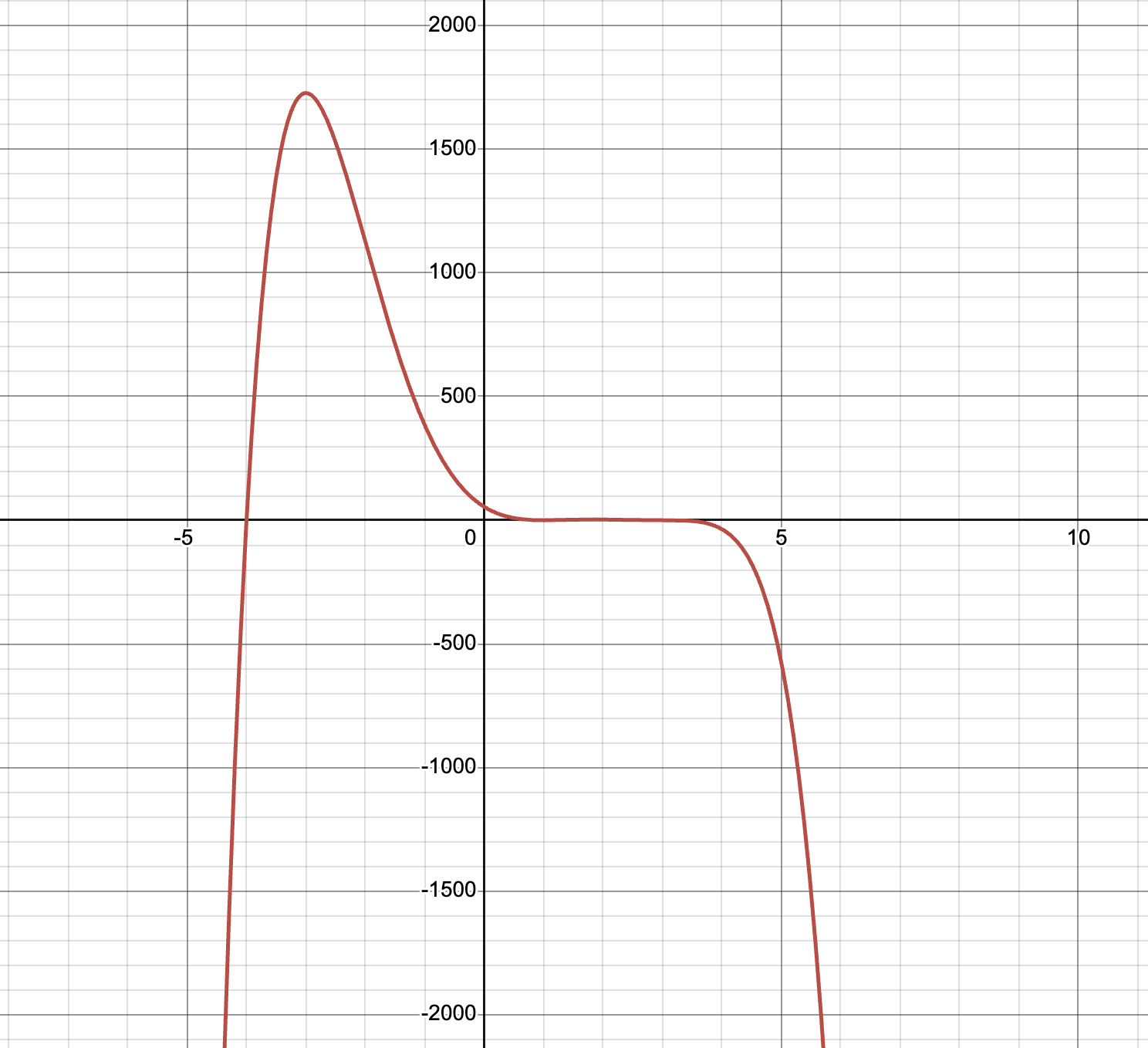
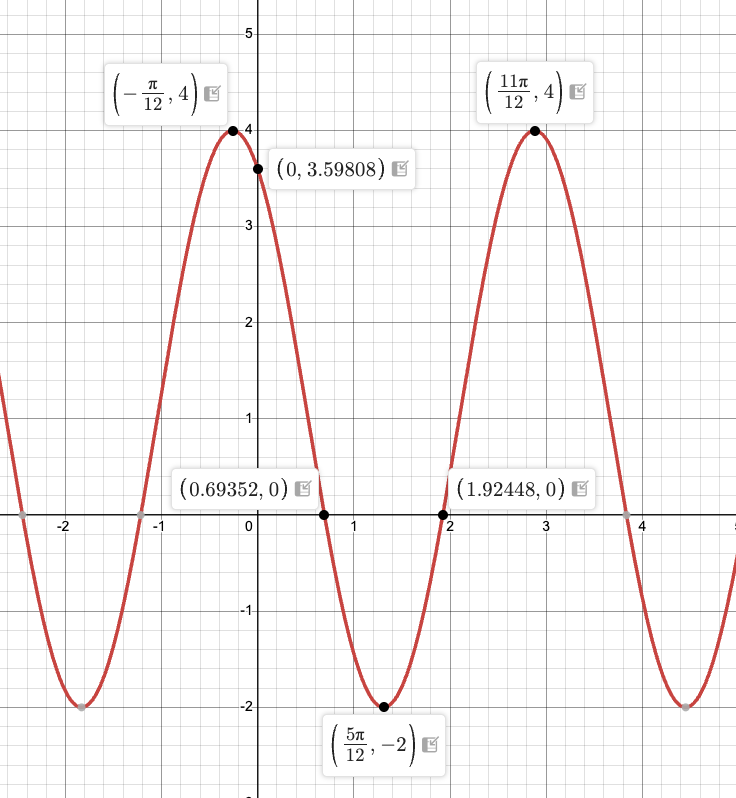
5 . \boxed{5}. 5 . This graph is shown below:
Because the polynomial has real coefficients, 3 − i 3-i 3 − i
f ( x ) = a ( x − 2 ) 2 ( x + 1 ) ( x − ( 3 + i ) ) ( x − ( 3 − i ) ) . f(x)=a(x-2)^2(x+1)\bigl(x-(3+i)\bigr)\bigl(x-(3-i)\bigr). f ( x ) = a ( x − 2 ) 2 ( x + 1 ) ( x − ( 3 + i ) ) ( x − ( 3 − i ) ) . The complex pair multiplies to
( x − ( 3 + i ) ) ( x − ( 3 − i ) ) = ( x − 3 ) 2 + 1. \bigl(x-(3+i)\bigr)\bigl(x-(3-i)\bigr)=(x-3)^2+1. ( x − ( 3 + i ) ) ( x − ( 3 − i ) ) = ( x − 3 ) 2 + 1. So
f ( x ) = a ( x − 2 ) 2 ( x + 1 ) ( ( x − 3 ) 2 + 1 ) . f(x)=a(x-2)^2(x+1)\bigl((x-3)^2+1\bigr). f ( x ) = a ( x − 2 ) 2 ( x + 1 ) ( ( x − 3 ) 2 + 1 ) . Use f ( 0 ) = 100 f(0)=100 f ( 0 ) = 100
100 = a ( 4 ) ( 1 ) ( 10 ) = 40 a . 100=a(4)(1)(10)=40a. 100 = a ( 4 ) ( 1 ) ( 10 ) = 40 a . Thus a = 5 2 a=\dfrac52 a = 2 5
f ( x ) = 5 2 ( x − 2 ) 2 ( x + 1 ) ( ( x − 3 ) 2 + 1 ) . \boxed{f(x)=\frac52(x-2)^2(x+1)\bigl((x-3)^2+1\bigr)}. f ( x ) = 2 5 ( x − 2 ) 2 ( x + 1 ) ( ( x − 3 ) 2 + 1 ) .
Since P ( 3 ) = 0 P(3)=0 P ( 3 ) = 0 x − 3 x-3 x − 3
3 1 − 3 − 11 39 − 18 3 0 − 33 18 1 0 − 11 6 0 \begin{array}{r|rrrrr}
3 & 1 & -3 & -11 & 39 & -18\\
& & 3 & 0 & -33 & 18\\ \hline
& 1 & 0 & -11 & 6 & 0
\end{array} 3 1 1 − 3 3 0 − 11 0 − 11 39 − 33 6 − 18 18 0 So
P ( x ) = ( x − 3 ) ( x 3 − 11 x + 6 ) . P(x)=(x-3)(x^3-11x+6). P ( x ) = ( x − 3 ) ( x 3 − 11 x + 6 ) . Test x = 3 x=3 x = 3
3 1 0 − 11 6 3 9 − 6 1 3 − 2 0 \begin{array}{r|rrrr}
3 & 1 & 0 & -11 & 6\\
& & 3 & 9 & -6\\ \hline
& 1 & 3 & -2 & 0
\end{array} 3 1 1 0 3 3 − 11 9 − 2 6 − 6 0 Thus
P ( x ) = ( x − 3 ) 2 ( x 2 + 3 x − 2 ) . P(x)=(x-3)^2(x^2+3x-2). P ( x ) = ( x − 3 ) 2 ( x 2 + 3 x − 2 ) . The quadratic formula gives
x = − 3 ± 9 + 8 2 = − 3 ± 17 2 . x=\frac{-3\pm\sqrt{9+8}}{2}
=\frac{-3\pm\sqrt{17}}{2}. x = 2 − 3 ± 9 + 8 = 2 − 3 ± 17 . Therefore
P ( x ) = ( x − 3 ) 2 ( x − − 3 + 17 2 ) ( x − − 3 − 17 2 ) . \boxed{P(x)=(x-3)^2\left(x-\frac{-3+\sqrt{17}}{2}\right)\left(x-\frac{-3-\sqrt{17}}{2}\right)}. P ( x ) = ( x − 3 ) 2 ( x − 2 − 3 + 17 ) ( x − 2 − 3 − 17 ) .
By the Rational Root Theorem, possible rational zeros are
± 1 , ± 2 , ± 3 , ± 5 , ± 6 , ± 10 , ± 15 , ± 30 , \pm1,\ \pm2,\ \pm3,\ \pm5,\ \pm6,\ \pm10,\ \pm15,\ \pm30, ± 1 , ± 2 , ± 3 , ± 5 , ± 6 , ± 10 , ± 15 , ± 30 , and
± 1 2 , ± 3 2 , ± 5 2 , ± 15 2 . \pm\frac12,\ \pm\frac32,\ \pm\frac52,\ \pm\frac{15}{2}. ± 2 1 , ± 2 3 , ± 2 5 , ± 2 15 . Factor by grouping:
2 x 4 − x 3 − 20 x 2 + 13 x + 30 = ( x 2 + x − 6 ) ( 2 x 2 − 3 x − 5 ) . 2x^4-x^3-20x^2+13x+30
=(x^2+x-6)(2x^2-3x-5). 2 x 4 − x 3 − 20 x 2 + 13 x + 30 = ( x 2 + x − 6 ) ( 2 x 2 − 3 x − 5 ) . Then
( x 2 + x − 6 ) ( 2 x 2 − 3 x − 5 ) = ( x + 3 ) ( x − 2 ) ( 2 x − 5 ) ( x + 1 ) . (x^2+x-6)(2x^2-3x-5)
=(x+3)(x-2)(2x-5)(x+1). ( x 2 + x − 6 ) ( 2 x 2 − 3 x − 5 ) = ( x + 3 ) ( x − 2 ) ( 2 x − 5 ) ( x + 1 ) . So the real zeros are
− 3 , − 1 , 2 , 5 2 . \boxed{-3,\ -1,\ 2,\ \frac52}. − 3 , − 1 , 2 , 2 5 .
When dividing by ( x − 2 ) ( x + 1 ) (x-2)(x+1) ( x − 2 ) ( x + 1 )
R ( x ) = a x + b . R(x)=ax+b. R ( x ) = a x + b . Since the remainder after division by x − 2 x-2 x − 2 5 5 5
R ( 2 ) = 5. R(2)=5. R ( 2 ) = 5. Since the remainder after division by x + 1 x+1 x + 1 − 4 -4 − 4
R ( − 1 ) = − 4. R(-1)=-4. R ( − 1 ) = − 4. Thus
2 a + b = 5 , − a + b = − 4. 2a+b=5,
\qquad
-a+b=-4. 2 a + b = 5 , − a + b = − 4. Subtract:
3 a = 9 , 3a=9, 3 a = 9 , so a = 3 a=3 a = 3 b = − 1 b=-1 b = − 1
3 x − 1 . \boxed{3x-1}. 3 x − 1 .
For rational coefficients, conjugate pairs are required:
1 + i , 1 − i , 2 − 3 , 2 + 3 . 1+i,\ 1-i,\ 2-\sqrt3,\ 2+\sqrt3. 1 + i , 1 − i , 2 − 3 , 2 + 3 . The polynomial is
( x − ( 1 + i ) ) ( x − ( 1 − i ) ) ( x − ( 2 − 3 ) ) ( x − ( 2 + 3 ) ) . \bigl(x-(1+i)\bigr)\bigl(x-(1-i)\bigr)\bigl(x-(2-\sqrt3)\bigr)\bigl(x-(2+\sqrt3)\bigr). ( x − ( 1 + i ) ) ( x − ( 1 − i ) ) ( x − ( 2 − 3 ) ) ( x − ( 2 + 3 ) ) . Since
( x − ( 1 + i ) ) ( x − ( 1 − i ) ) = ( x − 1 ) 2 + 1 = x 2 − 2 x + 2 \bigl(x-(1+i)\bigr)\bigl(x-(1-i)\bigr)=(x-1)^2+1=x^2-2x+2 ( x − ( 1 + i ) ) ( x − ( 1 − i ) ) = ( x − 1 ) 2 + 1 = x 2 − 2 x + 2 and
( x − ( 2 − 3 ) ) ( x − ( 2 + 3 ) ) = ( x − 2 ) 2 − 3 = x 2 − 4 x + 1 , \bigl(x-(2-\sqrt3)\bigr)\bigl(x-(2+\sqrt3)\bigr)=(x-2)^2-3=x^2-4x+1, ( x − ( 2 − 3 ) ) ( x − ( 2 + 3 ) ) = ( x − 2 ) 2 − 3 = x 2 − 4 x + 1 , we get
( x 2 − 2 x + 2 ) ( x 2 − 4 x + 1 ) . (x^2-2x+2)(x^2-4x+1). ( x 2 − 2 x + 2 ) ( x 2 − 4 x + 1 ) . Expanding:
x 4 − 6 x 3 + 11 x 2 − 10 x + 2 . \boxed{x^4-6x^3+11x^2-10x+2}. x 4 − 6 x 3 + 11 x 2 − 10 x + 2 .
Start with
R ( x ) = ( x − 2 ) ( x + 1 ) 2 ( x + 1 ) ( x − 3 ) . R(x)=\frac{(x-2)(x+1)^2}{(x+1)(x-3)}. R ( x ) = ( x + 1 ) ( x − 3 ) ( x − 2 ) ( x + 1 ) 2 . The original denominator is zero at x = − 1 x=-1 x = − 1 x = 3 x=3 x = 3
x ≠ − 1 , 3 . \boxed{x\ne -1,3}. x = − 1 , 3 . Cancel the common factor:
R ( x ) = ( x − 2 ) ( x + 1 ) x − 3 , x ≠ − 1 , 3. R(x)=\frac{(x-2)(x+1)}{x-3},
\qquad x\ne -1,3. R ( x ) = x − 3 ( x − 2 ) ( x + 1 ) , x = − 1 , 3. The canceled factor creates a hole at x = − 1 x=-1 x = − 1 y y y
( − 1 − 2 ) ( − 1 + 1 ) − 1 − 3 = 0 , \frac{(-1-2)(-1+1)}{-1-3}=0, − 1 − 3 ( − 1 − 2 ) ( − 1 + 1 ) = 0 , so the hole is
( − 1 , 0 ) . \boxed{(-1,0)}. ( − 1 , 0 ) . The uncanceled denominator gives the vertical asymptote:
x = 3 . \boxed{x=3}. x = 3 . There is no horizontal asymptote because the numerator degree is one more than the denominator degree. For the slant asymptote, simplify the numerator:
( x − 2 ) ( x + 1 ) = x 2 − x − 2. (x-2)(x+1)=x^2-x-2. ( x − 2 ) ( x + 1 ) = x 2 − x − 2. Divide:
x 2 − x − 2 x − 3 = x + 2 + 4 x − 3 . \frac{x^2-x-2}{x-3}
=x+2+\frac{4}{x-3}. x − 3 x 2 − x − 2 = x + 2 + x − 3 4 . Thus the slant asymptote is
y = x + 2 . \boxed{y=x+2}. y = x + 2 . The true x x x x = − 1 x=-1 x = − 1 x x x
( 2 , 0 ) . \boxed{(2,0)}. ( 2 , 0 ) . The y y y
R ( 0 ) = ( − 2 ) ( 1 ) 2 ( 1 ) ( − 3 ) = 2 3 , R(0)=\frac{(-2)(1)^2}{(1)(-3)}=\frac23, R ( 0 ) = ( 1 ) ( − 3 ) ( − 2 ) ( 1 ) 2 = 3 2 , so it is
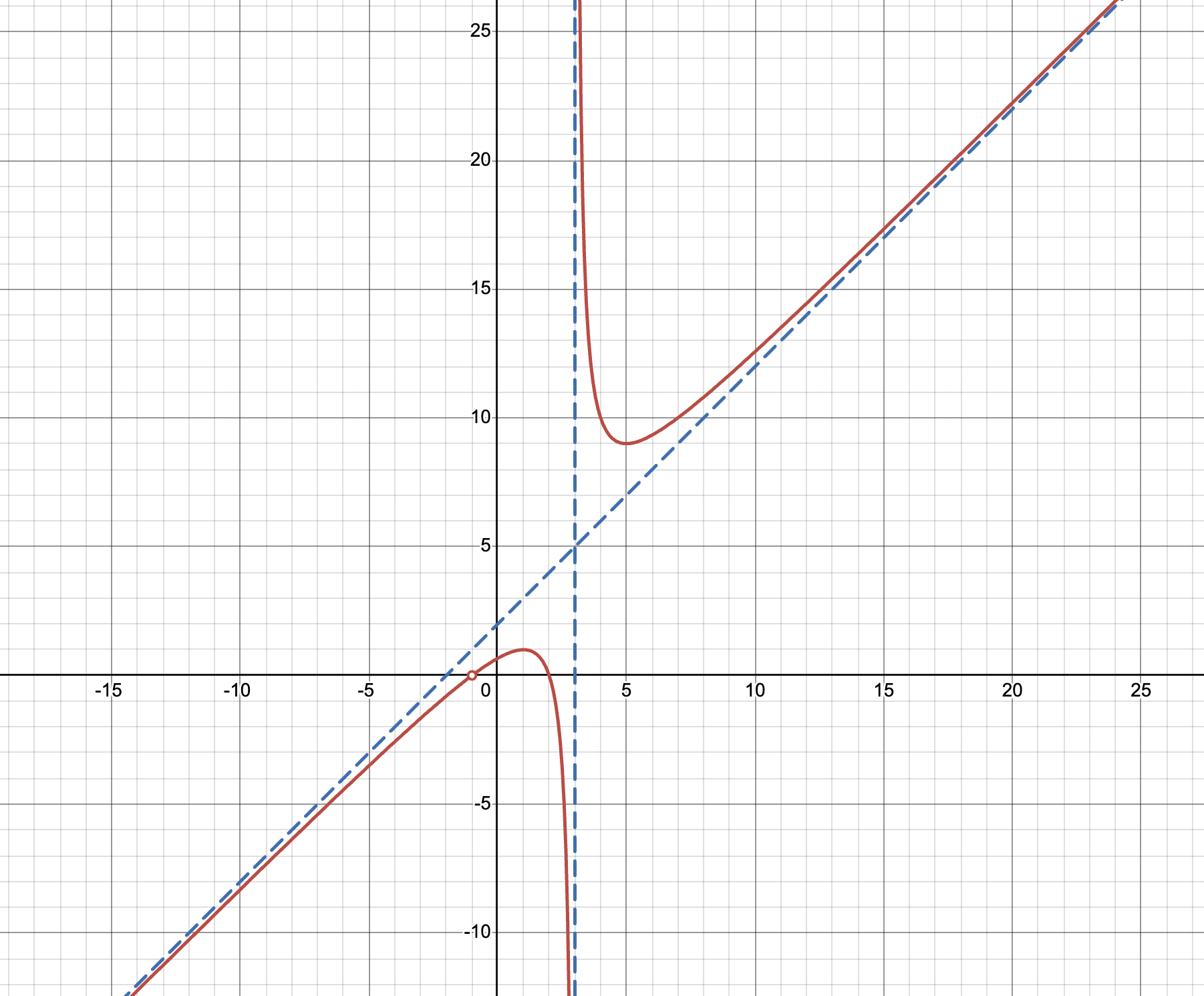
( 0 , 2 3 ) . \boxed{\left(0,\frac23\right)}. ( 0 , 3 2 ) . The graph is shown below:
( x − 4 ) ( x + 1 ) 2 ( x − 2 ) ( x + 1 ) \frac{(x-4)(x+1)^2}{(x-2)(x+1)} ( x − 2 ) ( x + 1 ) ( x − 4 ) ( x + 1 ) 2 has original domain restrictions
x ≠ − 1 , 2. x\ne -1,\ 2. x = − 1 , 2. Cancel one factor of x + 1 x+1 x + 1
( x − 4 ) ( x + 1 ) x − 2 ≤ 0 , x ≠ − 1 , 2. \frac{(x-4)(x+1)}{x-2}\le 0,
\qquad x\ne -1,2. x − 2 ( x − 4 ) ( x + 1 ) ≤ 0 , x = − 1 , 2. The critical numbers are
− 1 , 2 , 4. -1,\ 2,\ 4. − 1 , 2 , 4. Test intervals:
On ( − ∞ , − 1 ) (-\infty,-1) ( − ∞ , − 1 )
At x = − 1 x=-1 x = − 1
On ( − 1 , 2 ) (-1,2) ( − 1 , 2 )
At x = 2 x=2 x = 2
On ( 2 , 4 ) (2,4) ( 2 , 4 )
At x = 4 x=4 x = 4
On ( 4 , ∞ ) (4,\infty) ( 4 , ∞ )
Therefore the solution is
( − ∞ , − 1 ) ∪ ( 2 , 4 ] . \boxed{(-\infty,-1)\cup(2,4]}. ( − ∞ , − 1 ) ∪ ( 2 , 4 ] .
The dimensions of the box are:
length = 24 − 2 x , \text{length}=24-2x, length = 24 − 2 x , width = 18 − 2 x , \text{width}=18-2x, width = 18 − 2 x , height = x . \text{height}=x. height = x . So
V ( x ) = x ( 24 − 2 x ) ( 18 − 2 x ) . V(x)=x(24-2x)(18-2x). V ( x ) = x ( 24 − 2 x ) ( 18 − 2 x ) . The practical domain is
0 < x < 9 . \boxed{0<x<9}. 0 < x < 9 . Expanding,
V ( x ) = 4 x 3 − 84 x 2 + 432 x . V(x)=4x^3-84x^2+432x. V ( x ) = 4 x 3 − 84 x 2 + 432 x . Using a graph or calculator on 0 < x < 9 0<x<9 0 < x < 9
x ≈ 3.39 in . \boxed{x\approx 3.39\text{ in}}. x ≈ 3.39 in . The maximum volume is approximately
V ( 3.39 ) ≈ 655.0 in 3 . V(3.39)\approx 655.0\text{ in}^3. V ( 3.39 ) ≈ 655.0 in 3 .
Let
y = 150 x x 2 + 25 . y=\frac{150x}{x^2+25}. y = x 2 + 25 150 x . Then
y ( x 2 + 25 ) = 150 x . y(x^2+25)=150x. y ( x 2 + 25 ) = 150 x . Rearrange as a quadratic in x x x
y x 2 − 150 x + 25 y = 0. yx^2-150x+25y=0. y x 2 − 150 x + 25 y = 0. For real x x x
( − 150 ) 2 − 4 ( y ) ( 25 y ) ≥ 0. (-150)^2-4(y)(25y)\ge 0. ( − 150 ) 2 − 4 ( y ) ( 25 y ) ≥ 0. Thus
22500 − 100 y 2 ≥ 0 ⟹ y 2 ≤ 225. 22500-100y^2\ge 0
\quad\Longrightarrow\quad
y^2\le 225. 22500 − 100 y 2 ≥ 0 ⟹ y 2 ≤ 225. Since M ( x ) ≥ 0 M(x)\ge 0 M ( x ) ≥ 0 x ≥ 0 x\ge 0 x ≥ 0
15 . \boxed{15}. 15 . Find where it occurs:
15 = 150 x x 2 + 25 . 15=\frac{150x}{x^2+25}. 15 = x 2 + 25 150 x . Then
15 x 2 + 375 = 150 x ⟹ x 2 − 10 x + 25 = 0 ⟹ ( x − 5 ) 2 = 0. 15x^2+375=150x
\quad\Longrightarrow\quad
x^2-10x+25=0
\quad\Longrightarrow\quad
(x-5)^2=0. 15 x 2 + 375 = 150 x ⟹ x 2 − 10 x + 25 = 0 ⟹ ( x − 5 ) 2 = 0. So the maximum occurs at
x = 5 . \boxed{x=5}. x = 5 .
Let the large rectangle have length y y y x x x
4 x + 2 y = 240. 4x+2y=240. 4 x + 2 y = 240. So
y = 120 − 2 x . y=120-2x. y = 120 − 2 x . The total area is
A ( x ) = x y = x ( 120 − 2 x ) = 120 x − 2 x 2 . A(x)=xy=x(120-2x)=120x-2x^2. A ( x ) = x y = x ( 120 − 2 x ) = 120 x − 2 x 2 . This parabola opens downward, so its maximum occurs at
x = − 120 2 ( − 2 ) = 30. x=-\frac{120}{2(-2)}=30. x = − 2 ( − 2 ) 120 = 30. Then
y = 120 − 2 ( 30 ) = 60. y=120-2(30)=60. y = 120 − 2 ( 30 ) = 60. Thus the large rectangle should be
30 ft by 60 ft . \boxed{30\text{ ft by }60\text{ ft}}. 30 ft by 60 ft . The maximum total area is
1800 ft 2 . \boxed{1800\text{ ft}^2}. 1800 ft 2 .
For part (A), since p q \frac{p}{q} q p
a n ( p q ) n + a n − 1 ( p q ) n − 1 + ⋯ + a 1 ( p q ) + a 0 = 0. a_n\left(\frac{p}{q}\right)^n
+a_{n-1}\left(\frac{p}{q}\right)^{n-1}
+\cdots
+a_1\left(\frac{p}{q}\right)+a_0=0. a n ( q p ) n + a n − 1 ( q p ) n − 1 + ⋯ + a 1 ( q p ) + a 0 = 0. Multiplying by q n q^n q n
a n p n + a n − 1 p n − 1 q + ⋯ + a 1 p q n − 1 + a 0 q n = 0. a_np^n+a_{n-1}p^{n-1}q+\cdots+a_1pq^{n-1}+a_0q^n=0. a n p n + a n − 1 p n − 1 q + ⋯ + a 1 p q n − 1 + a 0 q n = 0. Move the constant-term part:
a n p n + a n − 1 p n − 1 q + ⋯ + a 1 p q n − 1 = − a 0 q n . a_np^n+a_{n-1}p^{n-1}q+\cdots+a_1pq^{n-1}=-a_0q^n. a n p n + a n − 1 p n − 1 q + ⋯ + a 1 p q n − 1 = − a 0 q n . Every term on the left has a factor of p p p
p ∣ a 0 q n . p\mid a_0q^n. p ∣ a 0 q n . Since p q \frac{p}{q} q p gcd ( p , q ) = 1 \gcd(p,q)=1 g cd( p , q ) = 1 p p p q n q^n q n p p p a 0 q n a_0q^n a 0 q n q n q^n q n
p ∣ a 0 . \boxed{p\mid a_0}. p ∣ a 0 . For part (B), now move the leading-term part instead:
a n − 1 p n − 1 q + ⋯ + a 1 p q n − 1 + a 0 q n = − a n p n . a_{n-1}p^{n-1}q+\cdots+a_1pq^{n-1}+a_0q^n=-a_np^n. a n − 1 p n − 1 q + ⋯ + a 1 p q n − 1 + a 0 q n = − a n p n . Every term on the left has a factor of q q q
q ∣ a n p n . q\mid a_np^n. q ∣ a n p n . Since gcd ( p , q ) = 1 \gcd(p,q)=1 g cd( p , q ) = 1 q q q p n p^n p n q q q a n p n a_np^n a n p n p n p^n p n
q ∣ a n . \boxed{q\mid a_n}. q ∣ a n . For part (C), the theorem statement is this: If a polynomial with integer coefficients has a rational zero p q \frac{p}{q} q p
p ∣ a 0 and q ∣ a n . \boxed{p\mid a_0\quad\text{and}\quad q\mid a_n}. p ∣ a 0 and q ∣ a n .
Full notes →
Let f ( x ) = 3 − 2 ⋅ 5 x + 1 f(x)=3-2\cdot 5^{x+1} f ( x ) = 3 − 2 ⋅ 5 x + 1 f − 1 ( x ) f^{-1}(x) f − 1 ( x )
The points ( − 1 , 17 ) (-1,17) ( − 1 , 17 ) ( 2 , 1 ) (2,1) ( 2 , 1 ) g ( x ) = a ⋅ b x − h + k g(x)=a\cdot b^{x-h}+k g ( x ) = a ⋅ b x − h + k y = − 1 y=-1 y = − 1 h = 1 h=1 h = 1 a a a b b b g g g
Find all real solutions to 4 x + 1 − 10 ⋅ 2 x + 1 = 0 4^{x+1}-10\cdot 2^x+1=0 4 x + 1 − 10 ⋅ 2 x + 1 = 0
Solve in R \mathbb{R} R 3 2 x − 28 ⋅ 3 x + 27 ≤ 0 3^{2x}-28\cdot 3^x+27\le 0 3 2 x − 28 ⋅ 3 x + 27 ≤ 0
Solve for x x x 2 x + 1 = 5 2 x − 3 . 2^{x+1}=5^{2x-3}. 2 x + 1 = 5 2 x − 3 .
Solve in R \mathbb{R} R e x + e − x = 13 6 . e^x+e^{-x}=\frac{13}{6}. e x + e − x = 6 13 .
Rewrite the following expression as a single logarithm with coefficient 1 1 1 1 2 ln ( x 2 − 9 ) − 2 ln ( x − 3 ) + ln ( x + 1 x ) . \frac12\ln(x^2-9)-2\ln(x-3)+\ln\left(\frac{x+1}{x}\right). 2 1 ln ( x 2 − 9 ) − 2 ln ( x − 3 ) + ln ( x x + 1 ) .
Expand completely using logarithm properties, and state all restrictions on x x x y y y log 3 ( x 4 y − 2 ( x 2 + 1 ) 3 ( 5 − y ) ) . \log_3\left(\frac{x^4\sqrt{y-2}}{(x^2+1)^3(5-y)}\right). log 3 ( ( x 2 + 1 ) 3 ( 5 − y ) x 4 y − 2 ) .
Solve in R \mathbb{R} R log 1 / 3 ( 2 x − 1 ) ≥ log 1 / 3 ( 7 − x ) . \log_{1/3}(2x-1)\ge \log_{1/3}(7-x). log 1/3 ( 2 x − 1 ) ≥ log 1/3 ( 7 − x ) .
Solve in R \mathbb{R} R ln ( x 2 − 5 x + 6 ) ≤ ln ( 2 x + 3 ) . \ln(x^2-5x+6)\le \ln(2x+3). ln ( x 2 − 5 x + 6 ) ≤ ln ( 2 x + 3 ) .
Let h ( x ) = log 4 ( 16 − 4 x ) − 2 h(x)=\log_4(16-4x)-2 h ( x ) = log 4 ( 16 − 4 x ) − 2 h − 1 ( x ) h^{-1}(x) h − 1 ( x )
A population is modeled by P ( t ) = 1200 1 + 19 e − 0.4 t P(t)=\dfrac{1200}{1+19e^{-0.4t}} P ( t ) = 1 + 19 e − 0.4 t 1200 t ≥ 0 t\ge 0 t ≥ 0 P ( t ) = 900 P(t)=900 P ( t ) = 900
Find the unique positive integer n n n log 2 ( log 16 n ) = log 4 ( log 4 n ) \log_2 (\log_{16} n) = \log_4 (\log_4 n) log 2 ( log 16 n ) = log 4 ( log 4 n )
Let F ( x ) = ln ( x − a b − x ) F(x)=\ln\left(\dfrac{x-a}{b-x}\right) F ( x ) = ln ( b − x x − a ) a < b a<b a < b a a a b b b F − 1 ( x ) F^{-1}(x) F − 1 ( x ) F F F
Find the exact value of the product ∏ k = 4 63 log k ( 5 k 2 − 1 ) log k + 1 ( 5 k 2 − 4 ) \prod_{k=4}^{63}\frac{\log_k\left(5^{k^2-1}\right)}{\log_{k+1}\left(5^{k^2-4}\right)} ∏ k = 4 63 l o g k + 1 ( 5 k 2 − 4 ) l o g k ( 5 k 2 − 1 )
(Bonus, The EML function)
Define a binary operation called EML \operatorname{EML} EML
EML ( x , y ) = e x − ln y , \operatorname{EML}(x,y)=e^x-\ln y, EML ( x , y ) = e x − ln y , where y > 0 y>0 y > 0
( A ) (A) ( A ) e x = EML ( x , 1 ) . e^x=\operatorname{EML}(x,1). e x = EML ( x , 1 ) .
( B ) (B) ( B ) EML ( 0 , x ) = 1 − ln x . \operatorname{EML}(0,x)=1-\ln x. EML ( 0 , x ) = 1 − ln x . ln x \ln x ln x EML ( 0 , x ) \operatorname{EML}(0,x) EML ( 0 , x )
( C ) (C) ( C ) ( B ) (B) ( B ) log b x \log_b x log b x b > 0 b>0 b > 0 b ≠ 1 b\ne1 b = 1 x > 0 x>0 x > 0
( D ) (D) ( D ) x + y = ln ( e x e y ) x+y=\ln(e^x e^y) x + y = ln ( e x e y ) x − y = ln ( e x e y ) x-y=\ln\left(\frac{e^x}{e^y}\right) x − y = ln ( e y e x ) x + y x+y x + y x − y x-y x − y
( E ) (E) ( E ) EML tree is an expression built by repeatedly feeding outputs of EML into new EML operations. For example, EML ( EML ( x , 1 ) , EML ( 0 , y ) ) \operatorname{EML}\left(\operatorname{EML}(x,1),\operatorname{EML}(0,y)\right) EML ( EML ( x , 1 ) , EML ( 0 , y ) )
( F ) (F) ( F ) 0 0 0 1 1 1 1 1 1
This problem is inspired by the paper All elementary functions from a single operator by Andrzej Odrzywołek. Learn more here: https://arxiv.org/html/2603.21852v2 .
The domain is all real numbers:
( − ∞ , ∞ ) . \boxed{(-\infty,\infty)}. ( − ∞ , ∞ ) . Since 5 x + 1 > 0 5^{x+1}>0 5 x + 1 > 0 − 2 ⋅ 5 x + 1 < 0 -2\cdot 5^{x+1}<0 − 2 ⋅ 5 x + 1 < 0
f ( x ) < 3. f(x)<3. f ( x ) < 3. Thus the range is
( − ∞ , 3 ) . \boxed{(-\infty,3)}. ( − ∞ , 3 ) . The horizontal asymptote is
y = 3 . \boxed{y=3}. y = 3 . The y y y
f ( 0 ) = 3 − 2 ⋅ 5 = − 7 , f(0)=3-2\cdot 5=-7, f ( 0 ) = 3 − 2 ⋅ 5 = − 7 , so the y y y
( 0 , − 7 ) . \boxed{(0,-7)}. ( 0 , − 7 ) . For the x x x
0 = 3 − 2 ⋅ 5 x + 1 0=3-2\cdot 5^{x+1} 0 = 3 − 2 ⋅ 5 x + 1 so
5 x + 1 = 3 2 . 5^{x+1}=\frac32. 5 x + 1 = 2 3 . Therefore
x + 1 = log 5 ( 3 2 ) , x+1=\log_5\left(\frac32\right), x + 1 = log 5 ( 2 3 ) , so the x x x
( log 5 ( 3 2 ) − 1 , 0 ) . \boxed{\left(\log_5\left(\frac32\right)-1,0\right)}. ( log 5 ( 2 3 ) − 1 , 0 ) . Since 5 x + 1 5^{x+1} 5 x + 1 f f f
( − ∞ , ∞ ) . \boxed{(-\infty,\infty)}. ( − ∞ , ∞ ) . It is never increasing.
To find the inverse, let
y = 3 − 2 ⋅ 5 x + 1 . y=3-2\cdot 5^{x+1}. y = 3 − 2 ⋅ 5 x + 1 . Then
2 ⋅ 5 x + 1 = 3 − y , 2\cdot 5^{x+1}=3-y, 2 ⋅ 5 x + 1 = 3 − y , so
5 x + 1 = 3 − y 2 . 5^{x+1}=\frac{3-y}{2}. 5 x + 1 = 2 3 − y . Take log 5 \log_5 log 5
x + 1 = log 5 ( 3 − y 2 ) . x+1=\log_5\left(\frac{3-y}{2}\right). x + 1 = log 5 ( 2 3 − y ) . Thus
x = log 5 ( 3 − y 2 ) − 1. x=\log_5\left(\frac{3-y}{2}\right)-1. x = log 5 ( 2 3 − y ) − 1. Switch x x x y y y
f − 1 ( x ) = log 5 ( 3 − x 2 ) − 1 . \boxed{f^{-1}(x)=\log_5\left(\frac{3-x}{2}\right)-1}. f − 1 ( x ) = log 5 ( 2 3 − x ) − 1 . The domain of f − 1 f^{-1} f − 1 f f f
( − ∞ , 3 ) . \boxed{(-\infty,3)}. ( − ∞ , 3 ) . The range of f − 1 f^{-1} f − 1 f f f
( − ∞ , ∞ ) . \boxed{(-\infty,\infty)}. ( − ∞ , ∞ ) .
Since the horizontal asymptote is y = − 1 y=-1 y = − 1 h = 1 h=1 h = 1
g ( x ) = a ⋅ b x − 1 − 1. g(x)=a\cdot b^{x-1}-1. g ( x ) = a ⋅ b x − 1 − 1. Use the point ( − 1 , 17 ) (-1,17) ( − 1 , 17 )
17 = a ⋅ b − 2 − 1. 17=a\cdot b^{-2}-1. 17 = a ⋅ b − 2 − 1. So
a b 2 = 18. \frac{a}{b^2}=18. b 2 a = 18. Use the point ( 2 , 1 ) (2,1) ( 2 , 1 )
1 = a ⋅ b 1 − 1. 1=a\cdot b^{1}-1. 1 = a ⋅ b 1 − 1. Thus
a b = 2. ab=2. ab = 2. From a b = 2 ab=2 ab = 2
a = 2 b . a=\frac2b. a = b 2 . Substitute into a b 2 = 18 \frac{a}{b^2}=18 b 2 a = 18
2 / b b 2 = 18. \frac{2/b}{b^2}=18. b 2 2/ b = 18. Then
2 b 3 = 18 , \frac{2}{b^3}=18, b 3 2 = 18 , so
b 3 = 1 9 . b^3=\frac19. b 3 = 9 1 . Therefore
b = 1 9 3 = 9 − 1 / 3 . \boxed{b=\sqrt[3]{\frac19}=9^{-1/3}}. b = 3 9 1 = 9 − 1/3 . Then
a = 2 b = 2 9 3 . a=\frac2b=2\sqrt[3]{9}. a = b 2 = 2 3 9 . So
a = 2 9 3 . \boxed{a=2\sqrt[3]{9}}. a = 2 3 9 . Since 0 < b < 1 0<b<1 0 < b < 1 a > 0 a>0 a > 0
exponential decay . \boxed{\text{exponential decay}}. exponential decay .
Rewrite everything in terms of 2 x 2^x 2 x
4 x + 1 = 4 ⋅ 4 x = 4 ⋅ 2 2 x . 4^{x+1}=4\cdot 4^x=4\cdot 2^{2x}. 4 x + 1 = 4 ⋅ 4 x = 4 ⋅ 2 2 x . So the equation becomes
4 ⋅ 2 2 x − 10 ⋅ 2 x + 1 = 0. 4\cdot 2^{2x}-10\cdot 2^x+1=0. 4 ⋅ 2 2 x − 10 ⋅ 2 x + 1 = 0. Let
u = 2 x . u=2^x. u = 2 x . Then
4 u 2 − 10 u + 1 = 0. 4u^2-10u+1=0. 4 u 2 − 10 u + 1 = 0. Use the quadratic formula:
u = 10 ± 100 − 16 8 = 10 ± 84 8 = 5 ± 21 4 . u=\frac{10\pm\sqrt{100-16}}{8}
=\frac{10\pm\sqrt{84}}{8}
=\frac{5\pm\sqrt{21}}{4}. u = 8 10 ± 100 − 16 = 8 10 ± 84 = 4 5 ± 21 . Both values are positive, so both are valid values of 2 x 2^x 2 x
2 x = 5 + 21 4 or 2 x = 5 − 21 4 . 2^x=\frac{5+\sqrt{21}}{4}
\qquad\text{or}\qquad
2^x=\frac{5-\sqrt{21}}{4}. 2 x = 4 5 + 21 or 2 x = 4 5 − 21 . Thus
x = log 2 ( 5 + 21 4 ) or x = log 2 ( 5 − 21 4 ) . \boxed{x=\log_2\left(\frac{5+\sqrt{21}}4\right)
\quad\text{or}\quad
x=\log_2\left(\frac{5-\sqrt{21}}4\right)}. x = log 2 ( 4 5 + 21 ) or x = log 2 ( 4 5 − 21 ) .
Let
u = 3 x . u=3^x. u = 3 x . Since 3 x > 0 3^x>0 3 x > 0 u > 0 u>0 u > 0
u 2 − 28 u + 27 ≤ 0. u^2-28u+27\le 0. u 2 − 28 u + 27 ≤ 0. Factor:
( u − 1 ) ( u − 27 ) ≤ 0. (u-1)(u-27)\le 0. ( u − 1 ) ( u − 27 ) ≤ 0. Thus
1 ≤ u ≤ 27. 1\le u\le 27. 1 ≤ u ≤ 27. Substitute back:
1 ≤ 3 x ≤ 27. 1\le 3^x\le 27. 1 ≤ 3 x ≤ 27. Since 1 = 3 0 1=3^0 1 = 3 0 27 = 3 3 27=3^3 27 = 3 3
3 0 ≤ 3 x ≤ 3 3 . 3^0\le 3^x\le 3^3. 3 0 ≤ 3 x ≤ 3 3 . Because 3 x 3^x 3 x
[ 0 , 3 ] . \boxed{[0,3]}. [ 0 , 3 ] .
Take natural logs of both sides:
ln ( 2 x + 1 ) = ln ( 5 2 x − 3 ) . \ln(2^{x+1})=\ln(5^{2x-3}). ln ( 2 x + 1 ) = ln ( 5 2 x − 3 ) . Use the power rule:
( x + 1 ) ln 2 = ( 2 x − 3 ) ln 5. (x+1)\ln 2=(2x-3)\ln 5. ( x + 1 ) ln 2 = ( 2 x − 3 ) ln 5. Expand:
x ln 2 + ln 2 = 2 x ln 5 − 3 ln 5. x\ln 2+\ln 2=2x\ln 5-3\ln 5. x ln 2 + ln 2 = 2 x ln 5 − 3 ln 5. Move the x x x
x ln 2 − 2 x ln 5 = − 3 ln 5 − ln 2. x\ln 2-2x\ln 5=-3\ln 5-\ln 2. x ln 2 − 2 x ln 5 = − 3 ln 5 − ln 2. Factor:
x ( ln 2 − 2 ln 5 ) = − ( 3 ln 5 + ln 2 ) . x(\ln 2-2\ln 5)=-(3\ln 5+\ln 2). x ( ln 2 − 2 ln 5 ) = − ( 3 ln 5 + ln 2 ) . Therefore
x = 3 ln 5 + ln 2 2 ln 5 − ln 2 . \boxed{x=\frac{3\ln 5+\ln 2}{2\ln 5-\ln 2}}. x = 2 ln 5 − ln 2 3 ln 5 + ln 2 .
Let
u = e x . u=e^x. u = e x . Then
e − x = 1 u . e^{-x}=\frac1u. e − x = u 1 . The equation becomes
u + 1 u = 13 6 . u+\frac1u=\frac{13}{6}. u + u 1 = 6 13 . Multiply by 6 u 6u 6 u
6 u 2 + 6 = 13 u . 6u^2+6=13u. 6 u 2 + 6 = 13 u . So
6 u 2 − 13 u + 6 = 0. 6u^2-13u+6=0. 6 u 2 − 13 u + 6 = 0. Factor:
( 3 u − 2 ) ( 2 u − 3 ) = 0. (3u-2)(2u-3)=0. ( 3 u − 2 ) ( 2 u − 3 ) = 0. Thus
u = 2 3 or u = 3 2 . u=\frac23
\qquad\text{or}\qquad
u=\frac32. u = 3 2 or u = 2 3 . Since u = e x u=e^x u = e x
e x = 2 3 or e x = 3 2 . e^x=\frac23
\qquad\text{or}\qquad
e^x=\frac32. e x = 3 2 or e x = 2 3 . Therefore
x = ln ( 2 3 ) or x = ln ( 3 2 ) . \boxed{x=\ln\left(\frac23\right)
\quad\text{or}\quad
x=\ln\left(\frac32\right)}. x = ln ( 3 2 ) or x = ln ( 2 3 ) .
Start with
1 2 ln ( x 2 − 9 ) − 2 ln ( x − 3 ) + ln ( x + 1 x ) . \frac12\ln(x^2-9)-2\ln(x-3)+\ln\left(\frac{x+1}{x}\right). 2 1 ln ( x 2 − 9 ) − 2 ln ( x − 3 ) + ln ( x x + 1 ) . Use the power rule:
ln x 2 − 9 − ln ( ( x − 3 ) 2 ) + ln ( x + 1 x ) . \ln\sqrt{x^2-9}-\ln((x-3)^2)+\ln\left(\frac{x+1}{x}\right). ln x 2 − 9 − ln (( x − 3 ) 2 ) + ln ( x x + 1 ) . Combine the logarithms:
ln ( x 2 − 9 ( x + 1 x ) ( x − 3 ) 2 ) . \ln\left(
\frac{\sqrt{x^2-9}\left(\frac{x+1}{x}\right)}{(x-3)^2}
\right). ln ( ( x − 3 ) 2 x 2 − 9 ( x x + 1 ) ) . So the expression becomes
ln ( ( x + 1 ) x 2 − 9 x ( x − 3 ) 2 ) . \boxed{\ln\left(\frac{(x+1)\sqrt{x^2-9}}{x(x-3)^2}\right)}. ln ( x ( x − 3 ) 2 ( x + 1 ) x 2 − 9 ) . Now find the domain of the original expression.
The first logarithm requires
x 2 − 9 > 0 , x^2-9>0, x 2 − 9 > 0 , so
x < − 3 or x > 3. x<-3
\qquad\text{or}\qquad
x>3. x < − 3 or x > 3. The second logarithm requires
x − 3 > 0 , x-3>0, x − 3 > 0 , so
x > 3. x>3. x > 3. The third logarithm requires
x + 1 x > 0 , \frac{x+1}{x}>0, x x + 1 > 0 , so
x < − 1 or x > 0. x<-1
\qquad\text{or}\qquad
x>0. x < − 1 or x > 0. The intersection is
x > 3 . \boxed{x>3}. x > 3 .
The expression is
log 3 ( x 4 y − 2 ( x 2 + 1 ) 3 ( 5 − y ) ) . \log_3\left(\frac{x^4\sqrt{y-2}}{(x^2+1)^3(5-y)}\right). log 3 ( ( x 2 + 1 ) 3 ( 5 − y ) x 4 y − 2 ) . Use the quotient rule:
log 3 ( x 4 y − 2 ) − log 3 ( ( x 2 + 1 ) 3 ( 5 − y ) ) . \log_3(x^4\sqrt{y-2})-\log_3((x^2+1)^3(5-y)). log 3 ( x 4 y − 2 ) − log 3 (( x 2 + 1 ) 3 ( 5 − y )) . Use the product rule:
log 3 ( x 4 ) + log 3 ( y − 2 ) − log 3 ( ( x 2 + 1 ) 3 ) − log 3 ( 5 − y ) . \log_3(x^4)+\log_3(\sqrt{y-2})-\log_3((x^2+1)^3)-\log_3(5-y). log 3 ( x 4 ) + log 3 ( y − 2 ) − log 3 (( x 2 + 1 ) 3 ) − log 3 ( 5 − y ) . Use the power rule:
4 log 3 ∣ x ∣ + 1 2 log 3 ( y − 2 ) − 3 log 3 ( x 2 + 1 ) − log 3 ( 5 − y ) . \boxed{4\log_3\lvert x\rvert+\frac12\log_3(y-2)-3\log_3(x^2+1)-\log_3(5-y)}. 4 log 3 ∣ x ∣ + 2 1 log 3 ( y − 2 ) − 3 log 3 ( x 2 + 1 ) − log 3 ( 5 − y ) . For restrictions, the square root requires
y − 2 ≥ 0. y-2\ge 0. y − 2 ≥ 0. But the full logarithm cannot have input 0 0 0
y > 2. y>2. y > 2. Also, the denominator must not be zero and the argument must be positive. Since x 2 + 1 > 0 x^2+1>0 x 2 + 1 > 0
5 − y > 0 , 5-y>0, 5 − y > 0 , so
y < 5. y<5. y < 5. Finally, x 4 x^4 x 4 0 0 0
x ≠ 0. x\ne 0. x = 0. Thus the restrictions are
x ≠ 0 , 2 < y < 5 . \boxed{x\ne 0,\qquad 2<y<5}. x = 0 , 2 < y < 5 .
The domain requires
2 x − 1 > 0 and 7 − x > 0. 2x-1>0
\qquad\text{and}\qquad
7-x>0. 2 x − 1 > 0 and 7 − x > 0. So
1 2 < x < 7. \frac12<x<7. 2 1 < x < 7. The inequality is
log 1 / 3 ( 2 x − 1 ) ≥ log 1 / 3 ( 7 − x ) . \log_{1/3}(2x-1)\ge \log_{1/3}(7-x). log 1/3 ( 2 x − 1 ) ≥ log 1/3 ( 7 − x ) . Since the base 1 3 \frac13 3 1 0 0 0 1 1 1
2 x − 1 ≤ 7 − x . 2x-1\le 7-x. 2 x − 1 ≤ 7 − x . Solve:
3 x ≤ 8 , 3x\le 8, 3 x ≤ 8 , so
x ≤ 8 3 . x\le \frac83. x ≤ 3 8 . Intersect this with the domain 1 2 < x < 7 \frac12<x<7 2 1 < x < 7
( 1 2 , 8 3 ] . \boxed{\left(\frac12,\frac83\right]}. ( 2 1 , 3 8 ] .
First find the logarithm domain:
x 2 − 5 x + 6 > 0 x^2-5x+6>0 x 2 − 5 x + 6 > 0 and
2 x + 3 > 0. 2x+3>0. 2 x + 3 > 0. Factor:
( x − 2 ) ( x − 3 ) > 0. (x-2)(x-3)>0. ( x − 2 ) ( x − 3 ) > 0. Thus
x < 2 or x > 3. x<2
\qquad\text{or}\qquad
x>3. x < 2 or x > 3. Also,
x > − 3 2 . x>-\frac32. x > − 2 3 . So the domain is
( − 3 2 , 2 ) ∪ ( 3 , ∞ ) . \left(-\frac32,2\right)\cup(3,\infty). ( − 2 3 , 2 ) ∪ ( 3 , ∞ ) . Since ln x \ln x ln x
ln ( x 2 − 5 x + 6 ) ≤ ln ( 2 x + 3 ) \ln(x^2-5x+6)\le \ln(2x+3) ln ( x 2 − 5 x + 6 ) ≤ ln ( 2 x + 3 ) is equivalent to
x 2 − 5 x + 6 ≤ 2 x + 3 x^2-5x+6\le 2x+3 x 2 − 5 x + 6 ≤ 2 x + 3 inside the logarithm domain.
Simplify:
x 2 − 7 x + 3 ≤ 0. x^2-7x+3\le 0. x 2 − 7 x + 3 ≤ 0. The roots are
x = 7 ± 49 − 12 2 = 7 ± 37 2 . x=\frac{7\pm\sqrt{49-12}}{2}
=\frac{7\pm\sqrt{37}}{2}. x = 2 7 ± 49 − 12 = 2 7 ± 37 . Since the parabola opens upward,
7 − 37 2 ≤ x ≤ 7 + 37 2 . \frac{7-\sqrt{37}}{2}\le x\le \frac{7+\sqrt{37}}{2}. 2 7 − 37 ≤ x ≤ 2 7 + 37 . Intersect with the logarithm domain:
[ 7 − 37 2 , 2 ) ∪ ( 3 , 7 + 37 2 ] . \boxed{\left[\frac{7-\sqrt{37}}2,2\right)\cup\left(3,\frac{7+\sqrt{37}}2\right]}. [ 2 7 − 37 , 2 ) ∪ ( 3 , 2 7 + 37 ] .
The function is
h ( x ) = log 4 ( 16 − 4 x ) − 2. h(x)=\log_4(16-4x)-2. h ( x ) = log 4 ( 16 − 4 x ) − 2. The logarithm requires
16 − 4 x > 0. 16-4x>0. 16 − 4 x > 0. Thus
x < 4 , x<4, x < 4 , so the domain is
( − ∞ , 4 ) . \boxed{(-\infty,4)}. ( − ∞ , 4 ) . A logarithmic function can output every real number, so the range is
( − ∞ , ∞ ) . \boxed{(-\infty,\infty)}. ( − ∞ , ∞ ) . The vertical asymptote occurs where the logarithm input approaches 0 0 0
16 − 4 x = 0. 16-4x=0. 16 − 4 x = 0. So the vertical asymptote is
x = 4 . \boxed{x=4}. x = 4 . For the x x x h ( x ) = 0 h(x)=0 h ( x ) = 0
log 4 ( 16 − 4 x ) − 2 = 0. \log_4(16-4x)-2=0. log 4 ( 16 − 4 x ) − 2 = 0. Then
log 4 ( 16 − 4 x ) = 2. \log_4(16-4x)=2. log 4 ( 16 − 4 x ) = 2. So
16 − 4 x = 4 2 = 16. 16-4x=4^2=16. 16 − 4 x = 4 2 = 16. Thus
x = 0. x=0. x = 0. The x x x
( 0 , 0 ) . \boxed{(0,0)}. ( 0 , 0 ) . The y y y
h ( 0 ) = log 4 ( 16 ) − 2 = 2 − 2 = 0 , h(0)=\log_4(16)-2=2-2=0, h ( 0 ) = log 4 ( 16 ) − 2 = 2 − 2 = 0 , so the y y y
( 0 , 0 ) . \boxed{(0,0)}. ( 0 , 0 ) . Since 16 − 4 x 16-4x 16 − 4 x x x x log 4 x \log_4 x log 4 x h h h
( − ∞ , 4 ) . \boxed{(-\infty,4)}. ( − ∞ , 4 ) . It is never increasing.
Now find the inverse. Let
y = log 4 ( 16 − 4 x ) − 2. y=\log_4(16-4x)-2. y = log 4 ( 16 − 4 x ) − 2. Then
y + 2 = log 4 ( 16 − 4 x ) . y+2=\log_4(16-4x). y + 2 = log 4 ( 16 − 4 x ) . Rewrite exponentially:
4 y + 2 = 16 − 4 x . 4^{y+2}=16-4x. 4 y + 2 = 16 − 4 x . Then
4 x = 16 − 4 y + 2 . 4x=16-4^{y+2}. 4 x = 16 − 4 y + 2 . So
x = 4 − 4 y + 1 . x=4-4^{y+1}. x = 4 − 4 y + 1 . Switch x x x y y y
h − 1 ( x ) = 4 − 4 x + 1 . \boxed{h^{-1}(x)=4-4^{x+1}}. h − 1 ( x ) = 4 − 4 x + 1 . The inverse has domain ( − ∞ , ∞ ) (-\infty,\infty) ( − ∞ , ∞ ) ( − ∞ , 4 ) (-\infty,4) ( − ∞ , 4 ) h h h h − 1 h^{-1} h − 1 y = x y=x y = x
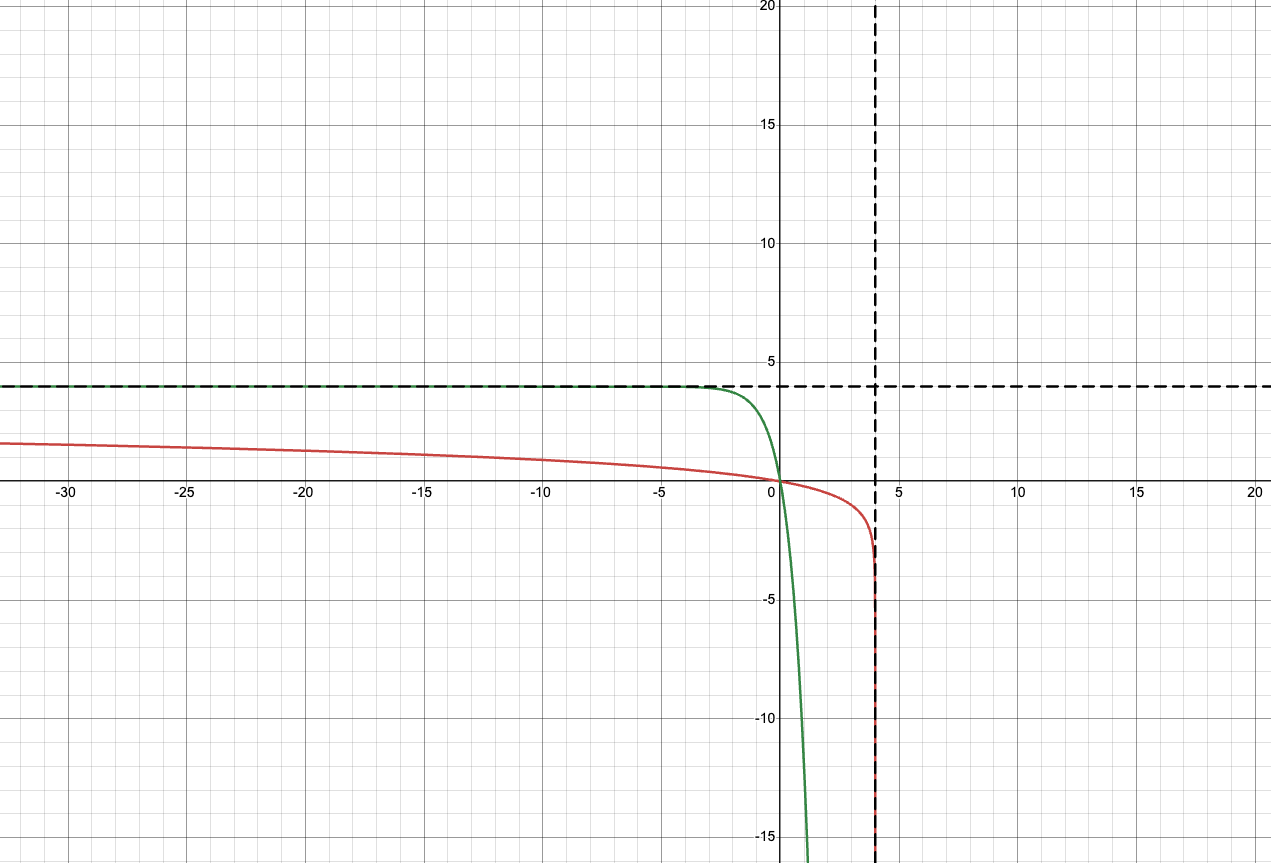
The graph of both functions are shown below (green = inverse function):
The model is
P ( t ) = 1200 1 + 19 e − 0.4 t . P(t)=\frac{1200}{1+19e^{-0.4t}}. P ( t ) = 1 + 19 e − 0.4 t 1200 . The initial population is
P ( 0 ) = 1200 1 + 19 e 0 = 1200 20 = 60. P(0)=\frac{1200}{1+19e^0}
=\frac{1200}{20}
=60. P ( 0 ) = 1 + 19 e 0 1200 = 20 1200 = 60. So
P ( 0 ) = 60 . \boxed{P(0)=60}. P ( 0 ) = 60 . As t → ∞ t\to\infty t → ∞
e − 0.4 t → 0. e^{-0.4t}\to 0. e − 0.4 t → 0. Thus
P ( t ) → 1200 1 = 1200. P(t)\to \frac{1200}{1}=1200. P ( t ) → 1 1200 = 1200. So the limiting population is
1200 . \boxed{1200}. 1200 . Now solve P ( t ) = 900 P(t)=900 P ( t ) = 900
900 = 1200 1 + 19 e − 0.4 t . 900=\frac{1200}{1+19e^{-0.4t}}. 900 = 1 + 19 e − 0.4 t 1200 . Then
900 ( 1 + 19 e − 0.4 t ) = 1200. 900(1+19e^{-0.4t})=1200. 900 ( 1 + 19 e − 0.4 t ) = 1200. Divide by 300 300 300
3 ( 1 + 19 e − 0.4 t ) = 4. 3(1+19e^{-0.4t})=4. 3 ( 1 + 19 e − 0.4 t ) = 4. So
1 + 19 e − 0.4 t = 4 3 . 1+19e^{-0.4t}=\frac43. 1 + 19 e − 0.4 t = 3 4 . Then
19 e − 0.4 t = 1 3 . 19e^{-0.4t}=\frac13. 19 e − 0.4 t = 3 1 . Thus
e − 0.4 t = 1 57 . e^{-0.4t}=\frac1{57}. e − 0.4 t = 57 1 . Take natural logs:
− 0.4 t = ln ( 1 57 ) = − ln 57. -0.4t=\ln\left(\frac1{57}\right)=-\ln 57. − 0.4 t = ln ( 57 1 ) = − ln 57. Therefore
t = ln 57 0.4 = 5 2 ln 57. t=\frac{\ln 57}{0.4}
=\frac52\ln 57. t = 0.4 ln 57 = 2 5 ln 57. So
t = 5 2 ln 57 . \boxed{t=\frac52\ln 57}. t = 2 5 ln 57 .
Let
t = log 4 n . t=\log_4 n. t = log 4 n . Then
log 16 n = log 4 n log 4 16 = t 2 . \log_{16} n=\frac{\log_4 n}{\log_4 16}
=\frac{t}{2}. log 16 n = log 4 16 log 4 n = 2 t . The equation becomes
log 2 ( t 2 ) = log 4 ( t ) . \log_2\left(\frac{t}{2}\right)=\log_4(t). log 2 ( 2 t ) = log 4 ( t ) . Rewrite both sides in base 2 2 2
log 2 t − log 2 2 = log 2 t log 2 4 . \log_2 t-\log_2 2=\frac{\log_2 t}{\log_2 4}. log 2 t − log 2 2 = log 2 4 log 2 t . So
log 2 t − 1 = 1 2 log 2 t . \log_2 t-1=\frac12\log_2 t. log 2 t − 1 = 2 1 log 2 t . Then
1 2 log 2 t = 1. \frac12\log_2 t=1. 2 1 log 2 t = 1. Thus
log 2 t = 2 , \log_2 t=2, log 2 t = 2 , so
t = 4. t=4. t = 4. Since t = log 4 n t=\log_4 n t = log 4 n
log 4 n = 4. \log_4 n=4. log 4 n = 4. Therefore
n = 4 4 = 256 . \boxed{n=4^4=256}. n = 4 4 = 256 .
The function is
F ( x ) = ln ( x − a b − x ) , F(x)=\ln\left(\frac{x-a}{b-x}\right), F ( x ) = ln ( b − x x − a ) , where a < b a<b a < b
For the logarithm to be defined,
x − a b − x > 0. \frac{x-a}{b-x}>0. b − x x − a > 0. Since a < b a<b a < b
a < x < b . a<x<b. a < x < b . So the domain is
( a , b ) . \boxed{(a,b)}. ( a , b ) . For the x x x F ( x ) = 0 F(x)=0 F ( x ) = 0
ln ( x − a b − x ) = 0. \ln\left(\frac{x-a}{b-x}\right)=0. ln ( b − x x − a ) = 0. Then
x − a b − x = 1. \frac{x-a}{b-x}=1. b − x x − a = 1. So
x − a = b − x . x-a=b-x. x − a = b − x . Thus
2 x = a + b , 2x=a+b, 2 x = a + b , and
x = a + b 2 . x=\frac{a+b}{2}. x = 2 a + b . The x x x
( a + b 2 , 0 ) . \boxed{\left(\frac{a+b}{2},0\right)}. ( 2 a + b , 0 ) . The y y y 0 0 0
a < 0 < b . a<0<b. a < 0 < b . If this is true, then
F ( 0 ) = ln ( − a b ) . F(0)=\ln\left(\frac{-a}{b}\right). F ( 0 ) = ln ( b − a ) . So the y y y
( 0 , ln ( − a b ) ) \boxed{\left(0,\ln\left(\frac{-a}{b}\right)\right)} ( 0 , ln ( b − a ) ) if a < 0 < b a<0<b a < 0 < b y y y
The vertical asymptotes occur at the endpoints of the domain:
x = a and x = b . \boxed{x=a\quad\text{and}\quad x=b}. x = a and x = b . Now find the inverse. Let
y = ln ( x − a b − x ) . y=\ln\left(\frac{x-a}{b-x}\right). y = ln ( b − x x − a ) . Rewrite exponentially:
e y = x − a b − x . e^y=\frac{x-a}{b-x}. e y = b − x x − a . Multiply:
e y ( b − x ) = x − a . e^y(b-x)=x-a. e y ( b − x ) = x − a . Expand:
b e y − x e y = x − a . be^y-xe^y=x-a. b e y − x e y = x − a . Move the x x x
b e y + a = x + x e y . be^y+a=x+xe^y. b e y + a = x + x e y . Factor:
b e y + a = x ( 1 + e y ) . be^y+a=x(1+e^y). b e y + a = x ( 1 + e y ) . Thus
x = a + b e y 1 + e y . x=\frac{a+be^y}{1+e^y}. x = 1 + e y a + b e y . Switch x x x y y y
F − 1 ( x ) = a + b e x 1 + e x . \boxed{F^{-1}(x)=\frac{a+be^x}{1+e^x}}. F − 1 ( x ) = 1 + e x a + b e x . As x x x ( a , b ) (a,b) ( a , b ) x − a b − x \frac{x-a}{b-x} b − x x − a ( 0 , ∞ ) (0,\infty) ( 0 , ∞ )
( − ∞ , ∞ ) . \boxed{(-\infty,\infty)}. ( − ∞ , ∞ ) .
The product is
∏ k = 4 63 log k ( 5 k 2 − 1 ) log k + 1 ( 5 k 2 − 4 ) . \prod_{k=4}^{63}\frac{\log_k\left(5^{k^2-1}\right)}{\log_{k+1}\left(5^{k^2-4}\right)}. k = 4 ∏ 63 log k + 1 ( 5 k 2 − 4 ) log k ( 5 k 2 − 1 ) . Use change of base:
log k ( 5 k 2 − 1 ) = ( k 2 − 1 ) ln 5 ln k , \log_k\left(5^{k^2-1}\right)
=\frac{(k^2-1)\ln 5}{\ln k}, log k ( 5 k 2 − 1 ) = ln k ( k 2 − 1 ) ln 5 , and
log k + 1 ( 5 k 2 − 4 ) = ( k 2 − 4 ) ln 5 ln ( k + 1 ) . \log_{k+1}\left(5^{k^2-4}\right)
=\frac{(k^2-4)\ln 5}{\ln(k+1)}. log k + 1 ( 5 k 2 − 4 ) = ln ( k + 1 ) ( k 2 − 4 ) ln 5 . So each factor becomes
( k 2 − 1 ) ln 5 ln k ( k 2 − 4 ) ln 5 ln ( k + 1 ) = k 2 − 1 k 2 − 4 ⋅ ln ( k + 1 ) ln k . \frac{\frac{(k^2-1)\ln 5}{\ln k}}{\frac{(k^2-4)\ln 5}{\ln(k+1)}}
=\frac{k^2-1}{k^2-4}\cdot\frac{\ln(k+1)}{\ln k}. l n ( k + 1 ) ( k 2 − 4 ) l n 5 l n k ( k 2 − 1 ) l n 5 = k 2 − 4 k 2 − 1 ⋅ ln k ln ( k + 1 ) . Factor the polynomials:
k 2 − 1 k 2 − 4 = ( k − 1 ) ( k + 1 ) ( k − 2 ) ( k + 2 ) . \frac{k^2-1}{k^2-4}
=\frac{(k-1)(k+1)}{(k-2)(k+2)}. k 2 − 4 k 2 − 1 = ( k − 2 ) ( k + 2 ) ( k − 1 ) ( k + 1 ) . Thus the product is
∏ k = 4 63 ( k − 1 ) ( k + 1 ) ( k − 2 ) ( k + 2 ) ⋅ ∏ k = 4 63 ln ( k + 1 ) ln k . \prod_{k=4}^{63}
\frac{(k-1)(k+1)}{(k-2)(k+2)}
\cdot
\prod_{k=4}^{63}\frac{\ln(k+1)}{\ln k}. k = 4 ∏ 63 ( k − 2 ) ( k + 2 ) ( k − 1 ) ( k + 1 ) ⋅ k = 4 ∏ 63 ln k ln ( k + 1 ) . First,
∏ k = 4 63 k − 1 k − 2 = 3 2 ⋅ 4 3 ⋅ 5 4 ⋯ 62 61 = 31. \prod_{k=4}^{63}\frac{k-1}{k-2}
=\frac32\cdot\frac43\cdot\frac54\cdots\frac{62}{61}
=31. k = 4 ∏ 63 k − 2 k − 1 = 2 3 ⋅ 3 4 ⋅ 4 5 ⋯ 61 62 = 31. Also,
∏ k = 4 63 k + 1 k + 2 = 5 6 ⋅ 6 7 ⋅ 7 8 ⋯ 64 65 = 5 65 = 1 13 . \prod_{k=4}^{63}\frac{k+1}{k+2}
=\frac56\cdot\frac67\cdot\frac78\cdots\frac{64}{65}
=\frac5{65}
=\frac1{13}. k = 4 ∏ 63 k + 2 k + 1 = 6 5 ⋅ 7 6 ⋅ 8 7 ⋯ 65 64 = 65 5 = 13 1 . So the rational part is
31 ⋅ 1 13 = 31 13 . 31\cdot\frac1{13}=\frac{31}{13}. 31 ⋅ 13 1 = 13 31 . The logarithm part telescopes:
∏ k = 4 63 ln ( k + 1 ) ln k = ln 5 ln 4 ⋅ ln 6 ln 5 ⋯ ln 64 ln 63 = ln 64 ln 4 . \prod_{k=4}^{63}\frac{\ln(k+1)}{\ln k}
=\frac{\ln 5}{\ln 4}\cdot\frac{\ln 6}{\ln 5}\cdots\frac{\ln 64}{\ln 63}
=\frac{\ln 64}{\ln 4}. k = 4 ∏ 63 ln k ln ( k + 1 ) = ln 4 ln 5 ⋅ ln 5 ln 6 ⋯ ln 63 ln 64 = ln 4 ln 64 . Since 64 = 4 3 64=4^3 64 = 4 3
ln 64 ln 4 = 3. \frac{\ln 64}{\ln 4}=3. ln 4 ln 64 = 3. Therefore the product is
31 13 ⋅ 3 = 93 13 . \frac{31}{13}\cdot 3=\boxed{\frac{93}{13}}. 13 31 ⋅ 3 = 13 93 .
For part ( A ) (A) ( A )
EML ( x , 1 ) = e x − ln 1. \operatorname{EML}(x,1)=e^x-\ln 1. EML ( x , 1 ) = e x − ln 1. Since ln 1 = 0 \ln 1=0 ln 1 = 0
EML ( x , 1 ) = e x . \operatorname{EML}(x,1)=e^x. EML ( x , 1 ) = e x . Thus
e x = EML ( x , 1 ) . \boxed{e^x=\operatorname{EML}(x,1)}. e x = EML ( x , 1 ) . For part ( B ) (B) ( B )
EML ( 0 , x ) = e 0 − ln x . \operatorname{EML}(0,x)=e^0-\ln x. EML ( 0 , x ) = e 0 − ln x . Since e 0 = 1 e^0=1 e 0 = 1
EML ( 0 , x ) = 1 − ln x . \operatorname{EML}(0,x)=1-\ln x. EML ( 0 , x ) = 1 − ln x . Solving for ln x \ln x ln x
ln x = 1 − EML ( 0 , x ) . \boxed{\ln x=1-\operatorname{EML}(0,x)}. ln x = 1 − EML ( 0 , x ) . For part ( C ) (C) ( C )
log b x = ln x ln b . \log_b x=\frac{\ln x}{\ln b}. log b x = ln b ln x . Using part ( B ) (B) ( B )
ln x = 1 − EML ( 0 , x ) \ln x=1-\operatorname{EML}(0,x) ln x = 1 − EML ( 0 , x ) and
ln b = 1 − EML ( 0 , b ) . \ln b=1-\operatorname{EML}(0,b). ln b = 1 − EML ( 0 , b ) . Therefore
log b x = 1 − EML ( 0 , x ) 1 − EML ( 0 , b ) . \boxed{\log_b x=\frac{1-\operatorname{EML}(0,x)}{1-\operatorname{EML}(0,b)}}. log b x = 1 − EML ( 0 , b ) 1 − EML ( 0 , x ) . For part ( D ) (D) ( D )
e x = EML ( x , 1 ) e^x=\operatorname{EML}(x,1) e x = EML ( x , 1 ) and
ln z = 1 − EML ( 0 , z ) . \ln z=1-\operatorname{EML}(0,z). ln z = 1 − EML ( 0 , z ) . Since
x + y = ln ( e x e y ) , x+y=\ln(e^xe^y), x + y = ln ( e x e y ) , we get
x + y = 1 − EML ( 0 , EML ( x , 1 ) EML ( y , 1 ) ) . \boxed{x+y=1-\operatorname{EML}\left(0,\operatorname{EML}(x,1)\operatorname{EML}(y,1)\right)}. x + y = 1 − EML ( 0 , EML ( x , 1 ) EML ( y , 1 ) ) . Similarly,
x − y = ln ( e x e y ) , x-y=\ln\left(\frac{e^x}{e^y}\right), x − y = ln ( e y e x ) , so
x − y = 1 − EML ( 0 , EML ( x , 1 ) EML ( y , 1 ) ) . \boxed{x-y=1-\operatorname{EML}\left(0,\frac{\operatorname{EML}(x,1)}{\operatorname{EML}(y,1)}\right)}. x − y = 1 − EML ( 0 , EML ( y , 1 ) EML ( x , 1 ) ) . For part ( E ) (E) ( E )
EML ( EML ( x , 1 ) , EML ( 0 , y ) ) \operatorname{EML}\left(\operatorname{EML}(x,1),\operatorname{EML}(0,y)\right) EML ( EML ( x , 1 ) , EML ( 0 , y ) ) has a top EML node. Its left input is another EML node with inputs x x x 1 1 1 0 0 0 y y y
In text form:
EML ( EML ( x , 1 ) , EML ( 0 , y ) ) . \operatorname{EML}
\left(
\begin{array}{c}
\operatorname{EML}(x,1),\\
\operatorname{EML}(0,y)
\end{array}
\right). EML ( EML ( x , 1 ) , EML ( 0 , y ) ) . Now simplify:
EML ( x , 1 ) = e x \operatorname{EML}(x,1)=e^x EML ( x , 1 ) = e x and
EML ( 0 , y ) = 1 − ln y . \operatorname{EML}(0,y)=1-\ln y. EML ( 0 , y ) = 1 − ln y . Therefore
EML ( EML ( x , 1 ) , EML ( 0 , y ) ) = EML ( e x , 1 − ln y ) . \operatorname{EML}\left(\operatorname{EML}(x,1),\operatorname{EML}(0,y)\right)
=\operatorname{EML}(e^x,1-\ln y). EML ( EML ( x , 1 ) , EML ( 0 , y ) ) = EML ( e x , 1 − ln y ) . Using the definition of EML,
EML ( e x , 1 − ln y ) = e e x − ln ( 1 − ln y ) . \operatorname{EML}(e^x,1-\ln y)
=e^{e^x}-\ln(1-\ln y). EML ( e x , 1 − ln y ) = e e x − ln ( 1 − ln y ) . So the expression simplifies to
e e x − ln ( 1 − ln y ) . \boxed{e^{e^x}-\ln(1-\ln y)}. e e x − ln ( 1 − ln y ) . This requires
1 − ln y > 0 , 1-\ln y>0, 1 − ln y > 0 , so
0 < y < e . 0<y<e. 0 < y < e . For part ( F ) (F) ( F ) 1 1 1
Full notes →
Let θ = − 29 π 6 \theta=-\frac{29\pi}{6} θ = − 6 29 π
( A ) (A) ( A ) θ \theta θ
( B ) (B) ( B )
( C ) (C) ( C ) θ \theta θ
( D ) (D) ( D ) θ \theta θ
A sector of a circle has perimeter 40 40 40 5 π 6 \frac{5\pi}{6} 6 5 π
A wheel of radius 18 18 18 45 45 45 7 7 7
A pulley system has two wheels connected by a belt without slipping. Wheel A has radius 4 4 4 150 150 150 60 60 60
Let θ \theta θ tan θ = − 8 15 \tan\theta=-\frac{8}{15} tan θ = − 15 8 sin θ \sin\theta sin θ cos θ \cos\theta cos θ sec θ \sec\theta sec θ csc θ \csc\theta csc θ cot θ \cot\theta cot θ sin ( π − θ ) \sin(\pi-\theta) sin ( π − θ ) cos ( θ + π ) \cos(\theta+\pi) cos ( θ + π )
Let P = ( x , y ) P=(x,y) P = ( x , y ) x − y = 2 2 x-y=\frac{\sqrt2}{2} x − y = 2 2 P P P θ ∈ [ 0 , 2 π ) \theta\in[0,2\pi) θ ∈ [ 0 , 2 π ) P P P
Evaluate exactly: 6 sin ( − 7 π 6 ) − 4 cos ( 11 π 3 ) + 3 tan ( − 13 π 4 ) − 2 sec ( 17 π 6 ) . 6\sin\left(-\frac{7\pi}{6}\right)-4\cos\left(\frac{11\pi}{3}\right)+3\tan\left(-\frac{13\pi}{4}\right)-2\sec\left(\frac{17\pi}{6}\right). 6 sin ( − 6 7 π ) − 4 cos ( 3 11 π ) + 3 tan ( − 4 13 π ) − 2 sec ( 6 17 π ) .
Solve exactly on [ 0 , 4 π ) [0,4\pi) [ 0 , 4 π ) 2 sin 2 x − sin x − 1 = 0. 2\sin^2x-\sin x-1=0. 2 sin 2 x − sin x − 1 = 0.
Solve exactly on [ 0 , 2 π ) [0,2\pi) [ 0 , 2 π ) 2 cos 2 x + 3 cos x − 1 = 0. 2\cos^2x+\sqrt3\cos x-1=0. 2 cos 2 x + 3 cos x − 1 = 0.
Solve exactly on [ 0 , 3 π ) [0,3\pi) [ 0 , 3 π ) tan 2 x − 3 = 0. \tan^2x-3=0. tan 2 x − 3 = 0.
The radius of the circle in the figure is 2 units. Express the length of D C DC D C α \alpha α
Prove the identity: 1 − cos θ sin θ + sin θ 1 − cos θ = 2 csc θ . \frac{1-\cos\theta}{\sin\theta}+\frac{\sin\theta}{1-\cos\theta}=2\csc\theta. s i n θ 1 − c o s θ + 1 − c o s θ s i n θ = 2 csc θ . θ \theta θ [ 0 , 2 π ) [0,2\pi) [ 0 , 2 π )
Prove the identity: 1 − sin 2 θ 1 + cot θ − cos 2 θ 1 + tan θ = sin θ cos θ . 1-\frac{\sin^2\theta}{1+\cot\theta}-\frac{\cos^2\theta}{1+\tan\theta}=\sin\theta\cos\theta. 1 − 1 + c o t θ s i n 2 θ − 1 + t a n θ c o s 2 θ = sin θ cos θ .
For each of the following trigonometric expressions, find a segment in the diagram that has length equal to the trigonometric expression: sin θ , cos θ , sec θ , csc θ , tan θ , cot θ \sin\theta, \cos\theta, \sec\theta, \csc\theta, \tan\theta, \cot\theta sin θ , cos θ , sec θ , csc θ , tan θ , cot θ
On [ 0 , 2 π ) [0,2\pi) [ 0 , 2 π ) 3 sin x − 2 cos x = 1. 3\sin x-2\cos x=1. 3 sin x − 2 cos x = 1. t = tan ( x / 2 ) t=\tan(x/2) t = tan ( x /2 ) x x x tan − 1 \tan^{-1} tan − 1
(Bonus, rational points on the unit circle)
The unit circle is
x 2 + y 2 = 1. x^2+y^2=1. x 2 + y 2 = 1. One obvious rational point on the unit circle is ( − 1 , 0 ) (-1,0) ( − 1 , 0 ) m m m ( − 1 , 0 ) (-1,0) ( − 1 , 0 )
y = m ( x + 1 ) . y=m(x+1). y = m ( x + 1 ) . ( A ) (A) ( A ) y = m ( x + 1 ) y=m(x+1) y = m ( x + 1 ) x 2 + y 2 = 1 x^2+y^2=1 x 2 + y 2 = 1 ( − 1 , 0 ) (-1,0) ( − 1 , 0 )
( B ) (B) ( B ) m m m
( C ) (C) ( C ) m m m
( D ) (D) ( D ) m = 2 3 m=\frac23 m = 3 2 ( cos θ , sin θ ) (\cos\theta,\sin\theta) ( cos θ , sin θ ) θ \theta θ
( E ) (E) ( E ) ( − 1 , 0 ) (-1,0) ( − 1 , 0 ) ( 1 , 0 ) (1,0) ( 1 , 0 )
Add multiples of 2 π 2\pi 2 π
− 29 π 6 + 3 ( 2 π ) = − 29 π 6 + 36 π 6 = 7 π 6 . -\frac{29\pi}{6}+3(2\pi)
=-\frac{29\pi}{6}+\frac{36\pi}{6}
=\frac{7\pi}{6}. − 6 29 π + 3 ( 2 π ) = − 6 29 π + 6 36 π = 6 7 π . This is positive, but not least positive, since
7 π 6 − 2 π = − 5 π 6 < 0. \frac{7\pi}{6}-2\pi=-\frac{5\pi}{6}<0. 6 7 π − 2 π = − 6 5 π < 0. So the least positive coterminal angle is
7 π 6 . \boxed{\frac{7\pi}{6}}. 6 7 π . Convert the original angle to degrees:
− 29 π 6 ⋅ 180 π = − 870 ∘ . -\frac{29\pi}{6}\cdot\frac{180}{\pi}
=-870^\circ. − 6 29 π ⋅ π 180 = − 87 0 ∘ . Also,
7 π 6 ⋅ 180 π = 210 ∘ . \frac{7\pi}{6}\cdot\frac{180}{\pi}
=210^\circ. 6 7 π ⋅ π 180 = 21 0 ∘ . Thus
− 29 π 6 = − 870 ∘ , 7 π 6 = 210 ∘ . \boxed{-\frac{29\pi}{6}=-870^\circ,\qquad \frac{7\pi}{6}=210^\circ}. − 6 29 π = − 87 0 ∘ , 6 7 π = 21 0 ∘ . The angle 7 π 6 \frac{7\pi}{6} 6 7 π
7 π 6 − π = π 6 . \frac{7\pi}{6}-\pi=\frac{\pi}{6}. 6 7 π − π = 6 π . So
reference angle = π 6 , Quadrant III . \boxed{\text{reference angle }=\frac{\pi}{6},\quad \text{Quadrant III}}. reference angle = 6 π , Quadrant III . Since θ \theta θ 7 π 6 \frac{7\pi}{6} 6 7 π
sin θ = − 1 2 , cos θ = − 3 2 , tan θ = 3 3 . \sin\theta=-\frac12,
\qquad
\cos\theta=-\frac{\sqrt3}{2},
\qquad
\tan\theta=\frac{\sqrt3}{3}. sin θ = − 2 1 , cos θ = − 2 3 , tan θ = 3 3 . The reciprocal functions are
csc θ = − 2 , sec θ = − 2 3 3 , cot θ = 3 . \csc\theta=-2,
\qquad
\sec\theta=-\frac{2\sqrt3}{3},
\qquad
\cot\theta=\sqrt3. csc θ = − 2 , sec θ = − 3 2 3 , cot θ = 3 .
For a sector,
P = 2 r + s . P=2r+s. P = 2 r + s . Since s = r θ s=r\theta s = r θ
P = 2 r + r θ = r ( 2 + θ ) . P=2r+r\theta=r(2+\theta). P = 2 r + r θ = r ( 2 + θ ) . We are given P = 40 P=40 P = 40 θ = 5 π 6 \theta=\frac{5\pi}{6} θ = 6 5 π
40 = r ( 2 + 5 π 6 ) . 40=r\left(2+\frac{5\pi}{6}\right). 40 = r ( 2 + 6 5 π ) . Thus
r = 40 2 + 5 π 6 = 240 12 + 5 π . r=\frac{40}{2+\frac{5\pi}{6}}
=\frac{240}{12+5\pi}. r = 2 + 6 5 π 40 = 12 + 5 π 240 . So
r = 240 12 + 5 π cm . \boxed{r=\frac{240}{12+5\pi}\text{ cm}}. r = 12 + 5 π 240 cm . The arc length is
s = r θ = 240 12 + 5 π ⋅ 5 π 6 = 200 π 12 + 5 π . s=r\theta
=\frac{240}{12+5\pi}\cdot\frac{5\pi}{6}
=\frac{200\pi}{12+5\pi}. s = r θ = 12 + 5 π 240 ⋅ 6 5 π = 12 + 5 π 200 π . Thus
s = 200 π 12 + 5 π cm . \boxed{s=\frac{200\pi}{12+5\pi}\text{ cm}}. s = 12 + 5 π 200 π cm . The sector area is
A = 1 2 r 2 θ . A=\frac12r^2\theta. A = 2 1 r 2 θ . So
A = 1 2 ( 240 12 + 5 π ) 2 ( 5 π 6 ) = 24000 π ( 12 + 5 π ) 2 . A=\frac12\left(\frac{240}{12+5\pi}\right)^2\left(\frac{5\pi}{6}\right)
=\frac{24000\pi}{(12+5\pi)^2}. A = 2 1 ( 12 + 5 π 240 ) 2 ( 6 5 π ) = ( 12 + 5 π ) 2 24000 π . Therefore
A = 24000 π ( 12 + 5 π ) 2 cm 2 . \boxed{A=\frac{24000\pi}{(12+5\pi)^2}\text{ cm}^2}. A = ( 12 + 5 π ) 2 24000 π cm 2 .
The wheel rotates at
45 rev/min = 45 ( 2 π ) = 90 π rad/min . 45\text{ rev/min}=45(2\pi)=90\pi\text{ rad/min}. 45 rev/min = 45 ( 2 π ) = 90 π rad/min . Convert to radians per second:
ω = 90 π 60 = 3 π 2 rad/sec . \omega=\frac{90\pi}{60}=\frac{3\pi}{2}\text{ rad/sec}. ω = 60 90 π = 2 3 π rad/sec . The bug starts at the point closest to the ground, so its starting angle is
3 π 2 . \frac{3\pi}{2}. 2 3 π . After 7 7 7
ω t = 3 π 2 ( 7 ) = 21 π 2 . \omega t=\frac{3\pi}{2}(7)=\frac{21\pi}{2}. ω t = 2 3 π ( 7 ) = 2 21 π . The total angle is
3 π 2 + 21 π 2 = 24 π 2 = 12 π . \frac{3\pi}{2}+\frac{21\pi}{2}
=\frac{24\pi}{2}
=12\pi. 2 3 π + 2 21 π = 2 24 π = 12 π . This is coterminal with 0 0 0
( 18 , 0 ) . \boxed{(18,0)}. ( 18 , 0 ) . The angle in standard position is
0 radians \boxed{0\text{ radians}} 0 radians after reducing coterminally.
The linear speed is
v = r ω = 18 ⋅ 3 π 2 = 27 π . v=r\omega=18\cdot\frac{3\pi}{2}=27\pi. v = r ω = 18 ⋅ 2 3 π = 27 π . Thus
v = 27 π cm/sec . \boxed{v=27\pi\text{ cm/sec}}. v = 27 π cm/sec .
Wheel A rotates at
150 rev/min = 300 π rad/min . 150\text{ rev/min}=300\pi\text{ rad/min}. 150 rev/min = 300 π rad/min . Its linear speed is
v = r ω = 4 ( 300 π ) = 1200 π in/min . v=r\omega=4(300\pi)=1200\pi\text{ in/min}. v = r ω = 4 ( 300 π ) = 1200 π in/min . The belt does not slip, so Wheel B has the same linear speed.
Wheel B rotates at
60 rev/min = 120 π rad/min . 60\text{ rev/min}=120\pi\text{ rad/min}. 60 rev/min = 120 π rad/min . So
1200 π = r B ( 120 π ) . 1200\pi=r_B(120\pi). 1200 π = r B ( 120 π ) . Therefore
r B = 10 inches . \boxed{r_B=10\text{ inches}}. r B = 10 inches . Convert the belt speed to inches per second:
1200 π in/min = 1200 π 60 in/sec = 20 π in/sec . 1200\pi\text{ in/min}
=\frac{1200\pi}{60}\text{ in/sec}
=20\pi\text{ in/sec}. 1200 π in/min = 60 1200 π in/sec = 20 π in/sec . Thus
20 π in/sec . \boxed{20\pi\text{ in/sec}}. 20 π in/sec .
Since θ \theta θ
tan θ = − 8 15 , \tan\theta=-\frac{8}{15}, tan θ = − 15 8 , we can use a reference triangle with opposite side 8 8 8 − 15 -15 − 15
8 2 + 15 2 = 17. \sqrt{8^2+15^2}=17. 8 2 + 1 5 2 = 17. Thus
sin θ = 8 17 , cos θ = − 15 17 , tan θ = − 8 15 . \boxed{\sin\theta=\frac8{17}},
\qquad
\boxed{\cos\theta=-\frac{15}{17}},
\qquad
\boxed{\tan\theta=-\frac8{15}}. sin θ = 17 8 , cos θ = − 17 15 , tan θ = − 15 8 . The reciprocal functions are
sec θ = − 17 15 , csc θ = 17 8 , cot θ = − 15 8 . \boxed{\sec\theta=-\frac{17}{15}},
\qquad
\boxed{\csc\theta=\frac{17}{8}},
\qquad
\boxed{\cot\theta=-\frac{15}{8}}. sec θ = − 15 17 , csc θ = 8 17 , cot θ = − 8 15 . Now,
sin ( π − θ ) = sin θ = 8 17 . \sin(\pi-\theta)=\sin\theta=\frac8{17}. sin ( π − θ ) = sin θ = 17 8 . Also,
cos ( θ + π ) = − cos θ = 15 17 . \cos(\theta+\pi)=-\cos\theta=\frac{15}{17}. cos ( θ + π ) = − cos θ = 17 15 . So
sin ( π − θ ) = 8 17 , cos ( θ + π ) = 15 17 . \boxed{\sin(\pi-\theta)=\frac8{17}},
\qquad
\boxed{\cos(\theta+\pi)=\frac{15}{17}}. sin ( π − θ ) = 17 8 , cos ( θ + π ) = 17 15 .
Since P = ( x , y ) P=(x,y) P = ( x , y )
x 2 + y 2 = 1. x^2+y^2=1. x 2 + y 2 = 1. We are also given
x − y = 2 2 . x-y=\frac{\sqrt2}{2}. x − y = 2 2 . So
y = x − 2 2 . y=x-\frac{\sqrt2}{2}. y = x − 2 2 . Substitute:
x 2 + ( x − 2 2 ) 2 = 1. x^2+\left(x-\frac{\sqrt2}{2}\right)^2=1. x 2 + ( x − 2 2 ) 2 = 1. Expand:
x 2 + x 2 − 2 x + 1 2 = 1. x^2+x^2-\sqrt2x+\frac12=1. x 2 + x 2 − 2 x + 2 1 = 1. Thus
2 x 2 − 2 x − 1 2 = 0. 2x^2-\sqrt2x-\frac12=0. 2 x 2 − 2 x − 2 1 = 0. Multiply by 2 2 2
4 x 2 − 2 2 x − 1 = 0. 4x^2-2\sqrt2x-1=0. 4 x 2 − 2 2 x − 1 = 0. Use the quadratic formula:
x = 2 2 ± 8 + 16 8 = 2 2 ± 2 6 8 = 2 ± 6 4 . x=\frac{2\sqrt2\pm\sqrt{8+16}}{8}
=\frac{2\sqrt2\pm2\sqrt6}{8}
=\frac{\sqrt2\pm\sqrt6}{4}. x = 8 2 2 ± 8 + 16 = 8 2 2 ± 2 6 = 4 2 ± 6 . Since the point is in Quadrant III, x < 0 x<0 x < 0
x = 2 − 6 4 . x=\frac{\sqrt2-\sqrt6}{4}. x = 4 2 − 6 . Then
y = x − 2 2 = 2 − 6 4 − 2 2 4 = − 2 + 6 4 . y=x-\frac{\sqrt2}{2}
=\frac{\sqrt2-\sqrt6}{4}-\frac{2\sqrt2}{4}
=-\frac{\sqrt2+\sqrt6}{4}. y = x − 2 2 = 4 2 − 6 − 4 2 2 = − 4 2 + 6 . So
P = ( 2 − 6 4 , − 2 + 6 4 ) . \boxed{P=\left(\frac{\sqrt2-\sqrt6}{4},-\frac{\sqrt2+\sqrt6}{4}\right)}. P = ( 4 2 − 6 , − 4 2 + 6 ) . This is the unit-circle point for
θ = 17 π 12 . \boxed{\theta=\frac{17\pi}{12}}. θ = 12 17 π . Equivalently, θ ≈ 4.451 \theta\approx4.451 θ ≈ 4.451
Use coterminal angles:
sin ( − 7 π 6 ) = sin ( 5 π 6 ) = 1 2 . \sin\left(-\frac{7\pi}{6}\right)=\sin\left(\frac{5\pi}{6}\right)=\frac12. sin ( − 6 7 π ) = sin ( 6 5 π ) = 2 1 . Also,
cos ( 11 π 3 ) = cos ( 5 π 3 ) = 1 2 . \cos\left(\frac{11\pi}{3}\right)=\cos\left(\frac{5\pi}{3}\right)=\frac12. cos ( 3 11 π ) = cos ( 3 5 π ) = 2 1 . Next,
tan ( − 13 π 4 ) = tan ( 3 π 4 ) = − 1. \tan\left(-\frac{13\pi}{4}\right)=\tan\left(\frac{3\pi}{4}\right)=-1. tan ( − 4 13 π ) = tan ( 4 3 π ) = − 1. Finally,
sec ( 17 π 6 ) = sec ( 5 π 6 ) = 1 − 3 2 = − 2 3 3 . \sec\left(\frac{17\pi}{6}\right)=\sec\left(\frac{5\pi}{6}\right)
=\frac1{-\frac{\sqrt3}{2}}
=-\frac{2\sqrt3}{3}. sec ( 6 17 π ) = sec ( 6 5 π ) = − 2 3 1 = − 3 2 3 . Substitute:
6 ( 1 2 ) − 4 ( 1 2 ) + 3 ( − 1 ) − 2 ( − 2 3 3 ) . 6\left(\frac12\right)
-4\left(\frac12\right)
+3(-1)
-2\left(-\frac{2\sqrt3}{3}\right). 6 ( 2 1 ) − 4 ( 2 1 ) + 3 ( − 1 ) − 2 ( − 3 2 3 ) . This becomes
3 − 2 − 3 + 4 3 3 . 3-2-3+\frac{4\sqrt3}{3}. 3 − 2 − 3 + 3 4 3 . Therefore
− 2 + 4 3 3 . \boxed{-2+\frac{4\sqrt3}{3}}. − 2 + 3 4 3 .
Let
u = sin x . u=\sin x. u = sin x . Then
2 u 2 − u − 1 = 0. 2u^2-u-1=0. 2 u 2 − u − 1 = 0. Factor:
( 2 u + 1 ) ( u − 1 ) = 0. (2u+1)(u-1)=0. ( 2 u + 1 ) ( u − 1 ) = 0. Thus
sin x = 1 or sin x = − 1 2 . \sin x=1
\qquad\text{or}\qquad
\sin x=-\frac12. sin x = 1 or sin x = − 2 1 . On [ 0 , 4 π ) [0,4\pi) [ 0 , 4 π ) sin x = 1 \sin x=1 sin x = 1
x = π 2 , 5 π 2 . x=\frac{\pi}{2},\frac{5\pi}{2}. x = 2 π , 2 5 π . Also, sin x = − 1 2 \sin x=-\frac12 sin x = − 2 1
x = 7 π 6 , 11 π 6 , 19 π 6 , 23 π 6 . x=\frac{7\pi}{6},\frac{11\pi}{6},\frac{19\pi}{6},\frac{23\pi}{6}. x = 6 7 π , 6 11 π , 6 19 π , 6 23 π . Therefore
x = π 2 , 7 π 6 , 11 π 6 , 5 π 2 , 19 π 6 , 23 π 6 . \boxed{x=\frac{\pi}{2},\frac{7\pi}{6},\frac{11\pi}{6},\frac{5\pi}{2},\frac{19\pi}{6},\frac{23\pi}{6}}. x = 2 π , 6 7 π , 6 11 π , 2 5 π , 6 19 π , 6 23 π .
Let
u = cos x . u=\cos x. u = cos x . Then
2 u 2 + 3 u − 1 = 0. 2u^2+\sqrt3u-1=0. 2 u 2 + 3 u − 1 = 0. Use the quadratic formula:
u = − 3 ± 3 + 8 4 = − 3 ± 11 4 . u=\frac{-\sqrt3\pm\sqrt{3+8}}{4}
=\frac{-\sqrt3\pm\sqrt{11}}{4}. u = 4 − 3 ± 3 + 8 = 4 − 3 ± 11 . The value
− 3 − 11 4 \frac{-\sqrt3-\sqrt{11}}{4} 4 − 3 − 11 is less than − 1 -1 − 1 cos x \cos x cos x
cos x = 11 − 3 4 . \cos x=\frac{\sqrt{11}-\sqrt3}{4}. cos x = 4 11 − 3 . On [ 0 , 2 π ) [0,2\pi) [ 0 , 2 π )
x = cos − 1 ( 11 − 3 4 ) or x = 2 π − cos − 1 ( 11 − 3 4 ) . \boxed{x=\cos^{-1}\left(\frac{\sqrt{11}-\sqrt3}{4}\right)
\quad\text{or}\quad
x=2\pi-\cos^{-1}\left(\frac{\sqrt{11}-\sqrt3}{4}\right)}. x = cos − 1 ( 4 11 − 3 ) or x = 2 π − cos − 1 ( 4 11 − 3 ) .
We have
tan 2 x − 3 = 0. \tan^2x-3=0. tan 2 x − 3 = 0. So
tan 2 x = 3 , \tan^2x=3, tan 2 x = 3 , which gives
tan x = ± 3 . \tan x=\pm\sqrt3. tan x = ± 3 . The tangent function has period π \pi π [ 0 , 3 π ) [0,3\pi) [ 0 , 3 π )
x = π 3 , 2 π 3 , 4 π 3 , 5 π 3 , 7 π 3 , 8 π 3 . \boxed{x=\frac{\pi}{3},\frac{2\pi}{3},\frac{4\pi}{3},\frac{5\pi}{3},\frac{7\pi}{3},\frac{8\pi}{3}}. x = 3 π , 3 2 π , 3 4 π , 3 5 π , 3 7 π , 3 8 π .
The radius of the circle is 2 2 2 C C C x x x
O C = 2. OC=2. O C = 2. The ray from O O O B B B D D D α \alpha α x x x O D C ODC O D C
tan α = D C O C . \tan\alpha=\frac{DC}{OC}. tan α = O C D C . Substitute O C = 2 OC=2 O C = 2
tan α = D C 2 . \tan\alpha=\frac{DC}{2}. tan α = 2 D C . Therefore
D C = 2 tan α . \boxed{DC=2\tan\alpha}. D C = 2 tan α .
Start with the left-hand side:
1 − cos θ sin θ + sin θ 1 − cos θ . \frac{1-\cos\theta}{\sin\theta}+\frac{\sin\theta}{1-\cos\theta}. sin θ 1 − cos θ + 1 − cos θ sin θ . Use the common denominator sin θ ( 1 − cos θ ) \sin\theta(1-\cos\theta) sin θ ( 1 − cos θ )
( 1 − cos θ ) 2 + sin 2 θ sin θ ( 1 − cos θ ) . \frac{(1-\cos\theta)^2+\sin^2\theta}{\sin\theta(1-\cos\theta)}. sin θ ( 1 − cos θ ) ( 1 − cos θ ) 2 + sin 2 θ . Expand the numerator:
1 − 2 cos θ + cos 2 θ + sin 2 θ . 1-2\cos\theta+\cos^2\theta+\sin^2\theta. 1 − 2 cos θ + cos 2 θ + sin 2 θ . Use sin 2 θ + cos 2 θ = 1 \sin^2\theta+\cos^2\theta=1 sin 2 θ + cos 2 θ = 1
1 − 2 cos θ + cos 2 θ + sin 2 θ = 2 − 2 cos θ . 1-2\cos\theta+\cos^2\theta+\sin^2\theta
=2-2\cos\theta. 1 − 2 cos θ + cos 2 θ + sin 2 θ = 2 − 2 cos θ . So the expression becomes
2 − 2 cos θ sin θ ( 1 − cos θ ) . \frac{2-2\cos\theta}{\sin\theta(1-\cos\theta)}. sin θ ( 1 − cos θ ) 2 − 2 cos θ . Factor:
2 ( 1 − cos θ ) sin θ ( 1 − cos θ ) . \frac{2(1-\cos\theta)}{\sin\theta(1-\cos\theta)}. sin θ ( 1 − cos θ ) 2 ( 1 − cos θ ) . Cancel:
2 sin θ = 2 csc θ . \frac2{\sin\theta}=2\csc\theta. sin θ 2 = 2 csc θ . Therefore
1 − cos θ sin θ + sin θ 1 − cos θ = 2 csc θ . \boxed{\frac{1-\cos\theta}{\sin\theta}+\frac{\sin\theta}{1-\cos\theta}=2\csc\theta}. sin θ 1 − cos θ + 1 − cos θ sin θ = 2 csc θ . The original expression is undefined when
sin θ = 0 \sin\theta=0 sin θ = 0 or
1 − cos θ = 0. 1-\cos\theta=0. 1 − cos θ = 0. On [ 0 , 2 π ) [0,2\pi) [ 0 , 2 π )
θ = 0 , π . \boxed{\theta=0,\pi}. θ = 0 , π .
Start with the left-hand side:
1 − sin 2 θ 1 + cot θ − cos 2 θ 1 + tan θ . 1-\frac{\sin^2\theta}{1+\cot\theta}-\frac{\cos^2\theta}{1+\tan\theta}. 1 − 1 + cot θ sin 2 θ − 1 + tan θ cos 2 θ . Rewrite cotangent and tangent using sine and cosine:
1 − sin 2 θ 1 + cos θ sin θ − cos 2 θ 1 + sin θ cos θ . 1-\frac{\sin^2\theta}{1+\frac{\cos\theta}{\sin\theta}}-\frac{\cos^2\theta}{1+\frac{\sin\theta}{\cos\theta}}. 1 − 1 + s i n θ c o s θ sin 2 θ − 1 + c o s θ s i n θ cos 2 θ . Simplify the denominators:
1 + cos θ sin θ = sin θ + cos θ sin θ 1+\frac{\cos\theta}{\sin\theta}=\frac{\sin\theta+\cos\theta}{\sin\theta} 1 + sin θ cos θ = sin θ sin θ + cos θ and
1 + sin θ cos θ = sin θ + cos θ cos θ . 1+\frac{\sin\theta}{\cos\theta}=\frac{\sin\theta+\cos\theta}{\cos\theta}. 1 + cos θ sin θ = cos θ sin θ + cos θ . So the expression becomes
1 − sin 3 θ sin θ + cos θ − cos 3 θ sin θ + cos θ . 1-\frac{\sin^3\theta}{\sin\theta+\cos\theta}-\frac{\cos^3\theta}{\sin\theta+\cos\theta}. 1 − sin θ + cos θ sin 3 θ − sin θ + cos θ cos 3 θ . Combine the fractions:
1 − sin 3 θ + cos 3 θ sin θ + cos θ . 1-\frac{\sin^3\theta+\cos^3\theta}{\sin\theta+\cos\theta}. 1 − sin θ + cos θ sin 3 θ + cos 3 θ . Use the sum of cubes formula:
a 3 + b 3 = ( a + b ) ( a 2 − a b + b 2 ) . a^3+b^3=(a+b)(a^2-ab+b^2). a 3 + b 3 = ( a + b ) ( a 2 − ab + b 2 ) . Then
sin 3 θ + cos 3 θ = ( sin θ + cos θ ) ( sin 2 θ − sin θ cos θ + cos 2 θ ) . \sin^3\theta+\cos^3\theta=(\sin\theta+\cos\theta)(\sin^2\theta-\sin\theta\cos\theta+\cos^2\theta). sin 3 θ + cos 3 θ = ( sin θ + cos θ ) ( sin 2 θ − sin θ cos θ + cos 2 θ ) . Cancel the common factor:
1 − ( sin 2 θ − sin θ cos θ + cos 2 θ ) . 1-(\sin^2\theta-\sin\theta\cos\theta+\cos^2\theta). 1 − ( sin 2 θ − sin θ cos θ + cos 2 θ ) . Since
sin 2 θ + cos 2 θ = 1 , \sin^2\theta+\cos^2\theta=1, sin 2 θ + cos 2 θ = 1 , this becomes
1 − ( 1 − sin θ cos θ ) = sin θ cos θ . 1-(1-\sin\theta\cos\theta)=\sin\theta\cos\theta. 1 − ( 1 − sin θ cos θ ) = sin θ cos θ . Therefore,
1 − sin 2 θ 1 + cot θ − cos 2 θ 1 + tan θ = sin θ cos θ . \boxed{1-\frac{\sin^2\theta}{1+\cot\theta}-\frac{\cos^2\theta}{1+\tan\theta}=\sin\theta\cos\theta}. 1 − 1 + cot θ sin 2 θ − 1 + tan θ cos 2 θ = sin θ cos θ .
In the diagram, the circle is the unit circle and A = ( cos θ , sin θ ) A=(\cos\theta,\sin\theta) A = ( cos θ , sin θ )
The horizontal segment from the origin to the foot under A A A
O C = cos θ . \boxed{OC=\cos\theta}. O C = cos θ . The vertical segment from the x x x A A A
A C = sin θ . \boxed{AC=\sin\theta}. A C = sin θ . The line through A A A
x cos θ + y sin θ = 1. x\cos\theta+y\sin\theta=1. x cos θ + y sin θ = 1. At the x x x y = 0 y=0 y = 0
x cos θ = 1 x\cos\theta=1 x cos θ = 1 and
x = sec θ . x=\sec\theta. x = sec θ . Thus
O D = sec θ . \boxed{OD=\sec\theta}. O D = sec θ . At the y y y x = 0 x=0 x = 0
y sin θ = 1 y\sin\theta=1 y sin θ = 1 and
y = csc θ . y=\csc\theta. y = csc θ . Thus
O B = csc θ . \boxed{OB=\csc\theta}. O B = csc θ . The tangent segment from A A A D D D
A D = ( sec θ − cos θ ) 2 + ( 0 − sin θ ) 2 . AD=\sqrt{(\sec\theta-\cos\theta)^2+(0-\sin\theta)^2}. A D = ( sec θ − cos θ ) 2 + ( 0 − sin θ ) 2 . Since
sec θ − cos θ = 1 cos θ − cos θ = 1 − cos 2 θ cos θ = sin 2 θ cos θ , \sec\theta-\cos\theta
=\frac1{\cos\theta}-\cos\theta
=\frac{1-\cos^2\theta}{\cos\theta}
=\frac{\sin^2\theta}{\cos\theta}, sec θ − cos θ = cos θ 1 − cos θ = cos θ 1 − cos 2 θ = cos θ sin 2 θ , this length simplifies to tan θ \tan\theta tan θ
A D = tan θ . \boxed{AD=\tan\theta}. A D = tan θ . The tangent segment from A A A B B B
A B = ( 0 − cos θ ) 2 + ( csc θ − sin θ ) 2 . AB=\sqrt{(0-\cos\theta)^2+(\csc\theta-\sin\theta)^2}. A B = ( 0 − cos θ ) 2 + ( csc θ − sin θ ) 2 . Similarly,
csc θ − sin θ = 1 sin θ − sin θ = cos 2 θ sin θ , \csc\theta-\sin\theta
=\frac1{\sin\theta}-\sin\theta
=\frac{\cos^2\theta}{\sin\theta}, csc θ − sin θ = sin θ 1 − sin θ = sin θ cos 2 θ , so this length simplifies to cot θ \cot\theta cot θ
A B = cot θ . \boxed{AB=\cot\theta}. A B = cot θ . So the six matching segments are
sin θ = A C , cos θ = O C , sec θ = O D , csc θ = O B , tan θ = A D , cot θ = A B . \boxed{\sin\theta=AC,\quad \cos\theta=OC,\quad \sec\theta=OD,\quad \csc\theta=OB,\quad \tan\theta=AD,\quad \cot\theta=AB}. sin θ = A C , cos θ = O C , sec θ = O D , csc θ = O B , tan θ = A D , cot θ = A B .
Use the substitution
t = tan x 2 . t=\tan\frac{x}{2}. t = tan 2 x . Then
sin x = 2 t 1 + t 2 \sin x=\frac{2t}{1+t^2} sin x = 1 + t 2 2 t and
cos x = 1 − t 2 1 + t 2 . \cos x=\frac{1-t^2}{1+t^2}. cos x = 1 + t 2 1 − t 2 . Substitute into
3 sin x − 2 cos x = 1. 3\sin x-2\cos x=1. 3 sin x − 2 cos x = 1. This gives
3 ( 2 t 1 + t 2 ) − 2 ( 1 − t 2 1 + t 2 ) = 1. 3\left(\frac{2t}{1+t^2}\right)-2\left(\frac{1-t^2}{1+t^2}\right)=1. 3 ( 1 + t 2 2 t ) − 2 ( 1 + t 2 1 − t 2 ) = 1. Multiply by 1 + t 2 1+t^2 1 + t 2
6 t − 2 ( 1 − t 2 ) = 1 + t 2 . 6t-2(1-t^2)=1+t^2. 6 t − 2 ( 1 − t 2 ) = 1 + t 2 . Expand:
6 t − 2 + 2 t 2 = 1 + t 2 . 6t-2+2t^2=1+t^2. 6 t − 2 + 2 t 2 = 1 + t 2 . Rearrange:
t 2 + 6 t − 3 = 0. t^2+6t-3=0. t 2 + 6 t − 3 = 0. Use the quadratic formula:
t = − 6 ± 36 + 12 2 = − 3 ± 2 3 . t=\frac{-6\pm\sqrt{36+12}}{2}
=-3\pm2\sqrt3. t = 2 − 6 ± 36 + 12 = − 3 ± 2 3 . So
tan x 2 = − 3 + 2 3 \tan\frac{x}{2}=-3+2\sqrt3 tan 2 x = − 3 + 2 3 or
tan x 2 = − 3 − 2 3 . \tan\frac{x}{2}=-3-2\sqrt3. tan 2 x = − 3 − 2 3 . Using a calculator and choosing values of x x x [ 0 , 2 π ) [0,2\pi) [ 0 , 2 π )
x ≈ 0.869 or x ≈ 3.450 . \boxed{x\approx0.869\quad\text{or}\quad x\approx3.450}. x ≈ 0.869 or x ≈ 3.450 .
For part ( A ) (A) ( A )
y = m ( x + 1 ) y=m(x+1) y = m ( x + 1 ) into
x 2 + y 2 = 1. x^2+y^2=1. x 2 + y 2 = 1. This gives
x 2 + m 2 ( x + 1 ) 2 = 1. x^2+m^2(x+1)^2=1. x 2 + m 2 ( x + 1 ) 2 = 1. Expand:
x 2 + m 2 ( x 2 + 2 x + 1 ) = 1. x^2+m^2(x^2+2x+1)=1. x 2 + m 2 ( x 2 + 2 x + 1 ) = 1. So
( 1 + m 2 ) x 2 + 2 m 2 x + m 2 − 1 = 0. (1+m^2)x^2+2m^2x+m^2-1=0. ( 1 + m 2 ) x 2 + 2 m 2 x + m 2 − 1 = 0. Since x = − 1 x=-1 x = − 1
( x + 1 ) ( ( 1 + m 2 ) x + ( m 2 − 1 ) ) = 0. (x+1)\left((1+m^2)x+(m^2-1)\right)=0. ( x + 1 ) ( ( 1 + m 2 ) x + ( m 2 − 1 ) ) = 0. Therefore the line intersects the circle at ( − 1 , 0 ) (-1,0) ( − 1 , 0 )
For part ( B ) (B) ( B )
( 1 + m 2 ) x + ( m 2 − 1 ) = 0. (1+m^2)x+(m^2-1)=0. ( 1 + m 2 ) x + ( m 2 − 1 ) = 0. Thus
x = 1 − m 2 1 + m 2 . x=\frac{1-m^2}{1+m^2}. x = 1 + m 2 1 − m 2 . Now plug into y = m ( x + 1 ) y=m(x+1) y = m ( x + 1 )
y = m ( 1 − m 2 1 + m 2 + 1 ) . y=m\left(\frac{1-m^2}{1+m^2}+1\right). y = m ( 1 + m 2 1 − m 2 + 1 ) . Simplify:
y = m ( 1 − m 2 + 1 + m 2 1 + m 2 ) = m ( 2 1 + m 2 ) = 2 m 1 + m 2 . y=m\left(\frac{1-m^2+1+m^2}{1+m^2}\right)
=m\left(\frac{2}{1+m^2}\right)
=\frac{2m}{1+m^2}. y = m ( 1 + m 2 1 − m 2 + 1 + m 2 ) = m ( 1 + m 2 2 ) = 1 + m 2 2 m . So the second intersection point is
( 1 − m 2 1 + m 2 , 2 m 1 + m 2 ) . \boxed{\left(\frac{1-m^2}{1+m^2},\frac{2m}{1+m^2}\right)}. ( 1 + m 2 1 − m 2 , 1 + m 2 2 m ) . For part ( C ) (C) ( C ) m m m m 2 m^2 m 2
1 − m 2 1 + m 2 and 2 m 1 + m 2 \frac{1-m^2}{1+m^2}
\qquad\text{and}\qquad
\frac{2m}{1+m^2} 1 + m 2 1 − m 2 and 1 + m 2 2 m are made from rational numbers using addition, subtraction, multiplication, and division. Therefore both coordinates are rational.
For part ( D ) (D) ( D ) m = 2 3 m=\frac23 m = 3 2
x = 1 − ( 2 3 ) 2 1 + ( 2 3 ) 2 = 1 − 4 9 1 + 4 9 = 5 9 13 9 = 5 13 . x=\frac{1-\left(\frac23\right)^2}{1+\left(\frac23\right)^2}
=\frac{1-\frac49}{1+\frac49}
=\frac{\frac59}{\frac{13}{9}}
=\frac5{13}. x = 1 + ( 3 2 ) 2 1 − ( 3 2 ) 2 = 1 + 9 4 1 − 9 4 = 9 13 9 5 = 13 5 . Also,
y = 2 ( 2 3 ) 1 + ( 2 3 ) 2 = 4 3 13 9 = 12 13 . y=\frac{2\left(\frac23\right)}{1+\left(\frac23\right)^2}
=\frac{\frac43}{\frac{13}{9}}
=\frac{12}{13}. y = 1 + ( 3 2 ) 2 2 ( 3 2 ) = 9 13 3 4 = 13 12 . So the rational point is
( 5 13 , 12 13 ) . \boxed{\left(\frac5{13},\frac{12}{13}\right)}. ( 13 5 , 13 12 ) . This means there is an angle θ \theta θ
cos θ = 5 13 , sin θ = 12 13 . \boxed{\cos\theta=\frac5{13},\qquad \sin\theta=\frac{12}{13}}. cos θ = 13 5 , sin θ = 13 12 . For part ( E ) (E) ( E ) ( − 1 , 0 ) (-1,0) ( − 1 , 0 ) ( − 1 , 0 ) (-1,0) ( − 1 , 0 ) ( − 1 , 0 ) (-1,0) ( − 1 , 0 )
To reach ( 1 , 0 ) (1,0) ( 1 , 0 ) x x x
m = 0 . \boxed{m=0}. m = 0 .
Full notes →
For f ( x ) = − 3 sin ( 2 ( x − π 6 ) ) + 1 f(x)=-3\sin\left(2\left(x-\frac{\pi}{6}\right)\right)+1 f ( x ) = − 3 sin ( 2 ( x − 6 π ) ) + 1
A sinusoidal function has maximum value 7 7 7 x = π 3 x=\frac{\pi}{3} x = 3 π − 1 -1 − 1 x = 7 π 6 x=\frac{7\pi}{6} x = 6 7 π
For g ( x ) = 2 tan ( 3 ( x + π 12 ) ) − 1 g(x)=2\tan\left(3\left(x+\frac{\pi}{12}\right)\right)-1 g ( x ) = 2 tan ( 3 ( x + 12 π ) ) − 1 x x x
For h ( x ) = − 2 sec ( 1 2 ( x − π ) ) + 3 h(x)=-2\sec\left(\frac12(x-\pi)\right)+3 h ( x ) = − 2 sec ( 2 1 ( x − π ) ) + 3 x = π x=\pi x = π
Solve exactly on [ 0 , 4 π ) [0,4\pi) [ 0 , 4 π ) y = 2 sin 2 x − sin x − 1 y=2\sin^2x-\sin x-1 y = 2 sin 2 x − sin x − 1 [ 0 , 4 π ) [0,4\pi) [ 0 , 4 π ) x x x 2 sin 2 x − sin x − 1 = 0. 2\sin^2x-\sin x-1=0. 2 sin 2 x − sin x − 1 = 0.
Solve on [ 0 , 4 π ) [0, 4\pi) [ 0 , 4 π ) 4 sin ( 4 x ) cos ( 6 x ) = 2 sin ( 10 x ) + 1 4\sin(4x)\cos(6x)= 2\sin(10x)+1 4 sin ( 4 x ) cos ( 6 x ) = 2 sin ( 10 x ) + 1
Solve exactly on [ 0 , 2 π ) [0,2\pi) [ 0 , 2 π ) tan x + cot x = 4. \tan x+\cot x=4. tan x + cot x = 4.
Evaluate each of these exactly: sin 75 ∘ , cos 15 ∘ , tan 105 ∘ . \sin 75^\circ, \cos 15^\circ,\tan 105^\circ. sin 7 5 ∘ , cos 1 5 ∘ , tan 10 5 ∘ . 15 ∘ 15^\circ 1 5 ∘ 75 ∘ 75^\circ 7 5 ∘
Prove the identity: sin ( x + y ) + sin ( x − y ) cos ( x + y ) + cos ( x − y ) = tan x . \frac{\sin(x+y)+\sin(x-y)}{\cos(x+y)+\cos(x-y)}=\tan x. c o s ( x + y ) + c o s ( x − y ) s i n ( x + y ) + s i n ( x − y ) = tan x .
Solve exactly on [ 0 , 2 π ) [0,2\pi) [ 0 , 2 π ) cos ( 5 x ) + cos ( 3 x ) = 0. \cos(5x)+\cos(3x)=0. cos ( 5 x ) + cos ( 3 x ) = 0.
Evaluate exactly: sin ( cos − 1 3 5 ) + cos ( sin − 1 ( − 5 13 ) ) + tan ( cos − 1 ( − 4 5 ) ) . \sin\left(\cos^{-1}\frac35\right)+\cos\left(\sin^{-1}\left(-\frac5{13}\right)\right)+\tan\left(\cos^{-1}\left(-\frac45\right)\right). sin ( cos − 1 5 3 ) + cos ( sin − 1 ( − 13 5 ) ) + tan ( cos − 1 ( − 5 4 ) ) .
How many solutions does the equation tan ( 2 x ) = cos ( x 2 ) \tan(2x)=\cos(\tfrac{x}{2}) tan ( 2 x ) = cos ( 2 x ) [ 0 , 2 π ] [0,2\pi] [ 0 , 2 π ]
Suppose π 2 < θ < π \frac{\pi}{2}<\theta<\pi 2 π < θ < π cos θ = − 3 5 \cos\theta=-\frac35 cos θ = − 5 3 sin ( θ 2 ) , cos ( θ 2 ) , \sin\left(\frac{\theta}{2}\right), \cos\left(\frac{\theta}{2}\right), sin ( 2 θ ) , cos ( 2 θ ) , tan ( θ 2 ) . \tan\left(\frac{\theta}{2}\right). tan ( 2 θ ) .
Let x x x y y y sin x sin y = 3 \frac{\sin x}{\sin y} = 3 s i n y s i n x = 3 cos x cos y = 1 2 \frac{\cos x}{\cos y} = \frac{1}{2} c o s y c o s x = 2 1 sin 2 x sin 2 y + cos 2 x cos 2 y \frac{\sin 2x}{\sin 2y} + \frac{\cos 2x}{\cos 2y} s i n 2 y s i n 2 x + c o s 2 y c o s 2 x p q \frac{p}{q} q p p p p q q q p + q p+q p + q
A tide height is modeled by a sinusoidal function of time. At t = 2 t=2 t = 2 11 11 11 t = 8 t=8 t = 8 3 3 3
( A ) (A) ( A ) H ( t ) H(t) H ( t )
( B ) (B) ( B )
( C ) (C) ( C ) t = 2 t=2 t = 2 9 9 9
( D ) (D) ( D ) H ( t ) = 9 H(t)=9 H ( t ) = 9 t = 2 t=2 t = 2
(Bonus, Viète’s formula for π \pi π
Let
a 1 = 2 a_1=\sqrt2 a 1 = 2 and define
a n + 1 = 2 + a n . a_{n+1}=\sqrt{2+a_n}. a n + 1 = 2 + a n . The nested radicals
2 , 2 + 2 , 2 + 2 + 2 , … \sqrt2,\quad \sqrt{2+\sqrt2},\quad \sqrt{2+\sqrt{2+\sqrt2}},\quad \ldots 2 , 2 + 2 , 2 + 2 + 2 , … are connected to repeated half-angle identities.
( A ) (A) ( A )
a n = 2 cos ( π 2 n + 1 ) . a_n=2\cos\left(\frac{\pi}{2^{n+1}}\right). a n = 2 cos ( 2 n + 1 π ) . ( B ) (B) ( B ) ( A ) (A) ( A ) sin ( 2 x ) = 2 sin x cos x \sin(2x)=2\sin x\cos x sin ( 2 x ) = 2 sin x cos x a n 2 \frac{a_n}{2} 2 a n 2 π \frac{2}{\pi} π 2
( C ) (C) ( C )
2 π = 2 2 ⋅ 2 + 2 2 ⋅ 2 + 2 + 2 2 ⋯ . \frac{2}{\pi}
=\frac{\sqrt2}{2}\cdot
\frac{\sqrt{2+\sqrt2}}{2}\cdot
\frac{\sqrt{2+\sqrt{2+\sqrt2}}}{2}\cdots. π 2 = 2 2 ⋅ 2 2 + 2 ⋅ 2 2 + 2 + 2 ⋯ .
The function is
f ( x ) = − 3 sin ( 2 ( x − π 6 ) ) + 1. f(x)=-3\sin\left(2\left(x-\frac{\pi}{6}\right)\right)+1. f ( x ) = − 3 sin ( 2 ( x − 6 π ) ) + 1. The amplitude is
3 . \boxed{3}. 3 . The period is
2 π ∣ 2 ∣ = π . \frac{2\pi}{\lvert 2 \rvert}=\pi. ∣ 2 ∣ 2 π = π . So
period = π . \boxed{\text{period}=\pi}. period = π . The phase shift is
π 6 right . \boxed{\frac{\pi}{6}\text{ right}}. 6 π right . The midline is
y = 1 . \boxed{y=1}. y = 1 . The range is
1 − 3 ≤ y ≤ 1 + 3 , 1-3\le y\le 1+3, 1 − 3 ≤ y ≤ 1 + 3 , so
[ − 2 , 4 ] . \boxed{[-2,4]}. [ − 2 , 4 ] . The key-point increment is one fourth of the period:
π 4 . \frac{\pi}{4}. 4 π . Starting at x = π 6 x=\frac{\pi}{6} x = 6 π x x x
π 6 , 5 π 12 , 2 π 3 , 11 π 12 , 7 π 6 . \frac{\pi}{6},\quad
\frac{5\pi}{12},\quad
\frac{2\pi}{3},\quad
\frac{11\pi}{12},\quad
\frac{7\pi}{6}. 6 π , 12 5 π , 3 2 π , 12 11 π , 6 7 π . Because the sine graph is reflected over the x x x y y y
1 , − 2 , 1 , 4 , 1. 1,\quad -2,\quad 1,\quad 4,\quad 1. 1 , − 2 , 1 , 4 , 1. Thus the five key points are
( π 6 , 1 ) , ( 5 π 12 , − 2 ) , ( 2 π 3 , 1 ) , ( 11 π 12 , 4 ) , ( 7 π 6 , 1 ) . \boxed{\left(\frac{\pi}{6},1\right),
\left(\frac{5\pi}{12},-2\right),
\left(\frac{2\pi}{3},1\right),
\left(\frac{11\pi}{12},4\right),
\left(\frac{7\pi}{6},1\right)}. ( 6 π , 1 ) , ( 12 5 π , − 2 ) , ( 3 2 π , 1 ) , ( 12 11 π , 4 ) , ( 6 7 π , 1 ) . A graph with many key points is shown below:
The maximum is 7 7 7 − 1 -1 − 1
D = 7 + ( − 1 ) 2 = 3. D=\frac{7+(-1)}{2}=3. D = 2 7 + ( − 1 ) = 3. The amplitude is half the distance between max and min:
A = 7 − ( − 1 ) 2 = 4. A=\frac{7-(-1)}{2}=4. A = 2 7 − ( − 1 ) = 4. The distance from a maximum to the next minimum is half a period:
7 π 6 − π 3 = 7 π 6 − 2 π 6 = 5 π 6 . \frac{7\pi}{6}-\frac{\pi}{3}
=\frac{7\pi}{6}-\frac{2\pi}{6}
=\frac{5\pi}{6}. 6 7 π − 3 π = 6 7 π − 6 2 π = 6 5 π . So the period is
2 ⋅ 5 π 6 = 5 π 3 . 2\cdot\frac{5\pi}{6}=\frac{5\pi}{3}. 2 ⋅ 6 5 π = 3 5 π . Thus
B = 2 π 5 π 3 = 6 5 . B=\frac{2\pi}{\frac{5\pi}{3}}=\frac65. B = 3 5 π 2 π = 5 6 . Since the function has a maximum at x = π 3 x=\frac{\pi}{3} x = 3 π
f ( x ) = 4 cos ( 6 5 ( x − π 3 ) ) + 3 . \boxed{f(x)=4\cos\left(\frac65\left(x-\frac{\pi}{3}\right)\right)+3}. f ( x ) = 4 cos ( 5 6 ( x − 3 π ) ) + 3 . The key-point increment is
1 4 ⋅ 5 π 3 = 5 π 12 . \frac14\cdot\frac{5\pi}{3}=\frac{5\pi}{12}. 4 1 ⋅ 3 5 π = 12 5 π . Starting at the maximum x = π 3 x=\frac{\pi}{3} x = 3 π
( π 3 , 7 ) , ( 3 π 4 , 3 ) , ( 7 π 6 , − 1 ) , ( 19 π 12 , 3 ) , ( 2 π , 7 ) . \boxed{\left(\frac{\pi}{3},7\right),
\left(\frac{3\pi}{4},3\right),
\left(\frac{7\pi}{6},-1\right),
\left(\frac{19\pi}{12},3\right),
\left(2\pi,7\right)}. ( 3 π , 7 ) , ( 4 3 π , 3 ) , ( 6 7 π , − 1 ) , ( 12 19 π , 3 ) , ( 2 π , 7 ) . A graph with many key points is shown below:
The function is
g ( x ) = 2 tan ( 3 ( x + π 12 ) ) − 1. g(x)=2\tan\left(3\left(x+\frac{\pi}{12}\right)\right)-1. g ( x ) = 2 tan ( 3 ( x + 12 π ) ) − 1. The period of tangent is
π ∣ 3 ∣ = π 3 . \frac{\pi}{\lvert 3 \rvert}=\frac{\pi}{3}. ∣ 3 ∣ π = 3 π . So
period = π 3 . \boxed{\text{period}=\frac{\pi}{3}}. period = 3 π . The center point occurs where the tangent input is 0 0 0
3 ( x + π 12 ) = 0. 3\left(x+\frac{\pi}{12}\right)=0. 3 ( x + 12 π ) = 0. Thus
x = − π 12 . x=-\frac{\pi}{12}. x = − 12 π . At the center,
g ( − π 12 ) = 2 tan ( 0 ) − 1 = − 1. g\left(-\frac{\pi}{12}\right)=2\tan(0)-1=-1. g ( − 12 π ) = 2 tan ( 0 ) − 1 = − 1. So the center point is
( − π 12 , − 1 ) . \boxed{\left(-\frac{\pi}{12},-1\right)}. ( − 12 π , − 1 ) . The distance from the center to each vertical asymptote is half the period:
1 2 ⋅ π 3 = π 6 . \frac12\cdot\frac{\pi}{3}=\frac{\pi}{6}. 2 1 ⋅ 3 π = 6 π . So the surrounding vertical asymptotes are
− π 12 − π 6 = − π 4 -\frac{\pi}{12}-\frac{\pi}{6}=-\frac{\pi}{4} − 12 π − 6 π = − 4 π and
− π 12 + π 6 = π 12 . -\frac{\pi}{12}+\frac{\pi}{6}=\frac{\pi}{12}. − 12 π + 6 π = 12 π . Thus
x = − π 4 and x = π 12 . \boxed{x=-\frac{\pi}{4}\quad\text{and}\quad x=\frac{\pi}{12}}. x = − 4 π and x = 12 π . For the x x x g ( x ) = 0 g(x)=0 g ( x ) = 0
2 tan ( 3 ( x + π 12 ) ) − 1 = 0. 2\tan\left(3\left(x+\frac{\pi}{12}\right)\right)-1=0. 2 tan ( 3 ( x + 12 π ) ) − 1 = 0. Then
tan ( 3 ( x + π 12 ) ) = 1 2 . \tan\left(3\left(x+\frac{\pi}{12}\right)\right)=\frac12. tan ( 3 ( x + 12 π ) ) = 2 1 . On the center branch,
3 ( x + π 12 ) = tan − 1 ( 1 2 ) . 3\left(x+\frac{\pi}{12}\right)=\tan^{-1}\left(\frac12\right). 3 ( x + 12 π ) = tan − 1 ( 2 1 ) . Therefore
x = 1 3 tan − 1 ( 1 2 ) − π 12 . \boxed{x=\frac13\tan^{-1}\left(\frac12\right)-\frac{\pi}{12}}. x = 3 1 tan − 1 ( 2 1 ) − 12 π . The branch should increase from the vertical asymptote x = − π 4 x=-\frac{\pi}{4} x = − 4 π x = π 12 x=\frac{\pi}{12} x = 12 π ( − π 12 , − 1 ) \left(-\frac{\pi}{12},-1\right) ( − 12 π , − 1 ) x x x
A graph with many key points is shown below:
The function is
h ( x ) = − 2 sec ( 1 2 ( x − π ) ) + 3. h(x)=-2\sec\left(\frac12(x-\pi)\right)+3. h ( x ) = − 2 sec ( 2 1 ( x − π ) ) + 3. The period of secant is
2 π ∣ 1 2 ∣ = 4 π . \frac{2\pi}{\left\lvert \frac12\right\rvert}=4\pi. 2 1 2 π = 4 π . So
period = 4 π . \boxed{\text{period}=4\pi}. period = 4 π . The midline is
y = 3 . \boxed{y=3}. y = 3 . One period starting at x = π x=\pi x = π
x = π x=\pi x = π to
x = π + 4 π = 5 π . x=\pi+4\pi=5\pi. x = π + 4 π = 5 π . Secant has vertical asymptotes when the cosine inside is 0 0 0
1 2 ( x − π ) = π 2 + k π . \frac12(x-\pi)=\frac{\pi}{2}+k\pi. 2 1 ( x − π ) = 2 π + k π . Multiply by 2 2 2
x − π = π + 2 k π . x-\pi=\pi+2k\pi. x − π = π + 2 k π . Thus
x = 2 π + 2 k π . x=2\pi+2k\pi. x = 2 π + 2 k π . In the period [ π , 5 π ] [\pi,5\pi] [ π , 5 π ]
x = 2 π and x = 4 π . \boxed{x=2\pi\quad\text{and}\quad x=4\pi}. x = 2 π and x = 4 π . The parent secant has range ( − ∞ , − 1 ] ∪ [ 1 , ∞ ) (-\infty,-1]\cup[1,\infty) ( − ∞ , − 1 ] ∪ [ 1 , ∞ ) − 2 -2 − 2 ( − ∞ , − 2 ] ∪ [ 2 , ∞ ) (-\infty,-2]\cup[2,\infty) ( − ∞ , − 2 ] ∪ [ 2 , ∞ ) 3 3 3
( − ∞ , 1 ] ∪ [ 5 , ∞ ) . \boxed{(-\infty,1]\cup[5,\infty)}. ( − ∞ , 1 ] ∪ [ 5 , ∞ ) . The guiding cosine curve is
y = − 2 cos ( 1 2 ( x − π ) ) + 3. y=-2\cos\left(\frac12(x-\pi)\right)+3. y = − 2 cos ( 2 1 ( x − π ) ) + 3. On [ π , 5 π ] [\pi,5\pi] [ π , 5 π ]
( π , 1 ) , ( 2 π , 3 ) , ( 3 π , 5 ) , ( 4 π , 3 ) , ( 5 π , 1 ) . (\pi,1),\quad (2\pi,3),\quad (3\pi,5),\quad (4\pi,3),\quad (5\pi,1). ( π , 1 ) , ( 2 π , 3 ) , ( 3 π , 5 ) , ( 4 π , 3 ) , ( 5 π , 1 ) . The secant graph has vertices at ( π , 1 ) (\pi,1) ( π , 1 ) ( 3 π , 5 ) (3\pi,5) ( 3 π , 5 ) ( 5 π , 1 ) (5\pi,1) ( 5 π , 1 ) x = 2 π x=2\pi x = 2 π x = 4 π x=4\pi x = 4 π
A graph with many key points is shown below:
Let
u = sin x . u=\sin x. u = sin x . Then
2 u 2 − u − 1 = 0. 2u^2-u-1=0. 2 u 2 − u − 1 = 0. Factor:
( 2 u + 1 ) ( u − 1 ) = 0. (2u+1)(u-1)=0. ( 2 u + 1 ) ( u − 1 ) = 0. Thus
sin x = − 1 2 or sin x = 1. \sin x=-\frac12
\qquad\text{or}\qquad
\sin x=1. sin x = − 2 1 or sin x = 1. On [ 0 , 4 π ) [0,4\pi) [ 0 , 4 π )
sin x = 1 \sin x=1 sin x = 1 at
x = π 2 , 5 π 2 . x=\frac{\pi}{2},\frac{5\pi}{2}. x = 2 π , 2 5 π . Also,
sin x = − 1 2 \sin x=-\frac12 sin x = − 2 1 at
x = 7 π 6 , 11 π 6 , 19 π 6 , 23 π 6 . x=\frac{7\pi}{6},\frac{11\pi}{6},\frac{19\pi}{6},\frac{23\pi}{6}. x = 6 7 π , 6 11 π , 6 19 π , 6 23 π . Therefore
x = π 2 , 7 π 6 , 11 π 6 , 5 π 2 , 19 π 6 , 23 π 6 . \boxed{x=\frac{\pi}{2},\frac{7\pi}{6},\frac{11\pi}{6},\frac{5\pi}{2},\frac{19\pi}{6},\frac{23\pi}{6}}. x = 2 π , 6 7 π , 6 11 π , 2 5 π , 6 19 π , 6 23 π . The graph of y = 2 sin 2 x − sin x − 1 y=2\sin^2x-\sin x-1 y = 2 sin 2 x − sin x − 1 x x x [ 0 , 4 π ) [0,4\pi) [ 0 , 4 π )
A graph with many key points is shown below:
Start with
4 sin ( 4 x ) cos ( 6 x ) = 2 sin ( 10 x ) + 1. 4\sin(4x)\cos(6x)=2\sin(10x)+1. 4 sin ( 4 x ) cos ( 6 x ) = 2 sin ( 10 x ) + 1. Use the product-to-sum identity
sin A cos B = 1 2 [ sin ( A + B ) + sin ( A − B ) ] . \sin A\cos B=\frac12[\sin(A+B)+\sin(A-B)]. sin A cos B = 2 1 [ sin ( A + B ) + sin ( A − B )] . Then
4 sin ( 4 x ) cos ( 6 x ) = 2 [ sin ( 10 x ) + sin ( − 2 x ) ] . 4\sin(4x)\cos(6x)
=2[\sin(10x)+\sin(-2x)]. 4 sin ( 4 x ) cos ( 6 x ) = 2 [ sin ( 10 x ) + sin ( − 2 x )] . Since sin ( − 2 x ) = − sin ( 2 x ) \sin(-2x)=-\sin(2x) sin ( − 2 x ) = − sin ( 2 x )
4 sin ( 4 x ) cos ( 6 x ) = 2 sin ( 10 x ) − 2 sin ( 2 x ) . 4\sin(4x)\cos(6x)=2\sin(10x)-2\sin(2x). 4 sin ( 4 x ) cos ( 6 x ) = 2 sin ( 10 x ) − 2 sin ( 2 x ) . So the equation becomes
2 sin ( 10 x ) − 2 sin ( 2 x ) = 2 sin ( 10 x ) + 1. 2\sin(10x)-2\sin(2x)=2\sin(10x)+1. 2 sin ( 10 x ) − 2 sin ( 2 x ) = 2 sin ( 10 x ) + 1. Subtract 2 sin ( 10 x ) 2\sin(10x) 2 sin ( 10 x )
− 2 sin ( 2 x ) = 1. -2\sin(2x)=1. − 2 sin ( 2 x ) = 1. Thus
sin ( 2 x ) = − 1 2 . \sin(2x)=-\frac12. sin ( 2 x ) = − 2 1 . Let u = 2 x u=2x u = 2 x x ∈ [ 0 , 4 π ) x\in[0,4\pi) x ∈ [ 0 , 4 π )
u ∈ [ 0 , 8 π ) . u\in[0,8\pi). u ∈ [ 0 , 8 π ) . On [ 0 , 8 π ) [0,8\pi) [ 0 , 8 π ) sin u = − 1 2 \sin u=-\frac12 sin u = − 2 1
u = 7 π 6 , 11 π 6 , 19 π 6 , 23 π 6 , 31 π 6 , 35 π 6 , 43 π 6 , 47 π 6 . u=\frac{7\pi}{6},\frac{11\pi}{6},\frac{19\pi}{6},\frac{23\pi}{6},
\frac{31\pi}{6},\frac{35\pi}{6},\frac{43\pi}{6},\frac{47\pi}{6}. u = 6 7 π , 6 11 π , 6 19 π , 6 23 π , 6 31 π , 6 35 π , 6 43 π , 6 47 π . Divide by 2 2 2
x = 7 π 12 , 11 π 12 , 19 π 12 , 23 π 12 , 31 π 12 , 35 π 12 , 43 π 12 , 47 π 12 . \boxed{x=\frac{7\pi}{12},\frac{11\pi}{12},\frac{19\pi}{12},\frac{23\pi}{12},
\frac{31\pi}{12},\frac{35\pi}{12},\frac{43\pi}{12},\frac{47\pi}{12}}. x = 12 7 π , 12 11 π , 12 19 π , 12 23 π , 12 31 π , 12 35 π , 12 43 π , 12 47 π .
The equation is
tan x + cot x = 4. \tan x+\cot x=4. tan x + cot x = 4. Let
t = tan x . t=\tan x. t = tan x . Then cot x = 1 t \cot x=\frac1t cot x = t 1
t + 1 t = 4. t+\frac1t=4. t + t 1 = 4. Multiply by t t t
t 2 + 1 = 4 t . t^2+1=4t. t 2 + 1 = 4 t . So
t 2 − 4 t + 1 = 0. t^2-4t+1=0. t 2 − 4 t + 1 = 0. Use the quadratic formula:
t = 4 ± 16 − 4 2 = 2 ± 3 . t=\frac{4\pm\sqrt{16-4}}{2}
=2\pm\sqrt3. t = 2 4 ± 16 − 4 = 2 ± 3 . Since
tan ( π 12 ) = 2 − 3 \tan\left(\frac{\pi}{12}\right)=2-\sqrt3 tan ( 12 π ) = 2 − 3 and
tan ( 5 π 12 ) = 2 + 3 , \tan\left(\frac{5\pi}{12}\right)=2+\sqrt3, tan ( 12 5 π ) = 2 + 3 , the solutions on [ 0 , 2 π ) [0,2\pi) [ 0 , 2 π )
x = π 12 , 5 π 12 , 13 π 12 , 17 π 12 . \boxed{x=\frac{\pi}{12},\frac{5\pi}{12},\frac{13\pi}{12},\frac{17\pi}{12}}. x = 12 π , 12 5 π , 12 13 π , 12 17 π .
Use angle addition and subtraction formulas.
First,
sin 75 ∘ = sin ( 45 ∘ + 30 ∘ ) . \sin75^\circ=\sin(45^\circ+30^\circ). sin 7 5 ∘ = sin ( 4 5 ∘ + 3 0 ∘ ) . So
sin 75 ∘ = sin 45 ∘ cos 30 ∘ + cos 45 ∘ sin 30 ∘ . \sin75^\circ
=\sin45^\circ\cos30^\circ+\cos45^\circ\sin30^\circ. sin 7 5 ∘ = sin 4 5 ∘ cos 3 0 ∘ + cos 4 5 ∘ sin 3 0 ∘ . Thus
sin 75 ∘ = 2 2 ⋅ 3 2 + 2 2 ⋅ 1 2 = 6 + 2 4 . \sin75^\circ
=\frac{\sqrt2}{2}\cdot\frac{\sqrt3}{2}
+\frac{\sqrt2}{2}\cdot\frac12
=\frac{\sqrt6+\sqrt2}{4}. sin 7 5 ∘ = 2 2 ⋅ 2 3 + 2 2 ⋅ 2 1 = 4 6 + 2 . Next,
cos 15 ∘ = cos ( 45 ∘ − 30 ∘ ) . \cos15^\circ=\cos(45^\circ-30^\circ). cos 1 5 ∘ = cos ( 4 5 ∘ − 3 0 ∘ ) . So
cos 15 ∘ = cos 45 ∘ cos 30 ∘ + sin 45 ∘ sin 30 ∘ = 6 + 2 4 . \cos15^\circ
=\cos45^\circ\cos30^\circ+\sin45^\circ\sin30^\circ
=\frac{\sqrt6+\sqrt2}{4}. cos 1 5 ∘ = cos 4 5 ∘ cos 3 0 ∘ + sin 4 5 ∘ sin 3 0 ∘ = 4 6 + 2 . Finally,
tan 105 ∘ = tan ( 60 ∘ + 45 ∘ ) . \tan105^\circ=\tan(60^\circ+45^\circ). tan 10 5 ∘ = tan ( 6 0 ∘ + 4 5 ∘ ) . Then
tan 105 ∘ = 3 + 1 1 − 3 . \tan105^\circ
=\frac{\sqrt3+1}{1-\sqrt3}. tan 10 5 ∘ = 1 − 3 3 + 1 . Rationalize:
3 + 1 1 − 3 ⋅ 1 + 3 1 + 3 = 4 + 2 3 − 2 = − 2 − 3 . \frac{\sqrt3+1}{1-\sqrt3}\cdot\frac{1+\sqrt3}{1+\sqrt3}
=\frac{4+2\sqrt3}{-2}
=-2-\sqrt3. 1 − 3 3 + 1 ⋅ 1 + 3 1 + 3 = − 2 4 + 2 3 = − 2 − 3 . Therefore
sin 75 ∘ = 6 + 2 4 , \boxed{\sin75^\circ=\frac{\sqrt6+\sqrt2}{4}}, sin 7 5 ∘ = 4 6 + 2 , cos 15 ∘ = 6 + 2 4 , \boxed{\cos15^\circ=\frac{\sqrt6+\sqrt2}{4}}, cos 1 5 ∘ = 4 6 + 2 , and
tan 105 ∘ = − 2 − 3 . \boxed{\tan105^\circ=-2-\sqrt3}. tan 10 5 ∘ = − 2 − 3 .
Start with the left-hand side:
sin ( x + y ) + sin ( x − y ) cos ( x + y ) + cos ( x − y ) . \frac{\sin(x+y)+\sin(x-y)}{\cos(x+y)+\cos(x-y)}. cos ( x + y ) + cos ( x − y ) sin ( x + y ) + sin ( x − y ) . Use sum-to-product formulas:
sin ( x + y ) + sin ( x − y ) = 2 sin x cos y . \sin(x+y)+\sin(x-y)
=2\sin x\cos y. sin ( x + y ) + sin ( x − y ) = 2 sin x cos y . Also,
cos ( x + y ) + cos ( x − y ) = 2 cos x cos y . \cos(x+y)+\cos(x-y)
=2\cos x\cos y. cos ( x + y ) + cos ( x − y ) = 2 cos x cos y . Therefore
sin ( x + y ) + sin ( x − y ) cos ( x + y ) + cos ( x − y ) = 2 sin x cos y 2 cos x cos y . \frac{\sin(x+y)+\sin(x-y)}{\cos(x+y)+\cos(x-y)}
=\frac{2\sin x\cos y}{2\cos x\cos y}. cos ( x + y ) + cos ( x − y ) sin ( x + y ) + sin ( x − y ) = 2 cos x cos y 2 sin x cos y . Cancel:
2 sin x cos y 2 cos x cos y = sin x cos x = tan x . \frac{2\sin x\cos y}{2\cos x\cos y}
=\frac{\sin x}{\cos x}
=\tan x. 2 cos x cos y 2 sin x cos y = cos x sin x = tan x . Thus
sin ( x + y ) + sin ( x − y ) cos ( x + y ) + cos ( x − y ) = tan x . \boxed{\frac{\sin(x+y)+\sin(x-y)}{\cos(x+y)+\cos(x-y)}=\tan x}. cos ( x + y ) + cos ( x − y ) sin ( x + y ) + sin ( x − y ) = tan x .
Use the sum-to-product formula:
cos A + cos B = 2 cos ( A + B 2 ) cos ( A − B 2 ) . \cos A+\cos B
=2\cos\left(\frac{A+B}{2}\right)\cos\left(\frac{A-B}{2}\right). cos A + cos B = 2 cos ( 2 A + B ) cos ( 2 A − B ) . With A = 5 x A=5x A = 5 x B = 3 x B=3x B = 3 x
cos ( 5 x ) + cos ( 3 x ) = 2 cos ( 4 x ) cos x . \cos(5x)+\cos(3x)
=2\cos(4x)\cos x. cos ( 5 x ) + cos ( 3 x ) = 2 cos ( 4 x ) cos x . So the equation becomes
2 cos ( 4 x ) cos x = 0. 2\cos(4x)\cos x=0. 2 cos ( 4 x ) cos x = 0. Thus
cos ( 4 x ) = 0 \cos(4x)=0 cos ( 4 x ) = 0 or
cos x = 0. \cos x=0. cos x = 0. For cos x = 0 \cos x=0 cos x = 0 [ 0 , 2 π ) [0,2\pi) [ 0 , 2 π )
x = π 2 , 3 π 2 . x=\frac{\pi}{2},\frac{3\pi}{2}. x = 2 π , 2 3 π . For cos ( 4 x ) = 0 \cos(4x)=0 cos ( 4 x ) = 0
4 x = π 2 + k π . 4x=\frac{\pi}{2}+k\pi. 4 x = 2 π + k π . So
x = π 8 + k π 4 . x=\frac{\pi}{8}+\frac{k\pi}{4}. x = 8 π + 4 k π . On [ 0 , 2 π ) [0,2\pi) [ 0 , 2 π )
x = π 8 , 3 π 8 , 5 π 8 , 7 π 8 , 9 π 8 , 11 π 8 , 13 π 8 , 15 π 8 . x=\frac{\pi}{8},\frac{3\pi}{8},\frac{5\pi}{8},\frac{7\pi}{8},
\frac{9\pi}{8},\frac{11\pi}{8},\frac{13\pi}{8},\frac{15\pi}{8}. x = 8 π , 8 3 π , 8 5 π , 8 7 π , 8 9 π , 8 11 π , 8 13 π , 8 15 π . Therefore
x = π 8 , 3 π 8 , π 2 , 5 π 8 , 7 π 8 , 9 π 8 , 11 π 8 , 3 π 2 , 13 π 8 , 15 π 8 . \boxed{x=\frac{\pi}{8},\frac{3\pi}{8},\frac{\pi}{2},\frac{5\pi}{8},\frac{7\pi}{8},\frac{9\pi}{8},\frac{11\pi}{8},\frac{3\pi}{2},\frac{13\pi}{8},\frac{15\pi}{8}}. x = 8 π , 8 3 π , 2 π , 8 5 π , 8 7 π , 8 9 π , 8 11 π , 2 3 π , 8 13 π , 8 15 π . The product-to-sum form
cos ( 5 x ) + cos ( 3 x ) = 2 cos ( 4 x ) cos x \cos(5x)+\cos(3x)=2\cos(4x)\cos x cos ( 5 x ) + cos ( 3 x ) = 2 cos ( 4 x ) cos x shows that zeros occur whenever either factor is zero. A sketch should mark the eight zeros from cos ( 4 x ) = 0 \cos(4x)=0 cos ( 4 x ) = 0 cos x = 0 \cos x=0 cos x = 0
ADD IMAGE OF GRAPH
Let
α = cos − 1 3 5 . \alpha=\cos^{-1}\frac35. α = cos − 1 5 3 . Then cos α = 3 5 \cos\alpha=\frac35 cos α = 5 3 α ∈ [ 0 , π ] \alpha\in[0,\pi] α ∈ [ 0 , π ] α \alpha α
sin α = 4 5 . \sin\alpha=\frac45. sin α = 5 4 . So
sin ( cos − 1 3 5 ) = 4 5 . \sin\left(\cos^{-1}\frac35\right)=\frac45. sin ( cos − 1 5 3 ) = 5 4 . Next, let
β = sin − 1 ( − 5 13 ) . \beta=\sin^{-1}\left(-\frac5{13}\right). β = sin − 1 ( − 13 5 ) . Since β ∈ [ − π 2 , π 2 ] \beta\in\left[-\frac{\pi}{2},\frac{\pi}{2}\right] β ∈ [ − 2 π , 2 π ] β \beta β
cos β = 12 13 . \cos\beta=\frac{12}{13}. cos β = 13 12 . So
cos ( sin − 1 ( − 5 13 ) ) = 12 13 . \cos\left(\sin^{-1}\left(-\frac5{13}\right)\right)=\frac{12}{13}. cos ( sin − 1 ( − 13 5 ) ) = 13 12 . Finally, let
γ = cos − 1 ( − 4 5 ) . \gamma=\cos^{-1}\left(-\frac45\right). γ = cos − 1 ( − 5 4 ) . Then γ ∈ [ 0 , π ] \gamma\in[0,\pi] γ ∈ [ 0 , π ] γ \gamma γ
sin γ = 3 5 , \sin\gamma=\frac35, sin γ = 5 3 , and
tan γ = 3 5 − 4 5 = − 3 4 . \tan\gamma=\frac{\frac35}{-\frac45}=-\frac34. tan γ = − 5 4 5 3 = − 4 3 . Now add:
4 5 + 12 13 − 3 4 . \frac45+\frac{12}{13}-\frac34. 5 4 + 13 12 − 4 3 . Using common denominator 260 260 260
208 260 + 240 260 − 195 260 = 253 260 . \frac{208}{260}+\frac{240}{260}-\frac{195}{260}
=\frac{253}{260}. 260 208 + 260 240 − 260 195 = 260 253 . Therefore
253 260 . \boxed{\frac{253}{260}}. 260 253 .
We need count solutions to
tan ( 2 x ) = cos ( x 2 ) \tan(2x)=\cos\left(\frac{x}{2}\right) tan ( 2 x ) = cos ( 2 x ) on [ 0 , 2 π ] [0,2\pi] [ 0 , 2 π ]
The tangent side is undefined when
2 x = π 2 + k π . 2x=\frac{\pi}{2}+k\pi. 2 x = 2 π + k π . Thus
x = π 4 + k π 2 . x=\frac{\pi}{4}+\frac{k\pi}{2}. x = 4 π + 2 k π . On [ 0 , 2 π ] [0,2\pi] [ 0 , 2 π ]
π 4 , 3 π 4 , 5 π 4 , 7 π 4 . \frac{\pi}{4},\frac{3\pi}{4},\frac{5\pi}{4},\frac{7\pi}{4}. 4 π , 4 3 π , 4 5 π , 4 7 π . These split the interval into five pieces:
[ 0 , π 4 ) , ( π 4 , 3 π 4 ) , ( 3 π 4 , 5 π 4 ) , ( 5 π 4 , 7 π 4 ) , ( 7 π 4 , 2 π ] . \left[0,\frac{\pi}{4}\right),\quad
\left(\frac{\pi}{4},\frac{3\pi}{4}\right),\quad
\left(\frac{3\pi}{4},\frac{5\pi}{4}\right),\quad
\left(\frac{5\pi}{4},\frac{7\pi}{4}\right),\quad
\left(\frac{7\pi}{4},2\pi\right]. [ 0 , 4 π ) , ( 4 π , 4 3 π ) , ( 4 3 π , 4 5 π ) , ( 4 5 π , 4 7 π ) , ( 4 7 π , 2 π ] . Let
F ( x ) = tan ( 2 x ) − cos ( x 2 ) . F(x)=\tan(2x)-\cos\left(\frac{x}{2}\right). F ( x ) = tan ( 2 x ) − cos ( 2 x ) . On each of the five pieces, tan ( 2 x ) \tan(2x) tan ( 2 x ) − ∞ -\infty − ∞ ∞ \infty ∞ cos ( x 2 ) \cos\left(\frac{x}{2}\right) cos ( 2 x ) 1 1 1 − 1 -1 − 1 [ 0 , 2 π ] [0,2\pi] [ 0 , 2 π ]
More formally,
F ′ ( x ) = 2 sec 2 ( 2 x ) + 1 2 sin ( x 2 ) > 0 F'(x)=2\sec^2(2x)+\frac12\sin\left(\frac{x}{2}\right)>0 F ′ ( x ) = 2 sec 2 ( 2 x ) + 2 1 sin ( 2 x ) > 0 wherever F F F [ 0 , 2 π ] [0,2\pi] [ 0 , 2 π ] F F F
On each piece, the function changes from negative to positive:
On the first interval, F ( 0 ) = − 1 F(0)=-1 F ( 0 ) = − 1 F ( x ) → ∞ F(x)\to\infty F ( x ) → ∞ x → π 4 − x\to\frac{\pi}{4}^{-} x → 4 π −
On each middle interval, F ( x ) → − ∞ F(x)\to-\infty F ( x ) → − ∞ F ( x ) → ∞ F(x)\to\infty F ( x ) → ∞
On the last interval, F ( x ) → − ∞ F(x)\to-\infty F ( x ) → − ∞ x → 7 π 4 + x\to\frac{7\pi}{4}^{+} x → 4 7 π + F ( 2 π ) = 1 F(2\pi)=1 F ( 2 π ) = 1
Therefore there is exactly one solution in each of the five pieces.
5 \boxed{5} 5
We are given
π 2 < θ < π , \frac{\pi}{2}<\theta<\pi, 2 π < θ < π , so θ \theta θ
θ 2 \frac{\theta}{2} 2 θ is in Quadrant I.
Since
cos θ = − 3 5 , \cos\theta=-\frac35, cos θ = − 5 3 , the half-angle formulas give
sin ( θ 2 ) = 1 − cos θ 2 . \sin\left(\frac{\theta}{2}\right)
=\sqrt{\frac{1-\cos\theta}{2}}. sin ( 2 θ ) = 2 1 − cos θ . Substitute:
sin ( θ 2 ) = 1 − ( − 3 5 ) 2 = 8 5 2 = 4 5 = 2 5 5 . \sin\left(\frac{\theta}{2}\right)
=\sqrt{\frac{1-\left(-\frac35\right)}{2}}
=\sqrt{\frac{\frac85}{2}}
=\sqrt{\frac45}
=\frac{2\sqrt5}{5}. sin ( 2 θ ) = 2 1 − ( − 5 3 ) = 2 5 8 = 5 4 = 5 2 5 . Also,
cos ( θ 2 ) = 1 + cos θ 2 = 1 − 3 5 2 = 2 5 2 = 1 5 = 5 5 . \cos\left(\frac{\theta}{2}\right)
=\sqrt{\frac{1+\cos\theta}{2}}
=\sqrt{\frac{1-\frac35}{2}}
=\sqrt{\frac{\frac25}{2}}
=\sqrt{\frac15}
=\frac{\sqrt5}{5}. cos ( 2 θ ) = 2 1 + cos θ = 2 1 − 5 3 = 2 5 2 = 5 1 = 5 5 . Thus
tan ( θ 2 ) = sin ( θ 2 ) cos ( θ 2 ) = 2. \tan\left(\frac{\theta}{2}\right)
=\frac{\sin\left(\frac{\theta}{2}\right)}{\cos\left(\frac{\theta}{2}\right)}
=2. tan ( 2 θ ) = cos ( 2 θ ) sin ( 2 θ ) = 2. Therefore
sin ( θ 2 ) = 2 5 5 , cos ( θ 2 ) = 5 5 , tan ( θ 2 ) = 2 . \boxed{\sin\left(\frac{\theta}{2}\right)=\frac{2\sqrt5}{5}},
\qquad
\boxed{\cos\left(\frac{\theta}{2}\right)=\frac{\sqrt5}{5}},
\qquad
\boxed{\tan\left(\frac{\theta}{2}\right)=2}. sin ( 2 θ ) = 5 2 5 , cos ( 2 θ ) = 5 5 , tan ( 2 θ ) = 2 .
We are given
sin x sin y = 3 \frac{\sin x}{\sin y}=3 sin y sin x = 3 and
cos x cos y = 1 2 . \frac{\cos x}{\cos y}=\frac12. cos y cos x = 2 1 . So
sin x = 3 sin y \sin x=3\sin y sin x = 3 sin y and
cos x = 1 2 cos y . \cos x=\frac12\cos y. cos x = 2 1 cos y . Let
S = sin 2 y and C = cos 2 y . S=\sin^2 y
\qquad\text{and}\qquad
C=\cos^2 y. S = sin 2 y and C = cos 2 y . Since S + C = 1 S+C=1 S + C = 1
sin 2 x + cos 2 x = 1. \sin^2x+\cos^2x=1. sin 2 x + cos 2 x = 1. Substitute the given ratios:
( 3 sin y ) 2 + ( 1 2 cos y ) 2 = 1. (3\sin y)^2+\left(\frac12\cos y\right)^2=1. ( 3 sin y ) 2 + ( 2 1 cos y ) 2 = 1. Thus
9 S + 1 4 C = 1. 9S+\frac14C=1. 9 S + 4 1 C = 1. Since C = 1 − S C=1-S C = 1 − S
9 S + 1 4 ( 1 − S ) = 1. 9S+\frac14(1-S)=1. 9 S + 4 1 ( 1 − S ) = 1. Multiply by 4 4 4
36 S + 1 − S = 4. 36S+1-S=4. 36 S + 1 − S = 4. So
35 S = 3 , 35S=3, 35 S = 3 , and
S = 3 35 . S=\frac3{35}. S = 35 3 . Then
C = 1 − 3 35 = 32 35 . C=1-\frac3{35}=\frac{32}{35}. C = 1 − 35 3 = 35 32 . Now,
sin 2 x sin 2 y = 2 sin x cos x 2 sin y cos y = sin x sin y ⋅ cos x cos y = 3 ⋅ 1 2 = 3 2 . \frac{\sin 2x}{\sin 2y}
=\frac{2\sin x\cos x}{2\sin y\cos y}
=\frac{\sin x}{\sin y}\cdot\frac{\cos x}{\cos y}
=3\cdot\frac12
=\frac32. sin 2 y sin 2 x = 2 sin y cos y 2 sin x cos x = sin y sin x ⋅ cos y cos x = 3 ⋅ 2 1 = 2 3 . Also,
cos 2 x cos 2 y = cos 2 x − sin 2 x cos 2 y − sin 2 y . \frac{\cos 2x}{\cos 2y}
=\frac{\cos^2x-\sin^2x}{\cos^2y-\sin^2y}. cos 2 y cos 2 x = cos 2 y − sin 2 y cos 2 x − sin 2 x . Compute the numerator:
cos 2 x − sin 2 x = 1 4 C − 9 S . \cos^2x-\sin^2x
=\frac14C-9S. cos 2 x − sin 2 x = 4 1 C − 9 S . Using C = 32 35 C=\frac{32}{35} C = 35 32 S = 3 35 S=\frac3{35} S = 35 3
1 4 C − 9 S = 1 4 ⋅ 32 35 − 9 ⋅ 3 35 = 8 35 − 27 35 = − 19 35 . \frac14C-9S
=\frac14\cdot\frac{32}{35}-9\cdot\frac3{35}
=\frac8{35}-\frac{27}{35}
=-\frac{19}{35}. 4 1 C − 9 S = 4 1 ⋅ 35 32 − 9 ⋅ 35 3 = 35 8 − 35 27 = − 35 19 . The denominator is
C − S = 32 35 − 3 35 = 29 35 . C-S=\frac{32}{35}-\frac3{35}
=\frac{29}{35}. C − S = 35 32 − 35 3 = 35 29 . Therefore
cos 2 x cos 2 y = − 19 35 29 35 = − 19 29 . \frac{\cos 2x}{\cos 2y}
=\frac{-\frac{19}{35}}{\frac{29}{35}}
=-\frac{19}{29}. cos 2 y cos 2 x = 35 29 − 35 19 = − 29 19 . Now add:
sin 2 x sin 2 y + cos 2 x cos 2 y = 3 2 − 19 29 . \frac{\sin 2x}{\sin 2y}+\frac{\cos 2x}{\cos 2y}
=\frac32-\frac{19}{29}. sin 2 y sin 2 x + cos 2 y cos 2 x = 2 3 − 29 19 . Use denominator 58 58 58
3 2 − 19 29 = 87 58 − 38 58 = 49 58 . \frac32-\frac{19}{29}
=\frac{87}{58}-\frac{38}{58}
=\frac{49}{58}. 2 3 − 29 19 = 58 87 − 58 38 = 58 49 . Thus
p = 49 and q = 58. p=49
\qquad\text{and}\qquad
q=58. p = 49 and q = 58. So
p + q = 107 . \boxed{p+q=107}. p + q = 107 .
The high tide is 11 11 11 3 3 3
D = 11 + 3 2 = 7. D=\frac{11+3}{2}=7. D = 2 11 + 3 = 7. The amplitude is
A = 11 − 3 2 = 4. A=\frac{11-3}{2}=4. A = 2 11 − 3 = 4. The time from high to the next low is half a period:
8 − 2 = 6. 8-2=6. 8 − 2 = 6. So the period is
12. 12. 12. Thus
B = 2 π 12 = π 6 . B=\frac{2\pi}{12}=\frac{\pi}{6}. B = 12 2 π = 6 π . Since the tide is at a high when t = 2 t=2 t = 2
H ( t ) = 4 cos ( π 6 ( t − 2 ) ) + 7 . \boxed{H(t)=4\cos\left(\frac{\pi}{6}(t-2)\right)+7}. H ( t ) = 4 cos ( 6 π ( t − 2 ) ) + 7 . The period is
12 hours , \boxed{12\text{ hours}}, 12 hours , and the midline is
H = 7 . \boxed{H=7}. H = 7 . Now solve for when H ( t ) = 9 H(t)=9 H ( t ) = 9
9 = 4 cos ( π 6 ( t − 2 ) ) + 7. 9=4\cos\left(\frac{\pi}{6}(t-2)\right)+7. 9 = 4 cos ( 6 π ( t − 2 ) ) + 7. Then
2 = 4 cos ( π 6 ( t − 2 ) ) , 2=4\cos\left(\frac{\pi}{6}(t-2)\right), 2 = 4 cos ( 6 π ( t − 2 ) ) , so
cos ( π 6 ( t − 2 ) ) = 1 2 . \cos\left(\frac{\pi}{6}(t-2)\right)=\frac12. cos ( 6 π ( t − 2 ) ) = 2 1 . The first time after the high occurs when the angle is π 3 \frac{\pi}{3} 3 π
π 6 ( t − 2 ) = π 3 . \frac{\pi}{6}(t-2)=\frac{\pi}{3}. 6 π ( t − 2 ) = 3 π . Multiply by 6 π \frac6\pi π 6
t − 2 = 2. t-2=2. t − 2 = 2. So
t = 4 hours . \boxed{t=4\text{ hours}}. t = 4 hours . One full period runs from t = 2 t=2 t = 2 t = 14 t=14 t = 14
( 2 , 11 ) , ( 5 , 7 ) , ( 8 , 3 ) , ( 11 , 7 ) , ( 14 , 11 ) . (2,11),\quad (5,7),\quad (8,3),\quad (11,7),\quad (14,11). ( 2 , 11 ) , ( 5 , 7 ) , ( 8 , 3 ) , ( 11 , 7 ) , ( 14 , 11 ) . The point where H ( t ) = 9 H(t)=9 H ( t ) = 9 t = 2 t=2 t = 2
( 4 , 9 ) . \boxed{(4,9)}. ( 4 , 9 ) . ADD IMAGE OF GRAPH
For part ( A ) (A) ( A )
a 1 = 2 = 2 ⋅ 2 2 = 2 cos ( π 4 ) . a_1=\sqrt2=2\cdot\frac{\sqrt2}{2}=2\cos\left(\frac{\pi}{4}\right). a 1 = 2 = 2 ⋅ 2 2 = 2 cos ( 4 π ) . Since
π 4 = π 2 2 , \frac{\pi}{4}=\frac{\pi}{2^{2}}, 4 π = 2 2 π , this matches
a 1 = 2 cos ( π 2 1 + 1 ) . a_1=2\cos\left(\frac{\pi}{2^{1+1}}\right). a 1 = 2 cos ( 2 1 + 1 π ) . Now assume
a n = 2 cos ( π 2 n + 1 ) . a_n=2\cos\left(\frac{\pi}{2^{n+1}}\right). a n = 2 cos ( 2 n + 1 π ) . Then
a n + 1 = 2 + a n = 2 + 2 cos ( π 2 n + 1 ) . a_{n+1}
=\sqrt{2+a_n}
=\sqrt{2+2\cos\left(\frac{\pi}{2^{n+1}}\right)}. a n + 1 = 2 + a n = 2 + 2 cos ( 2 n + 1 π ) . Use the half-angle identity
cos ( u 2 ) = 1 + cos u 2 \cos\left(\frac{u}{2}\right)=\sqrt{\frac{1+\cos u}{2}} cos ( 2 u ) = 2 1 + cos u for angles in Quadrant I. Rearranging gives
2 cos ( u 2 ) = 2 + 2 cos u . 2\cos\left(\frac{u}{2}\right)=\sqrt{2+2\cos u}. 2 cos ( 2 u ) = 2 + 2 cos u . With
u = π 2 n + 1 , u=\frac{\pi}{2^{n+1}}, u = 2 n + 1 π , we get
a n + 1 = 2 cos ( π 2 n + 2 ) . a_{n+1}
=2\cos\left(\frac{\pi}{2^{n+2}}\right). a n + 1 = 2 cos ( 2 n + 2 π ) . Thus
a n = 2 cos ( π 2 n + 1 ) . \boxed{a_n=2\cos\left(\frac{\pi}{2^{n+1}}\right)}. a n = 2 cos ( 2 n + 1 π ) . For part ( B ) (B) ( B ) ( A ) (A) ( A )
a n 2 = cos ( π 2 n + 1 ) . \frac{a_n}{2}=\cos\left(\frac{\pi}{2^{n+1}}\right). 2 a n = cos ( 2 n + 1 π ) . Consider the finite product
P N = ∏ n = 1 N a n 2 = ∏ n = 1 N cos ( π 2 n + 1 ) . P_N=\prod_{n=1}^{N}\frac{a_n}{2}
=\prod_{n=1}^{N}\cos\left(\frac{\pi}{2^{n+1}}\right). P N = n = 1 ∏ N 2 a n = n = 1 ∏ N cos ( 2 n + 1 π ) . Use the repeated double-angle identity
sin ( 2 x ) = 2 sin x cos x . \sin(2x)=2\sin x\cos x. sin ( 2 x ) = 2 sin x cos x . Starting with x = π 2 N + 1 x=\frac{\pi}{2^{N+1}} x = 2 N + 1 π
sin ( π 2 ) = 2 N sin ( π 2 N + 1 ) ∏ n = 1 N cos ( π 2 n + 1 ) . \sin\left(\frac{\pi}{2}\right)
=2^N\sin\left(\frac{\pi}{2^{N+1}}\right)
\prod_{n=1}^{N}\cos\left(\frac{\pi}{2^{n+1}}\right). sin ( 2 π ) = 2 N sin ( 2 N + 1 π ) n = 1 ∏ N cos ( 2 n + 1 π ) . Since sin ( π 2 ) = 1 \sin\left(\frac{\pi}{2}\right)=1 sin ( 2 π ) = 1
1 = 2 N sin ( π 2 N + 1 ) P N . 1=2^N\sin\left(\frac{\pi}{2^{N+1}}\right)P_N. 1 = 2 N sin ( 2 N + 1 π ) P N . Therefore
P N = 1 2 N sin ( π 2 N + 1 ) . P_N=\frac{1}{2^N\sin\left(\frac{\pi}{2^{N+1}}\right)}. P N = 2 N sin ( 2 N + 1 π ) 1 . For part ( C ) (C) ( C )
u N = π 2 N + 1 . u_N=\frac{\pi}{2^{N+1}}. u N = 2 N + 1 π . Then
2 N = π 2 u N . 2^N=\frac{\pi}{2u_N}. 2 N = 2 u N π . So
P N = 1 2 N sin u N = 1 π 2 u N sin u N = 2 π ⋅ u N sin u N . P_N=\frac{1}{2^N\sin u_N}
=\frac{1}{\frac{\pi}{2u_N}\sin u_N}
=\frac{2}{\pi}\cdot\frac{u_N}{\sin u_N}. P N = 2 N sin u N 1 = 2 u N π sin u N 1 = π 2 ⋅ sin u N u N . As N → ∞ N\to\infty N → ∞ u N → 0 u_N\to0 u N → 0
u N sin u N → 1. \frac{u_N}{\sin u_N}\to1. sin u N u N → 1. Thus
lim N → ∞ P N = 2 π . \lim_{N\to\infty}P_N=\frac2\pi. N → ∞ lim P N = π 2 . Since
a 1 2 = 2 2 , \frac{a_1}{2}=\frac{\sqrt2}{2}, 2 a 1 = 2 2 , a 2 2 = 2 + 2 2 , \frac{a_2}{2}=\frac{\sqrt{2+\sqrt2}}{2}, 2 a 2 = 2 2 + 2 , and so on, we get Viète’s product:
2 π = 2 2 ⋅ 2 + 2 2 ⋅ 2 + 2 + 2 2 ⋯ . \boxed{
\frac{2}{\pi}
=\frac{\sqrt2}{2}\cdot
\frac{\sqrt{2+\sqrt2}}{2}\cdot
\frac{\sqrt{2+\sqrt{2+\sqrt2}}}{2}\cdots
}. π 2 = 2 2 ⋅ 2 2 + 2 ⋅ 2 2 + 2 + 2 ⋯ .
Full notes →
Solve the triangle with A = 60 ∘ A=60^\circ A = 6 0 ∘ a = 9 a=9 a = 9 b = 10 b=10 b = 10
A plane is flying above the ocean. The angle of depression to a submarine is 24 ∘ 24^\circ 2 4 ∘ 17 ∘ 17^\circ 1 7 ∘ 5120 5120 5120
Two towns A A A B B B 1.4 1.4 1.4 B B B A A A S 22 ∘ E S22^\circ E S 2 2 ∘ E A A A S 43 ∘ W S43^\circ W S 4 3 ∘ W B B B
Prove that for any triangle with side lengths a , b , c a,b,c a , b , c s = 1 2 ( a + b + c ) s=\frac12(a+b+c) s = 2 1 ( a + b + c ) sin 2 ( C 2 ) = ( s − a ) ( s − b ) a b . \sin^2\left(\frac C2\right)=\frac{(s-a)(s-b)}{ab}. sin 2 ( 2 C ) = ab ( s − a ) ( s − b ) .
Let u = ⟨ − 2 , 1 ⟩ \mathbf u=\langle -2,1\rangle u = ⟨ − 2 , 1 ⟩ v = ⟨ − 5 , 3 ⟩ \mathbf v=\langle -5,3\rangle v = ⟨ − 5 , 3 ⟩
( A ) (A) ( A ) 2 u − 3 v 2\mathbf u-3\mathbf v 2 u − 3 v
( B ) (B) ( B ) u \mathbf u u v \mathbf v v
( C ) (C) ( C ) u + v \mathbf u+\mathbf v u + v
A plane is heading 40 ∘ 40^\circ 4 0 ∘ 120 120 120 10 10 10
A force of 18 18 18 235 ∘ 235^\circ 23 5 ∘ x x x ⟨ 12 , − 5 ⟩ \langle 12,-5\rangle ⟨ 12 , − 5 ⟩
A particle moves according to x ( t ) = 2 cos t − sin ( 2 t ) , y ( t ) = 6 sin t , x(t)=2\cos t-\sin(2t),\qquad y(t)=6\sin t, x ( t ) = 2 cos t − sin ( 2 t ) , y ( t ) = 6 sin t , 0 ≤ t ≤ 2 π 0\le t\le 2\pi 0 ≤ t ≤ 2 π
( A ) (A) ( A ) x x x
( B ) (B) ( B ) t = π 2 t=\frac{\pi}{2} t = 2 π t = 7 π 6 t=\frac{7\pi}{6} t = 6 7 π
( C ) (C) ( C ) t t t
Eliminate the parameter and describe the curve, including any domain restrictions and orientation: x = e t x=e^t x = e t y = e 2 t − 3 y=e^{2t}-3 y = e 2 t − 3 − ln 2 ≤ t ≤ ln 3. -\ln2\le t\le \ln3. − ln 2 ≤ t ≤ ln 3.
The curve x = 4 cos t x=4\cos t x = 4 cos t y = − 2 sin t y=-2\sin t y = − 2 sin t 0 ≤ t ≤ 2 π 0\le t\le 2\pi 0 ≤ t ≤ 2 π
Classify each polar curve as a cardioid, limacon, rose curve, lemniscate, circle, line, or spiral. For rose curves, state the number of petals. Graph each of the curves.
( A ) (A) ( A ) r = 3 − 3 sin θ r=3-3\sin\theta r = 3 − 3 sin θ
( B ) (B) ( B ) r = 2 + 5 cos θ r=2+5\cos\theta r = 2 + 5 cos θ
( C ) (C) ( C ) r = 4 sin ( 3 θ ) r=4\sin(3\theta) r = 4 sin ( 3 θ )
( D ) (D) ( D ) r 2 = 25 sin ( 2 θ ) r^2=25\sin(2\theta) r 2 = 25 sin ( 2 θ )
Graph both r = 2 + 2 cos θ r=2+2\cos\theta r = 2 + 2 cos θ r = 2 − 2 cos θ r=2-2\cos\theta r = 2 − 2 cos θ
Suppose you have an octagon centered at the origin with one vertex at P 1 = 2 2 P_1=2\sqrt2 P 1 = 2 2 ( A ) (A) ( A ) ( B ) (B) ( B ) P 1 + P 2 + ⋯ + P 8 P_1+P_2+\cdots+P_8 P 1 + P 2 + ⋯ + P 8 ( C ) (C) ( C ) P 1 P 2 ⋯ P 8 P_1P_2\cdots P_8 P 1 P 2 ⋯ P 8
Let z 1 = − 2 + 2 3 i , z 2 = 1 − i . z_1=-2+2\sqrt3i,\qquad z_2=1-i. z 1 = − 2 + 2 3 i , z 2 = 1 − i .
( A ) (A) ( A )
( B ) (B) ( B )
( C ) (C) ( C ) z 1 z 2 z_1z_2 z 1 z 2
Use De Moivre’s Theorem to find all fourth roots of 16 ( cos 2 π 3 + i sin 2 π 3 ) . 16\left(\cos\frac{2\pi}{3}+i\sin\frac{2\pi}{3}\right). 16 ( cos 3 2 π + i sin 3 2 π ) .
(Bonus, Brahmagupta’s and Bretschneider’s formulas)
Let A B C D ABCD A B C D a , b , c , d a,b,c,d a , b , c , d
s = 1 2 ( a + b + c + d ) . s=\frac12(a+b+c+d). s = 2 1 ( a + b + c + d ) . The goal is to prove the area of a cyclic quadrilateral is:
K = ( s − a ) ( s − b ) ( s − c ) ( s − d ) , K=\sqrt{(s-a)(s-b)(s-c)(s-d)}, K = ( s − a ) ( s − b ) ( s − c ) ( s − d ) , where K K K
( A ) (A) ( A ) A C AC A C ∠ A B C = B \angle ABC=B ∠ A B C = B ∠ A D C = D \angle ADC=D ∠ A D C = D D = 180 ∘ − B D=180^\circ-B D = 18 0 ∘ − B K = 1 2 ( a b + c d ) sin B . K=\frac12(ab+cd)\sin B. K = 2 1 ( ab + c d ) sin B .
( B ) (B) ( B ) A B C ABC A B C A D C ADC A D C 2 a b cos B = a 2 + b 2 − c 2 − d 2 + 2 c d cos D . 2ab\cos B=a^2+b^2-c^2-d^2+2cd\cos D. 2 ab cos B = a 2 + b 2 − c 2 − d 2 + 2 c d cos D .
( C ) (C) ( C ) cos D = − cos B \cos D=-\cos B cos D = − cos B cos B \cos B cos B K = 1 2 ( a b + c d ) sin B K=\frac12(ab+cd)\sin B K = 2 1 ( ab + c d ) sin B sin 2 B = 1 − cos 2 B \sin^2B=1-\cos^2B sin 2 B = 1 − cos 2 B K 2 = ( s − a ) ( s − b ) ( s − c ) ( s − d ) . K^2=(s-a)(s-b)(s-c)(s-d). K 2 = ( s − a ) ( s − b ) ( s − c ) ( s − d ) .
( D ) (D) ( D ) A B C D ABCD A B C D B B B D D D ( 4 K ) 2 + ( a 2 + b 2 − c 2 − d 2 ) 2 = 4 ( a 2 b 2 + c 2 d 2 − 2 a b c d cos ( B + D ) ) . (4K)^2+(a^2+b^2-c^2-d^2)^2=4(a^2b^2+c^2d^2-2abcd\cos(B+D)). ( 4 K ) 2 + ( a 2 + b 2 − c 2 − d 2 ) 2 = 4 ( a 2 b 2 + c 2 d 2 − 2 ab c d cos ( B + D )) .
( E ) (E) ( E ) Bretschneider’s formula : K 2 = ( s − a ) ( s − b ) ( s − c ) ( s − d ) − a b c d cos 2 ( B + D 2 ) . K^2=(s-a)(s-b)(s-c)(s-d)-abcd\cos^2\left(\frac{B+D}{2}\right). K 2 = ( s − a ) ( s − b ) ( s − c ) ( s − d ) − ab c d cos 2 ( 2 B + D ) .
( F ) (F) ( F ) A B C D ABCD A B C D
By the Law of Sines,
sin B 10 = sin 60 ∘ 9 , \frac{\sin B}{10}=\frac{\sin 60^\circ}{9}, 10 sin B = 9 sin 6 0 ∘ , so
sin B = 10 sin 60 ∘ 9 = 5 3 9 . \sin B=\frac{10\sin 60^\circ}{9}=\frac{5\sqrt3}{9}. sin B = 9 10 sin 6 0 ∘ = 9 5 3 . This gives two possible angles:
B ≈ 74.2 ∘ or B ≈ 105.8 ∘ . B\approx 74.2^\circ\quad \text{or}\quad B\approx 105.8^\circ. B ≈ 74. 2 ∘ or B ≈ 105. 8 ∘ . If B ≈ 74.2 ∘ B\approx 74.2^\circ B ≈ 74. 2 ∘
C ≈ 45.8 ∘ , c ≈ 7.45 cm . C\approx 45.8^\circ,\qquad c\approx 7.45\text{ cm}. C ≈ 45. 8 ∘ , c ≈ 7.45 cm . If B ≈ 105.8 ∘ B\approx 105.8^\circ B ≈ 105. 8 ∘
C ≈ 14.2 ∘ , c ≈ 2.55 cm . C\approx 14.2^\circ,\qquad c\approx 2.55\text{ cm}. C ≈ 14. 2 ∘ , c ≈ 2.55 cm . Therefore, there are two possible triangles .
The plane-to-ship distance is 5120 5120 5120 17 ∘ 17^\circ 1 7 ∘
h = 5120 sin 17 ∘ ≈ 1496.94 ft . h=5120\sin 17^\circ\approx 1496.94\text{ ft}. h = 5120 sin 1 7 ∘ ≈ 1496.94 ft . The horizontal distance from the plane to the ship is
5120 cos 17 ∘ ≈ 4896.28 ft . 5120\cos 17^\circ\approx 4896.28\text{ ft}. 5120 cos 1 7 ∘ ≈ 4896.28 ft . The horizontal distance from the plane to the submarine is
h tan 24 ∘ ≈ 3362.19 ft . \frac{h}{\tan 24^\circ}\approx 3362.19\text{ ft}. tan 2 4 ∘ h ≈ 3362.19 ft . Assuming the ship and submarine are on the same side of the plane, their distance apart is
4896.28 − 3362.19 ≈ 1534.09 ft . 4896.28-3362.19\approx 1534.09\text{ ft}. 4896.28 − 3362.19 ≈ 1534.09 ft .
Place town A A A ( 0 , 0 ) (0,0) ( 0 , 0 ) B B B ( 1.4 , 0 ) (1.4,0) ( 1.4 , 0 ) S 22 ∘ E S22^\circ E S 2 2 ∘ E A A A S 43 ∘ W S43^\circ W S 4 3 ∘ W B B B
Solving the two bearing lines gives the signal at approximately
( 0.423 , − 1.047 ) . (0.423,-1.047). ( 0.423 , − 1.047 ) . Therefore,
A S ≈ 1.13 miles , B S ≈ 1.43 miles . AS\approx 1.13\text{ miles},\qquad BS\approx 1.43\text{ miles}. A S ≈ 1.13 miles , B S ≈ 1.43 miles .
Use the half-angle identity:
sin 2 ( C 2 ) = 1 − cos C 2 . \sin^2\left(\frac C2\right)=\frac{1-\cos C}{2}. sin 2 ( 2 C ) = 2 1 − cos C . By the Law of Cosines,
cos C = a 2 + b 2 − c 2 2 a b . \cos C=\frac{a^2+b^2-c^2}{2ab}. cos C = 2 ab a 2 + b 2 − c 2 . Substitute:
sin 2 ( C 2 ) = 1 2 ( 1 − a 2 + b 2 − c 2 2 a b ) = c 2 − ( a − b ) 2 4 a b . \sin^2\left(\frac C2\right)
=\frac{1}{2}\left(1-\frac{a^2+b^2-c^2}{2ab}\right)
=\frac{c^2-(a-b)^2}{4ab}. sin 2 ( 2 C ) = 2 1 ( 1 − 2 ab a 2 + b 2 − c 2 ) = 4 ab c 2 − ( a − b ) 2 . Factor the numerator:
c 2 − ( a − b ) 2 = ( c − a + b ) ( c + a − b ) . c^2-(a-b)^2=(c-a+b)(c+a-b). c 2 − ( a − b ) 2 = ( c − a + b ) ( c + a − b ) . Since s = 1 2 ( a + b + c ) s=\frac12(a+b+c) s = 2 1 ( a + b + c )
c − a + b = 2 ( s − a ) , c + a − b = 2 ( s − b ) . c-a+b=2(s-a),\qquad c+a-b=2(s-b). c − a + b = 2 ( s − a ) , c + a − b = 2 ( s − b ) . Thus,
sin 2 ( C 2 ) = ( s − a ) ( s − b ) a b . \sin^2\left(\frac C2\right)=\frac{(s-a)(s-b)}{ab}. sin 2 ( 2 C ) = ab ( s − a ) ( s − b ) .
We have
u = ⟨ − 2 , 1 ⟩ , v = ⟨ − 5 , 3 ⟩ . \mathbf u=\langle -2,1\rangle,\qquad \mathbf v=\langle -5,3\rangle. u = ⟨ − 2 , 1 ⟩ , v = ⟨ − 5 , 3 ⟩ . For part (A),
2 u − 3 v = ⟨ − 4 , 2 ⟩ − ⟨ − 15 , 9 ⟩ = ⟨ 11 , − 7 ⟩ . 2\mathbf u-3\mathbf v
=\langle -4,2\rangle-\langle -15,9\rangle
=\langle 11,-7\rangle. 2 u − 3 v = ⟨ − 4 , 2 ⟩ − ⟨ − 15 , 9 ⟩ = ⟨ 11 , − 7 ⟩ . For part (B),
u ⋅ v = ( − 2 ) ( − 5 ) + ( 1 ) ( 3 ) = 13. \mathbf u\cdot \mathbf v=(-2)(-5)+(1)(3)=13. u ⋅ v = ( − 2 ) ( − 5 ) + ( 1 ) ( 3 ) = 13. Also,
∣ u ∣ = 5 , ∣ v ∣ = 34 . \lvert \mathbf u \rvert=\sqrt5,\qquad \lvert \mathbf v \rvert=\sqrt{34}. ∣ u ∣ = 5 , ∣ v ∣ = 34 . So
cos θ = 13 5 34 = 13 170 . \cos\theta=\frac{13}{\sqrt5\sqrt{34}}=\frac{13}{\sqrt{170}}. cos θ = 5 34 13 = 170 13 . Therefore,
θ ≈ 4 ∘ . \theta\approx 4^\circ. θ ≈ 4 ∘ . For part (C), since
u + v = ⟨ − 7 , 4 ⟩ , \mathbf u+\mathbf v=\langle -7,4\rangle, u + v = ⟨ − 7 , 4 ⟩ , a unit vector in that direction is
⟨ − 7 , 4 ⟩ 65 = ⟨ − 7 65 , 4 65 ⟩ . \frac{\langle -7,4\rangle}{\sqrt{65}}
=\left\langle \frac{-7}{\sqrt{65}},\frac{4}{\sqrt{65}}\right\rangle. 65 ⟨ − 7 , 4 ⟩ = ⟨ 65 − 7 , 65 4 ⟩ .
Let east be positive x x x y y y 40 ∘ 40^\circ 4 0 ∘ 120 120 120
⟨ 120 sin 40 ∘ , 120 cos 40 ∘ ⟩ . \langle 120\sin40^\circ,120\cos40^\circ\rangle. ⟨ 120 sin 4 0 ∘ , 120 cos 4 0 ∘ ⟩ . A wind directly from the east blows west, so its vector is
⟨ − 10 , 0 ⟩ . \langle -10,0\rangle. ⟨ − 10 , 0 ⟩ . The ground-speed vector is
⟨ 120 sin 40 ∘ − 10 , 120 cos 40 ∘ ⟩ ≈ ⟨ 67.13 , 91.93 ⟩ . \langle 120\sin40^\circ-10,120\cos40^\circ\rangle
\approx \langle 67.13,91.93\rangle. ⟨ 120 sin 4 0 ∘ − 10 , 120 cos 4 0 ∘ ⟩ ≈ ⟨ 67.13 , 91.93 ⟩ . The ground speed is
67.13 2 + 91.93 2 ≈ 113.83 mph . \sqrt{67.13^2+91.93^2}\approx 113.83\text{ mph}. 67.1 3 2 + 91.9 3 2 ≈ 113.83 mph . The actual direction is about
tan − 1 ( 67.13 91.93 ) ≈ 36.1 ∘ \tan^{-1}\left(\frac{67.13}{91.93}\right)\approx 36.1^\circ tan − 1 ( 91.93 67.13 ) ≈ 36. 1 ∘ east of north. Since the intended heading was 40 ∘ 40^\circ 4 0 ∘
40 ∘ − 36.1 ∘ = 3.9 ∘ 40^\circ-36.1^\circ=3.9^\circ 4 0 ∘ − 36. 1 ∘ = 3. 9 ∘ west of the intended heading.
The force components are
⟨ 18 cos 235 ∘ , 18 sin 235 ∘ ⟩ ≈ ⟨ − 10.32 , − 14.74 ⟩ . \langle 18\cos235^\circ,18\sin235^\circ\rangle
\approx \langle -10.32,-14.74\rangle. ⟨ 18 cos 23 5 ∘ , 18 sin 23 5 ∘ ⟩ ≈ ⟨ − 10.32 , − 14.74 ⟩ . Add ⟨ 12 , − 5 ⟩ \langle 12,-5\rangle ⟨ 12 , − 5 ⟩
⟨ − 10.32 , − 14.74 ⟩ + ⟨ 12 , − 5 ⟩ ≈ ⟨ 1.68 , − 19.74 ⟩ . \langle -10.32,-14.74\rangle+\langle 12,-5\rangle
\approx \langle 1.68,-19.74\rangle. ⟨ − 10.32 , − 14.74 ⟩ + ⟨ 12 , − 5 ⟩ ≈ ⟨ 1.68 , − 19.74 ⟩ . The magnitude is
1.68 2 + ( − 19.74 ) 2 ≈ 19.82. \sqrt{1.68^2+(-19.74)^2}\approx 19.82. 1.6 8 2 + ( − 19.74 ) 2 ≈ 19.82. The direction angle is approximately
274.9 ∘ . 274.9^\circ. 274. 9 ∘ .
The particle has
x ( t ) = 2 cos t − sin ( 2 t ) , y ( t ) = 6 sin t . x(t)=2\cos t-\sin(2t),\qquad y(t)=6\sin t. x ( t ) = 2 cos t − sin ( 2 t ) , y ( t ) = 6 sin t . For part (A), use sin ( 2 t ) = 2 sin t cos t \sin(2t)=2\sin t\cos t sin ( 2 t ) = 2 sin t cos t
x ( t ) = 2 cos t − 2 sin t cos t = 2 cos t ( 1 − sin t ) . x(t)=2\cos t-2\sin t\cos t=2\cos t(1-\sin t). x ( t ) = 2 cos t − 2 sin t cos t = 2 cos t ( 1 − sin t ) . So x ( t ) = 0 x(t)=0 x ( t ) = 0
cos t = 0 or sin t = 1. \cos t=0\quad \text{or}\quad \sin t=1. cos t = 0 or sin t = 1. On 0 ≤ t ≤ 2 π 0\le t\le 2\pi 0 ≤ t ≤ 2 π
t = π 2 , 3 π 2 . t=\frac{\pi}{2},\frac{3\pi}{2}. t = 2 π , 2 3 π . The exact x x x
( 0 , 6 ) and ( 0 , − 6 ) . (0,6)\quad \text{and}\quad (0,-6). ( 0 , 6 ) and ( 0 , − 6 ) . For part (B), when t = π 2 t=\frac{\pi}{2} t = 2 π
( x , y ) = ( 0 , 6 ) . (x,y)=(0,6). ( x , y ) = ( 0 , 6 ) . When t = 7 π 6 t=\frac{7\pi}{6} t = 6 7 π
x = 2 cos 7 π 6 − sin 7 π 3 = − 3 − 3 2 = − 3 3 2 , x=2\cos\frac{7\pi}{6}-\sin\frac{7\pi}{3}
=-\sqrt3-\frac{\sqrt3}{2}
=-\frac{3\sqrt3}{2}, x = 2 cos 6 7 π − sin 3 7 π = − 3 − 2 3 = − 2 3 3 , and
y = 6 sin 7 π 6 = − 3. y=6\sin\frac{7\pi}{6}=-3. y = 6 sin 6 7 π = − 3. So the position is
( − 3 3 2 , − 3 ) . \left(-\frac{3\sqrt3}{2},-3\right). ( − 2 3 3 , − 3 ) . For part (C), the distance from the origin is
d ( t ) = x ( t ) 2 + y ( t ) 2 . d(t)=\sqrt{x(t)^2+y(t)^2}. d ( t ) = x ( t ) 2 + y ( t ) 2 . Therefore,
d ( t ) = ( 2 cos t − sin ( 2 t ) ) 2 + 36 sin 2 t . d(t)=\sqrt{(2\cos t-\sin(2t))^2+36\sin^2t}. d ( t ) = ( 2 cos t − sin ( 2 t ) ) 2 + 36 sin 2 t .
Since
x = e t , x=e^t, x = e t , we have
t = ln x . t=\ln x. t = ln x . Then
y = e 2 t − 3 = ( e t ) 2 − 3 = x 2 − 3. y=e^{2t}-3=(e^t)^2-3=x^2-3. y = e 2 t − 3 = ( e t ) 2 − 3 = x 2 − 3. Because
− ln 2 ≤ t ≤ ln 3 , -\ln2\le t\le \ln3, − ln 2 ≤ t ≤ ln 3 , the domain is
1 2 ≤ x ≤ 3. \frac12\le x\le 3. 2 1 ≤ x ≤ 3. The curve is the parabola
y = x 2 − 3 y=x^2-3 y = x 2 − 3 restricted to 1 2 ≤ x ≤ 3 \frac12\le x\le 3 2 1 ≤ x ≤ 3 t t t x = e t x=e^t x = e t
( 1 2 , − 11 4 ) \left(\frac12,-\frac{11}{4}\right) ( 2 1 , − 4 11 ) to
( 3 , 6 ) . (3,6). ( 3 , 6 ) .
From
x = 4 cos t , x=4\cos t, x = 4 cos t , we get
cos t = x 4 . \cos t=\frac{x}{4}. cos t = 4 x . From
y = − 2 sin t , y=-2\sin t, y = − 2 sin t , we get
sin t = − y 2 . \sin t=-\frac{y}{2}. sin t = − 2 y . Using cos 2 t + sin 2 t = 1 \cos^2t+\sin^2t=1 cos 2 t + sin 2 t = 1
x 2 16 + y 2 4 = 1. \frac{x^2}{16}+\frac{y^2}{4}=1. 16 x 2 + 4 y 2 = 1. This is an ellipse. At t = 0 t=0 t = 0
( 4 , 0 ) . (4,0). ( 4 , 0 ) . For small positive t t t y = − 2 sin t y=-2\sin t y = − 2 sin t ( 4 , 0 ) (4,0) ( 4 , 0 ) clockwise .
This is an Archimedean spiral:
r = 2 θ π . r=\frac{2\theta}{\pi}. r = π 2 θ . As θ \theta θ − 4 π -4\pi − 4 π 4 π 4\pi 4 π r r r − 8 -8 − 8 8 8 8 r r r θ \theta θ
ADD IMAGE HERE
The curves are
r = 2 + 2 cos θ r=2+2\cos\theta r = 2 + 2 cos θ and
r = 2 − 2 cos θ . r=2-2\cos\theta. r = 2 − 2 cos θ . Both are cardioids. The first opens to the right, and the second opens to the left.
ADD IMAGE HERE
To find intersections with the same angle, set the equations equal:
2 + 2 cos θ = 2 − 2 cos θ . 2+2\cos\theta=2-2\cos\theta. 2 + 2 cos θ = 2 − 2 cos θ . Then
4 cos θ = 0 , 4\cos\theta=0, 4 cos θ = 0 , so
cos θ = 0. \cos\theta=0. cos θ = 0. Thus,
θ = π 2 , 3 π 2 . \theta=\frac{\pi}{2},\frac{3\pi}{2}. θ = 2 π , 2 3 π . These give the points
( 0 , 2 ) and ( 0 , − 2 ) . (0,2)\quad \text{and}\quad (0,-2). ( 0 , 2 ) and ( 0 , − 2 ) . Both cardioids also pass through the pole: r = 0 r=0 r = 0 θ = π \theta=\pi θ = π r = 0 r=0 r = 0 θ = 0 \theta=0 θ = 0
3 \boxed{3} 3 intersection points.
For part (A), the resulting octagon is regular, so consecutive vertices differ by an angle of
2 π 8 = π 4 . \frac{2\pi}{8}=\frac{\pi}{4}. 8 2 π = 4 π . Since
P 1 = 2 2 , P_1=2\sqrt2, P 1 = 2 2 , the first vertex lies on the positive real axis with magnitude 2 2 2\sqrt2 2 2 45 ∘ 45^\circ 4 5 ∘
A third-quadrant vertex occurs at angle 225 ∘ 225^\circ 22 5 ∘
2 2 ( cos 225 ∘ + i sin 225 ∘ ) = − 2 − 2 i . 2\sqrt2(\cos225^\circ+i\sin225^\circ)=-2-2i. 2 2 ( cos 22 5 ∘ + i sin 22 5 ∘ ) = − 2 − 2 i . A fourth-quadrant vertex occurs at angle 315 ∘ 315^\circ 31 5 ∘
2 2 ( cos 315 ∘ + i sin 315 ∘ ) = 2 − 2 i . 2\sqrt2(\cos315^\circ+i\sin315^\circ)=2-2i. 2 2 ( cos 31 5 ∘ + i sin 31 5 ∘ ) = 2 − 2 i . For part (B), for a regular polygon centered at the origin, the vertices balance evenly around the circle, so
P 1 + P 2 + ⋯ + P 8 = 0. P_1+P_2+\cdots+P_8=0. P 1 + P 2 + ⋯ + P 8 = 0. For part (C), for the product P 1 P 2 ⋯ P 8 P_1P_2\cdots P_8 P 1 P 2 ⋯ P 8
( 2 2 ) 8 = 4096. (2\sqrt2)^8=4096. ( 2 2 ) 8 = 4096. The eight angles are
0 ∘ , 45 ∘ , 90 ∘ , 135 ∘ , 180 ∘ , 225 ∘ , 270 ∘ , 315 ∘ , 0^\circ,45^\circ,90^\circ,135^\circ,180^\circ,225^\circ,270^\circ,315^\circ, 0 ∘ , 4 5 ∘ , 9 0 ∘ , 13 5 ∘ , 18 0 ∘ , 22 5 ∘ , 27 0 ∘ , 31 5 ∘ , whose sum is
1260 ∘ . 1260^\circ. 126 0 ∘ . Since 1260 ∘ 1260^\circ 126 0 ∘ 180 ∘ 180^\circ 18 0 ∘
P 1 P 2 ⋯ P 8 = 4096 ( cos 180 ∘ + i sin 180 ∘ ) . P_1P_2\cdots P_8=4096(\cos180^\circ+i\sin180^\circ). P 1 P 2 ⋯ P 8 = 4096 ( cos 18 0 ∘ + i sin 18 0 ∘ ) . Therefore,
P 1 P 2 ⋯ P 8 = − 4096. P_1P_2\cdots P_8=-4096. P 1 P 2 ⋯ P 8 = − 4096.
For part (A), for
z 1 = − 2 + 2 3 i , z_1=-2+2\sqrt3i, z 1 = − 2 + 2 3 i , the magnitude is
∣ z 1 ∣ = ( − 2 ) 2 + ( 2 3 ) 2 = 4. \lvert z_1 \rvert=\sqrt{(-2)^2+(2\sqrt3)^2}=4. ∣ z 1 ∣ = ( − 2 ) 2 + ( 2 3 ) 2 = 4. Since z 1 z_1 z 1
θ 1 = 120 ∘ = 2 π 3 . \theta_1=120^\circ=\frac{2\pi}{3}. θ 1 = 12 0 ∘ = 3 2 π . So
z 1 = 4 ( cos 2 π 3 + i sin 2 π 3 ) . z_1=4\left(\cos\frac{2\pi}{3}+i\sin\frac{2\pi}{3}\right). z 1 = 4 ( cos 3 2 π + i sin 3 2 π ) . For
z 2 = 1 − i , z_2=1-i, z 2 = 1 − i , the magnitude is 2 \sqrt2 2 − 45 ∘ = − π 4 -45^\circ=-\frac{\pi}{4} − 4 5 ∘ = − 4 π
z 2 = 2 ( cos ( − π 4 ) + i sin ( − π 4 ) ) . z_2=\sqrt2\left(\cos\left(-\frac{\pi}{4}\right)+i\sin\left(-\frac{\pi}{4}\right)\right). z 2 = 2 ( cos ( − 4 π ) + i sin ( − 4 π ) ) . For part (B), in exponential form,
z 1 = 4 e 2 π i / 3 , z 2 = 2 e − π i / 4 . z_1=4e^{2\pi i/3},\qquad z_2=\sqrt2e^{-\pi i/4}. z 1 = 4 e 2 π i /3 , z 2 = 2 e − π i /4 . For part (C), multiply magnitudes and add angles:
z 1 z 2 = 4 2 e i ( 2 π / 3 − π / 4 ) = 4 2 e 5 π i / 12 . z_1z_2=4\sqrt2e^{i(2\pi/3-\pi/4)}=4\sqrt2e^{5\pi i/12}. z 1 z 2 = 4 2 e i ( 2 π /3 − π /4 ) = 4 2 e 5 π i /12 . In polar form,
z 1 z 2 = 4 2 ( cos 5 π 12 + i sin 5 π 12 ) . z_1z_2=4\sqrt2\left(\cos\frac{5\pi}{12}+i\sin\frac{5\pi}{12}\right). z 1 z 2 = 4 2 ( cos 12 5 π + i sin 12 5 π ) . In rectangular form,
z 1 z 2 = ( 2 3 − 2 ) + ( 2 3 + 2 ) i . z_1z_2=(2\sqrt3-2)+(2\sqrt3+2)i. z 1 z 2 = ( 2 3 − 2 ) + ( 2 3 + 2 ) i .
Write the complex number as
16 ( cos 2 π 3 + i sin 2 π 3 ) . 16\left(\cos\frac{2\pi}{3}+i\sin\frac{2\pi}{3}\right). 16 ( cos 3 2 π + i sin 3 2 π ) . The fourth roots have magnitude
16 4 = 2. \sqrt[4]{16}=2. 4 16 = 2. Their angles are
2 π 3 + 2 π k 4 = π 6 + k π 2 , \frac{\frac{2\pi}{3}+2\pi k}{4}
=\frac{\pi}{6}+\frac{k\pi}{2}, 4 3 2 π + 2 π k = 6 π + 2 k π , where k = 0 , 1 , 2 , 3 k=0,1,2,3 k = 0 , 1 , 2 , 3
2 cis π 6 , 2 cis 2 π 3 , 2 cis 7 π 6 , 2 cis 5 π 3 . 2\operatorname{cis}\frac{\pi}{6},\quad
2\operatorname{cis}\frac{2\pi}{3},\quad
2\operatorname{cis}\frac{7\pi}{6},\quad
2\operatorname{cis}\frac{5\pi}{3}. 2 cis 6 π , 2 cis 3 2 π , 2 cis 6 7 π , 2 cis 3 5 π . In rectangular form, these are
3 + i , − 1 + 3 i , − 3 − i , 1 − 3 i . \sqrt3+i,\quad -1+\sqrt3i,\quad -\sqrt3-i,\quad 1-\sqrt3i. 3 + i , − 1 + 3 i , − 3 − i , 1 − 3 i .
For part (A), draw diagonal A C AC A C A B C ABC A B C A D C ADC A D C K = 1 2 a b sin C K=\frac12ab\sin C K = 2 1 ab sin C
[ A B C ] = 1 2 a b sin B [ABC]=\frac12ab\sin B [ A B C ] = 2 1 ab sin B and
[ A D C ] = 1 2 c d sin D . [ADC]=\frac12cd\sin D. [ A D C ] = 2 1 c d sin D . Therefore,
K = 1 2 a b sin B + 1 2 c d sin D . K=\frac12ab\sin B+\frac12cd\sin D. K = 2 1 ab sin B + 2 1 c d sin D . Since A B C D ABCD A B C D
B + D = 180 ∘ . B+D=180^\circ. B + D = 18 0 ∘ . So
D = 180 ∘ − B D=180^\circ-B D = 18 0 ∘ − B and
sin D = sin ( 180 ∘ − B ) = sin B . \sin D=\sin(180^\circ-B)=\sin B. sin D = sin ( 18 0 ∘ − B ) = sin B . Therefore,
K = 1 2 a b sin B + 1 2 c d sin B = 1 2 ( a b + c d ) sin B . K=\frac12ab\sin B+\frac12cd\sin B
=\frac12(ab+cd)\sin B. K = 2 1 ab sin B + 2 1 c d sin B = 2 1 ( ab + c d ) sin B . For part (B), apply the Law of Cosines to triangle A B C ABC A B C
A C 2 = a 2 + b 2 − 2 a b cos B . AC^2=a^2+b^2-2ab\cos B. A C 2 = a 2 + b 2 − 2 ab cos B . Apply the Law of Cosines to triangle A D C ADC A D C
A C 2 = c 2 + d 2 − 2 c d cos D . AC^2=c^2+d^2-2cd\cos D. A C 2 = c 2 + d 2 − 2 c d cos D . Set these equal:
a 2 + b 2 − 2 a b cos B = c 2 + d 2 − 2 c d cos D . a^2+b^2-2ab\cos B=c^2+d^2-2cd\cos D. a 2 + b 2 − 2 ab cos B = c 2 + d 2 − 2 c d cos D . Rearranging gives
2 a b cos B = a 2 + b 2 − c 2 − d 2 + 2 c d cos D . 2ab\cos B=a^2+b^2-c^2-d^2+2cd\cos D. 2 ab cos B = a 2 + b 2 − c 2 − d 2 + 2 c d cos D . For part (C), since D = 180 ∘ − B D=180^\circ-B D = 18 0 ∘ − B
cos D = − cos B . \cos D=-\cos B. cos D = − cos B . Substitute into the result from part ( C ) (C) ( C )
2 a b cos B = a 2 + b 2 − c 2 − d 2 − 2 c d cos B . 2ab\cos B=a^2+b^2-c^2-d^2-2cd\cos B. 2 ab cos B = a 2 + b 2 − c 2 − d 2 − 2 c d cos B . So
2 ( a b + c d ) cos B = a 2 + b 2 − c 2 − d 2 , 2(ab+cd)\cos B=a^2+b^2-c^2-d^2, 2 ( ab + c d ) cos B = a 2 + b 2 − c 2 − d 2 , and
cos B = a 2 + b 2 − c 2 − d 2 2 ( a b + c d ) . \cos B=\frac{a^2+b^2-c^2-d^2}{2(ab+cd)}. cos B = 2 ( ab + c d ) a 2 + b 2 − c 2 − d 2 . From part ( B ) (B) ( B )
K = 1 2 ( a b + c d ) sin B . K=\frac12(ab+cd)\sin B. K = 2 1 ( ab + c d ) sin B . Square both sides:
K 2 = 1 4 ( a b + c d ) 2 sin 2 B . K^2=\frac14(ab+cd)^2\sin^2B. K 2 = 4 1 ( ab + c d ) 2 sin 2 B . Use sin 2 B = 1 − cos 2 B \sin^2B=1-\cos^2B sin 2 B = 1 − cos 2 B
K 2 = 1 4 ( a b + c d ) 2 ( 1 − ( a 2 + b 2 − c 2 − d 2 2 ( a b + c d ) ) 2 ) . K^2=\frac14(ab+cd)^2\left(1-\left(\frac{a^2+b^2-c^2-d^2}{2(ab+cd)}\right)^2\right). K 2 = 4 1 ( ab + c d ) 2 ( 1 − ( 2 ( ab + c d ) a 2 + b 2 − c 2 − d 2 ) 2 ) . Simplifying gives
K 2 = 4 ( a b + c d ) 2 − ( a 2 + b 2 − c 2 − d 2 ) 2 16 . K^2=\frac{4(ab+cd)^2-(a^2+b^2-c^2-d^2)^2}{16}. K 2 = 16 4 ( ab + c d ) 2 − ( a 2 + b 2 − c 2 − d 2 ) 2 . This factors as
K 2 = ( a + b + c − d ) ( a + b − c + d ) ( a − b + c + d ) ( − a + b + c + d ) 16 . K^2=\frac{(a+b+c-d)(a+b-c+d)(a-b+c+d)(-a+b+c+d)}{16}. K 2 = 16 ( a + b + c − d ) ( a + b − c + d ) ( a − b + c + d ) ( − a + b + c + d ) . Since
s = 1 2 ( a + b + c + d ) , s=\frac12(a+b+c+d), s = 2 1 ( a + b + c + d ) , the four factors are
2 ( s − d ) , 2 ( s − c ) , 2 ( s − b ) , 2 ( s − a ) . 2(s-d),\quad 2(s-c),\quad 2(s-b),\quad 2(s-a). 2 ( s − d ) , 2 ( s − c ) , 2 ( s − b ) , 2 ( s − a ) . Therefore,
K 2 = ( s − a ) ( s − b ) ( s − c ) ( s − d ) , K^2=(s-a)(s-b)(s-c)(s-d), K 2 = ( s − a ) ( s − b ) ( s − c ) ( s − d ) , so
K = ( s − a ) ( s − b ) ( s − c ) ( s − d ) . K=\sqrt{(s-a)(s-b)(s-c)(s-d)}. K = ( s − a ) ( s − b ) ( s − c ) ( s − d ) . For part (D), for a general quadrilateral, the area is still
K = 1 2 a b sin B + 1 2 c d sin D , K=\frac12ab\sin B+\frac12cd\sin D, K = 2 1 ab sin B + 2 1 c d sin D , so
4 K = 2 a b sin B + 2 c d sin D . 4K=2ab\sin B+2cd\sin D. 4 K = 2 ab sin B + 2 c d sin D . Also, using the shared diagonal A C AC A C
a 2 + b 2 − 2 a b cos B = c 2 + d 2 − 2 c d cos D . a^2+b^2-2ab\cos B=c^2+d^2-2cd\cos D. a 2 + b 2 − 2 ab cos B = c 2 + d 2 − 2 c d cos D . Thus,
a 2 + b 2 − c 2 − d 2 = 2 a b cos B − 2 c d cos D . a^2+b^2-c^2-d^2=2ab\cos B-2cd\cos D. a 2 + b 2 − c 2 − d 2 = 2 ab cos B − 2 c d cos D . Now compute
( 4 K ) 2 + ( a 2 + b 2 − c 2 − d 2 ) 2 . (4K)^2+(a^2+b^2-c^2-d^2)^2. ( 4 K ) 2 + ( a 2 + b 2 − c 2 − d 2 ) 2 . Substitute the two expressions above:
( 2 a b sin B + 2 c d sin D ) 2 + ( 2 a b cos B − 2 c d cos D ) 2 . (2ab\sin B+2cd\sin D)^2+(2ab\cos B-2cd\cos D)^2. ( 2 ab sin B + 2 c d sin D ) 2 + ( 2 ab cos B − 2 c d cos D ) 2 . Expand:
4 a 2 b 2 sin 2 B + 8 a b c d sin B sin D + 4 c 2 d 2 sin 2 D 4a^2b^2\sin^2B+8abcd\sin B\sin D+4c^2d^2\sin^2D 4 a 2 b 2 sin 2 B + 8 ab c d sin B sin D + 4 c 2 d 2 sin 2 D + 4 a 2 b 2 cos 2 B − 8 a b c d cos B cos D + 4 c 2 d 2 cos 2 D . +4a^2b^2\cos^2B-8abcd\cos B\cos D+4c^2d^2\cos^2D. + 4 a 2 b 2 cos 2 B − 8 ab c d cos B cos D + 4 c 2 d 2 cos 2 D . Group terms:
4 a 2 b 2 ( sin 2 B + cos 2 B ) + 4 c 2 d 2 ( sin 2 D + cos 2 D ) 4a^2b^2(\sin^2B+\cos^2B)+4c^2d^2(\sin^2D+\cos^2D) 4 a 2 b 2 ( sin 2 B + cos 2 B ) + 4 c 2 d 2 ( sin 2 D + cos 2 D ) + 8 a b c d ( sin B sin D − cos B cos D ) . +8abcd(\sin B\sin D-\cos B\cos D). + 8 ab c d ( sin B sin D − cos B cos D ) . Since
sin 2 x + cos 2 x = 1 \sin^2x+\cos^2x=1 sin 2 x + cos 2 x = 1 and
cos ( B + D ) = cos B cos D − sin B sin D , \cos(B+D)=\cos B\cos D-\sin B\sin D, cos ( B + D ) = cos B cos D − sin B sin D , this becomes
4 a 2 b 2 + 4 c 2 d 2 − 8 a b c d cos ( B + D ) . 4a^2b^2+4c^2d^2-8abcd\cos(B+D). 4 a 2 b 2 + 4 c 2 d 2 − 8 ab c d cos ( B + D ) . Therefore,
( 4 K ) 2 + ( a 2 + b 2 − c 2 − d 2 ) 2 = 4 ( a 2 b 2 + c 2 d 2 − 2 a b c d cos ( B + D ) ) . (4K)^2+(a^2+b^2-c^2-d^2)^2=4(a^2b^2+c^2d^2-2abcd\cos(B+D)). ( 4 K ) 2 + ( a 2 + b 2 − c 2 − d 2 ) 2 = 4 ( a 2 b 2 + c 2 d 2 − 2 ab c d cos ( B + D )) . For part (E), rearrange the result from part (D):
16 K 2 = 4 ( a 2 b 2 + c 2 d 2 − 2 a b c d cos ( B + D ) ) − ( a 2 + b 2 − c 2 − d 2 ) 2 . 16K^2=4(a^2b^2+c^2d^2-2abcd\cos(B+D))-(a^2+b^2-c^2-d^2)^2. 16 K 2 = 4 ( a 2 b 2 + c 2 d 2 − 2 ab c d cos ( B + D )) − ( a 2 + b 2 − c 2 − d 2 ) 2 . Use
cos ( B + D ) = 2 cos 2 ( B + D 2 ) − 1. \cos(B+D)=2\cos^2\left(\frac{B+D}{2}\right)-1. cos ( B + D ) = 2 cos 2 ( 2 B + D ) − 1. Then
− 2 a b c d cos ( B + D ) = − 4 a b c d cos 2 ( B + D 2 ) + 2 a b c d . -2abcd\cos(B+D)
=-4abcd\cos^2\left(\frac{B+D}{2}\right)+2abcd. − 2 ab c d cos ( B + D ) = − 4 ab c d cos 2 ( 2 B + D ) + 2 ab c d . So
16 K 2 = 4 ( a 2 b 2 + c 2 d 2 + 2 a b c d ) − ( a 2 + b 2 − c 2 − d 2 ) 2 16K^2=4(a^2b^2+c^2d^2+2abcd)-(a^2+b^2-c^2-d^2)^2 16 K 2 = 4 ( a 2 b 2 + c 2 d 2 + 2 ab c d ) − ( a 2 + b 2 − c 2 − d 2 ) 2 − 16 a b c d cos 2 ( B + D 2 ) . -16abcd\cos^2\left(\frac{B+D}{2}\right). − 16 ab c d cos 2 ( 2 B + D ) . Since
4 ( a 2 b 2 + c 2 d 2 + 2 a b c d ) = 4 ( a b + c d ) 2 , 4(a^2b^2+c^2d^2+2abcd)=4(ab+cd)^2, 4 ( a 2 b 2 + c 2 d 2 + 2 ab c d ) = 4 ( ab + c d ) 2 , we get
16 K 2 = 4 ( a b + c d ) 2 − ( a 2 + b 2 − c 2 − d 2 ) 2 − 16 a b c d cos 2 ( B + D 2 ) . 16K^2=4(ab+cd)^2-(a^2+b^2-c^2-d^2)^2
-16abcd\cos^2\left(\frac{B+D}{2}\right). 16 K 2 = 4 ( ab + c d ) 2 − ( a 2 + b 2 − c 2 − d 2 ) 2 − 16 ab c d cos 2 ( 2 B + D ) . From part ( D ) (D) ( D )
16 ( s − a ) ( s − b ) ( s − c ) ( s − d ) . 16(s-a)(s-b)(s-c)(s-d). 16 ( s − a ) ( s − b ) ( s − c ) ( s − d ) . Therefore,
16 K 2 = 16 ( s − a ) ( s − b ) ( s − c ) ( s − d ) − 16 a b c d cos 2 ( B + D 2 ) . 16K^2=16(s-a)(s-b)(s-c)(s-d)
-16abcd\cos^2\left(\frac{B+D}{2}\right). 16 K 2 = 16 ( s − a ) ( s − b ) ( s − c ) ( s − d ) − 16 ab c d cos 2 ( 2 B + D ) . Divide by 16 16 16
K 2 = ( s − a ) ( s − b ) ( s − c ) ( s − d ) − a b c d cos 2 ( B + D 2 ) . K^2=(s-a)(s-b)(s-c)(s-d)-abcd\cos^2\left(\frac{B+D}{2}\right). K 2 = ( s − a ) ( s − b ) ( s − c ) ( s − d ) − ab c d cos 2 ( 2 B + D ) . This is Bretschneider’s formula.
For part (F), if A B C D ABCD A B C D
B + D = 180 ∘ . B+D=180^\circ. B + D = 18 0 ∘ . Thus,
B + D 2 = 90 ∘ , \frac{B+D}{2}=90^\circ, 2 B + D = 9 0 ∘ , so
cos 2 ( B + D 2 ) = cos 2 ( 90 ∘ ) = 0. \cos^2\left(\frac{B+D}{2}\right)=\cos^2(90^\circ)=0. cos 2 ( 2 B + D ) = cos 2 ( 9 0 ∘ ) = 0. Bretschneider’s formula becomes
K 2 = ( s − a ) ( s − b ) ( s − c ) ( s − d ) , K^2=(s-a)(s-b)(s-c)(s-d), K 2 = ( s − a ) ( s − b ) ( s − c ) ( s − d ) , which is Brahmagupta’s formula.
Full notes →
Solve the system using Gaussian elimination:
{ 2 x − y + 3 z = 9 x + 2 y − z = 2 3 x + y + z = 8 \begin{cases}
2x-y+3z=9\\
x+2y-z=2\\
3x+y+z=8
\end{cases} ⎩ ⎨ ⎧ 2 x − y + 3 z = 9 x + 2 y − z = 2 3 x + y + z = 8
Solve the system and classify it as having one solution, no solution, or infinitely many solutions:
{ x + 2 y − z = 4 2 x + 4 y − 2 z = 8 3 x − y + z = 1 \begin{cases}
x+2y-z=4\\
2x+4y-2z=8\\
3x-y+z=1
\end{cases} ⎩ ⎨ ⎧ x + 2 y − z = 4 2 x + 4 y − 2 z = 8 3 x − y + z = 1
Find all values of k k k
{ k x + 2 y = 6 8 x + k y = 12 \begin{cases}
kx+2y=6\\
8x+ky=12
\end{cases} { k x + 2 y = 6 8 x + k y = 12 For each such value of k k k
Let
A = [ 2 − 1 3 4 ] , B = [ 0 5 − 2 1 ] . A=\begin{bmatrix}2&-1\\3&4\end{bmatrix},
\qquad
B=\begin{bmatrix}0&5\\-2&1\end{bmatrix}. A = [ 2 3 − 1 4 ] , B = [ 0 − 2 5 1 ] . Compute 2 A − 3 B 2A-3B 2 A − 3 B A B AB A B B A BA B A
Let
A = [ 1 2 0 3 ] , B = [ a b c d ] . A=\begin{bmatrix}1&2\\0&3\end{bmatrix},
\qquad
B=\begin{bmatrix}a&b\\c&d\end{bmatrix}. A = [ 1 0 2 3 ] , B = [ a c b d ] . Find all matrices B B B A B = B A AB=BA A B = B A
Find A − 1 A^{-1} A − 1 A X = B AX=B A X = B
A = [ 4 7 2 5 ] , B = [ 1 − 3 ] . A=\begin{bmatrix}4&7\\2&5\end{bmatrix},
\qquad
B=\begin{bmatrix}1\\-3\end{bmatrix}. A = [ 4 2 7 5 ] , B = [ 1 − 3 ] .
Find the inverse of
A = [ 1 2 0 0 1 3 0 0 2 ] . A=\begin{bmatrix}
1&2&0\\
0&1&3\\
0&0&2
\end{bmatrix}. A = 1 0 0 2 1 0 0 3 2 .
Find all values of t t t
A = [ t 1 0 2 t 1 0 3 t ] . A=\begin{bmatrix}
t&1&0\\
2&t&1\\
0&3&t
\end{bmatrix}. A = t 2 0 1 t 3 0 1 t .
Use Cramer’s Rule to solve:
{ 3 x − 2 y = 11 5 x + 4 y = 7 \begin{cases}
3x-2y=11\\
5x+4y=7
\end{cases} { 3 x − 2 y = 11 5 x + 4 y = 7
A quadratic function f ( x ) = a x 2 + b x + c f(x)=ax^2+bx+c f ( x ) = a x 2 + b x + c ( − 1 , 6 ) (-1,6) ( − 1 , 6 ) ( 2 , 3 ) (2,3) ( 2 , 3 ) ( 4 , 15 ) (4,15) ( 4 , 15 ) a , b , c a,b,c a , b , c
Solve the nonlinear system:
{ x 2 + y 2 = 25 x − y = 1 \begin{cases}
x^2+y^2=25\\
x-y=1
\end{cases} { x 2 + y 2 = 25 x − y = 1
Solve the nonlinear system:
{ x y = 12 x + y = 8 \begin{cases}
xy=12\\
x+y=8
\end{cases} { x y = 12 x + y = 8
Find the vertices and area of the region satisfying
{ x ≥ 0 y ≥ 0 x + 2 y ≤ 8 3 x + y ≤ 9 \begin{cases}
x\ge 0\\
y\ge 0\\
x+2y\le 8\\
3x+y\le 9
\end{cases} ⎩ ⎨ ⎧ x ≥ 0 y ≥ 0 x + 2 y ≤ 8 3 x + y ≤ 9
A matrix transformation sends the point ( x , y ) (x,y) ( x , y )
[ x ′ y ′ ] = [ 2 − 1 1 1 ] [ x y ] . \begin{bmatrix}
x'\\
y'
\end{bmatrix}
=
\begin{bmatrix}
2&-1\\
1&1
\end{bmatrix}
\begin{bmatrix}
x\\
y
\end{bmatrix}. [ x ′ y ′ ] = [ 2 1 − 1 1 ] [ x y ] . Find the original point ( x , y ) (x,y) ( x , y ) ( 7 , 5 ) (7,5) ( 7 , 5 ) y = 2 x + 1 y=2x+1 y = 2 x + 1
A small economy has two sectors: food and tools. Producing one unit of food requires 0.20 0.20 0.20 0.10 0.10 0.10 0.30 0.30 0.30 0.20 0.20 0.20 110 110 110 80 80 80 F F F T T T F F F T T T
Extension (Cayley-Hamilton and Matrix Powers). Let
A = [ a b c d ] , tr ( A ) = a + d , det ( A ) = a d − b c . A=\begin{bmatrix}a&b\\c&d\end{bmatrix},
\qquad
\operatorname{tr}(A)=a+d,
\qquad
\det(A)=ad-bc. A = [ a c b d ] , tr ( A ) = a + d , det ( A ) = a d − b c . ( A ) (A) ( A )
A 2 − tr ( A ) A + det ( A ) I = 0. A^2-\operatorname{tr}(A)A+\det(A)I=0. A 2 − tr ( A ) A + det ( A ) I = 0. ( B ) (B) ( B ) ( A ) (A) ( A ) A A A det ( A ) ≠ 0 \det(A)\ne 0 det ( A ) = 0
( C ) (C) ( C ) A n A^n A n n ≥ 2 n\ge 2 n ≥ 2
A n = α n A + β n I A^n=\alpha_n A+\beta_n I A n = α n A + β n I for some constants α n \alpha_n α n β n \beta_n β n
( D ) (D) ( D )
M = [ 2 1 1 1 ] . M=\begin{bmatrix}2&1\\1&1\end{bmatrix}. M = [ 2 1 1 1 ] . Use part ( C ) (C) ( C ) M 6 M^6 M 6
Start with the augmented matrix:
[ 2 − 1 3 9 1 2 − 1 2 3 1 1 8 ] . \left[
\begin{array}{ccc|c}
2&-1&3&9\\
1&2&-1&2\\
3&1&1&8
\end{array}
\right]. 2 1 3 − 1 2 1 3 − 1 1 9 2 8 . Swap rows 1 1 1 2 2 2
[ 1 2 − 1 2 2 − 1 3 9 3 1 1 8 ] . \left[
\begin{array}{ccc|c}
1&2&-1&2\\
2&-1&3&9\\
3&1&1&8
\end{array}
\right]. 1 2 3 2 − 1 1 − 1 3 1 2 9 8 . Eliminate below the first pivot:
R 2 ← R 2 − 2 R 1 , R 3 ← R 3 − 3 R 1 . R_2\leftarrow R_2-2R_1,\qquad R_3\leftarrow R_3-3R_1. R 2 ← R 2 − 2 R 1 , R 3 ← R 3 − 3 R 1 . Then
[ 1 2 − 1 2 0 − 5 5 5 0 − 5 4 2 ] . \left[
\begin{array}{ccc|c}
1&2&-1&2\\
0&-5&5&5\\
0&-5&4&2
\end{array}
\right]. 1 0 0 2 − 5 − 5 − 1 5 4 2 5 2 . Subtract row 2 2 2 3 3 3
[ 1 2 − 1 2 0 − 5 5 5 0 0 − 1 − 3 ] . \left[
\begin{array}{ccc|c}
1&2&-1&2\\
0&-5&5&5\\
0&0&-1&-3
\end{array}
\right]. 1 0 0 2 − 5 0 − 1 5 − 1 2 5 − 3 . The last row gives
− z = − 3 , -z=-3, − z = − 3 , so
z = 3. z=3. z = 3. From row 2 2 2
− 5 y + 5 z = 5. -5y+5z=5. − 5 y + 5 z = 5. Thus
− 5 y + 15 = 5 , -5y+15=5, − 5 y + 15 = 5 , so
y = 2. y=2. y = 2. From row 1 1 1
x + 2 y − z = 2. x+2y-z=2. x + 2 y − z = 2. Therefore
x + 4 − 3 = 2 , x+4-3=2, x + 4 − 3 = 2 , so x = 1 x=1 x = 1
( 1 , 2 , 3 ) . \boxed{(1,2,3)}. ( 1 , 2 , 3 ) .
The second equation is exactly 2 2 2
{ x + 2 y − z = 4 3 x − y + z = 1 \begin{cases}
x+2y-z=4\\
3x-y+z=1
\end{cases} { x + 2 y − z = 4 3 x − y + z = 1 Let z = t z=t z = t
x + 2 y = 4 + t x+2y=4+t x + 2 y = 4 + t and
3 x − y = 1 − t . 3x-y=1-t. 3 x − y = 1 − t . From the first equation,
x = 4 + t − 2 y . x=4+t-2y. x = 4 + t − 2 y . Substitute:
3 ( 4 + t − 2 y ) − y = 1 − t . 3(4+t-2y)-y=1-t. 3 ( 4 + t − 2 y ) − y = 1 − t . Then
12 + 3 t − 7 y = 1 − t , 12+3t-7y=1-t, 12 + 3 t − 7 y = 1 − t , so
7 y = 11 + 4 t , y = 11 + 4 t 7 . 7y=11+4t,
\qquad
y=\frac{11+4t}{7}. 7 y = 11 + 4 t , y = 7 11 + 4 t . Now
x = 4 + t − 2 ( 11 + 4 t 7 ) = 6 − t 7 . x=4+t-2\left(\frac{11+4t}{7}\right)=\frac{6-t}{7}. x = 4 + t − 2 ( 7 11 + 4 t ) = 7 6 − t . Thus the system has infinitely many solutions:
( x , y , z ) = ( 6 − t 7 , 11 + 4 t 7 , t ) , t ∈ R . \boxed{(x,y,z)=\left(\frac{6-t}{7},\frac{11+4t}{7},t\right),\quad t\in\mathbb R}. ( x , y , z ) = ( 7 6 − t , 7 11 + 4 t , t ) , t ∈ R .
The coefficient matrix is
[ k 2 8 k ] . \begin{bmatrix}
k&2\\
8&k
\end{bmatrix}. [ k 8 2 k ] . The system has no unique solution when the determinant is zero:
k 2 − 16 = 0. k^2-16=0. k 2 − 16 = 0. Thus
k = ± 4. k=\pm4. k = ± 4. If k = 4 k=4 k = 4
{ 4 x + 2 y = 6 8 x + 4 y = 12 \begin{cases}
4x+2y=6\\
8x+4y=12
\end{cases} { 4 x + 2 y = 6 8 x + 4 y = 12 and the second equation is 2 2 2
If k = − 4 k=-4 k = − 4
{ − 4 x + 2 y = 6 8 x − 4 y = 12 \begin{cases}
-4x+2y=6\\
8x-4y=12
\end{cases} { − 4 x + 2 y = 6 8 x − 4 y = 12 Multiplying the first equation by − 2 -2 − 2
8 x − 4 y = − 12 , 8x-4y=-12, 8 x − 4 y = − 12 , which contradicts 8 x − 4 y = 12 8x-4y=12 8 x − 4 y = 12
Therefore:
k = 4 gives infinitely many solutions, and k = − 4 gives no solution . \boxed{k=4\text{ gives infinitely many solutions, and }k=-4\text{ gives no solution}.} k = 4 gives infinitely many solutions, and k = − 4 gives no solution .
First,
2 A = [ 4 − 2 6 8 ] , 3 B = [ 0 15 − 6 3 ] . 2A=
\begin{bmatrix}
4&-2\\
6&8
\end{bmatrix},
\qquad
3B=
\begin{bmatrix}
0&15\\
-6&3
\end{bmatrix}. 2 A = [ 4 6 − 2 8 ] , 3 B = [ 0 − 6 15 3 ] . So
2 A − 3 B = [ 4 − 17 12 5 ] . 2A-3B=
\begin{bmatrix}
4&-17\\
12&5
\end{bmatrix}. 2 A − 3 B = [ 4 12 − 17 5 ] . Next,
A B = [ 2 − 1 3 4 ] [ 0 5 − 2 1 ] = [ 2 9 − 8 19 ] . AB=
\begin{bmatrix}
2&-1\\
3&4
\end{bmatrix}
\begin{bmatrix}
0&5\\
-2&1
\end{bmatrix}
=
\begin{bmatrix}
2&9\\
-8&19
\end{bmatrix}. A B = [ 2 3 − 1 4 ] [ 0 − 2 5 1 ] = [ 2 − 8 9 19 ] . Also,
B A = [ 0 5 − 2 1 ] [ 2 − 1 3 4 ] = [ 15 20 − 1 6 ] . BA=
\begin{bmatrix}
0&5\\
-2&1
\end{bmatrix}
\begin{bmatrix}
2&-1\\
3&4
\end{bmatrix}
=
\begin{bmatrix}
15&20\\
-1&6
\end{bmatrix}. B A = [ 0 − 2 5 1 ] [ 2 3 − 1 4 ] = [ 15 − 1 20 6 ] . Thus
2 A − 3 B = [ 4 − 17 12 5 ] , A B = [ 2 9 − 8 19 ] , B A = [ 15 20 − 1 6 ] . \boxed{
2A-3B=
\begin{bmatrix}
4&-17\\
12&5
\end{bmatrix},
\quad
AB=
\begin{bmatrix}
2&9\\
-8&19
\end{bmatrix},
\quad
BA=
\begin{bmatrix}
15&20\\
-1&6
\end{bmatrix}
}. 2 A − 3 B = [ 4 12 − 17 5 ] , A B = [ 2 − 8 9 19 ] , B A = [ 15 − 1 20 6 ] .
Compute A B AB A B
A B = [ 1 2 0 3 ] [ a b c d ] = [ a + 2 c b + 2 d 3 c 3 d ] . AB=
\begin{bmatrix}
1&2\\
0&3
\end{bmatrix}
\begin{bmatrix}
a&b\\
c&d
\end{bmatrix}
=
\begin{bmatrix}
a+2c&b+2d\\
3c&3d
\end{bmatrix}. A B = [ 1 0 2 3 ] [ a c b d ] = [ a + 2 c 3 c b + 2 d 3 d ] . Compute B A BA B A
B A = [ a b c d ] [ 1 2 0 3 ] = [ a 2 a + 3 b c 2 c + 3 d ] . BA=
\begin{bmatrix}
a&b\\
c&d
\end{bmatrix}
\begin{bmatrix}
1&2\\
0&3
\end{bmatrix}
=
\begin{bmatrix}
a&2a+3b\\
c&2c+3d
\end{bmatrix}. B A = [ a c b d ] [ 1 0 2 3 ] = [ a c 2 a + 3 b 2 c + 3 d ] . Set corresponding entries equal:
a + 2 c = a , b + 2 d = 2 a + 3 b , 3 c = c , 3 d = 2 c + 3 d . a+2c=a,\qquad b+2d=2a+3b,\qquad 3c=c,\qquad 3d=2c+3d. a + 2 c = a , b + 2 d = 2 a + 3 b , 3 c = c , 3 d = 2 c + 3 d . The first and third equations give c = 0 c=0 c = 0
2 d = 2 a + 2 b , 2d=2a+2b, 2 d = 2 a + 2 b , so
d = a + b . d=a+b. d = a + b . Therefore
B = [ a b 0 a + b ] for any real numbers a , b . \boxed{
B=
\begin{bmatrix}
a&b\\
0&a+b
\end{bmatrix}
\text{ for any real numbers }a,b.
} B = [ a 0 b a + b ] for any real numbers a , b .
The determinant is
4 ( 5 ) − 7 ( 2 ) = 6. 4(5)-7(2)=6. 4 ( 5 ) − 7 ( 2 ) = 6. Since the determinant is nonzero, the inverse exists:
A − 1 = 1 6 [ 5 − 7 − 2 4 ] . A^{-1}
=
\frac16
\begin{bmatrix}
5&-7\\
-2&4
\end{bmatrix}. A − 1 = 6 1 [ 5 − 2 − 7 4 ] . Then
X = A − 1 B = 1 6 [ 5 − 7 − 2 4 ] [ 1 − 3 ] . X=A^{-1}B
=
\frac16
\begin{bmatrix}
5&-7\\
-2&4
\end{bmatrix}
\begin{bmatrix}
1\\
-3
\end{bmatrix}. X = A − 1 B = 6 1 [ 5 − 2 − 7 4 ] [ 1 − 3 ] . Compute:
X = 1 6 [ 5 + 21 − 2 − 12 ] = 1 6 [ 26 − 14 ] = [ 13 / 3 − 7 / 3 ] . X=
\frac16
\begin{bmatrix}
5+21\\
-2-12
\end{bmatrix}
=
\frac16
\begin{bmatrix}
26\\
-14
\end{bmatrix}
=
\begin{bmatrix}
13/3\\
-7/3
\end{bmatrix}. X = 6 1 [ 5 + 21 − 2 − 12 ] = 6 1 [ 26 − 14 ] = [ 13/3 − 7/3 ] . So
A − 1 = 1 6 [ 5 − 7 − 2 4 ] and X = [ 13 / 3 − 7 / 3 ] . \boxed{A^{-1}=\frac16
\begin{bmatrix}
5&-7\\
-2&4
\end{bmatrix}
\quad\text{and}\quad
X=
\begin{bmatrix}
13/3\\
-7/3
\end{bmatrix}.} A − 1 = 6 1 [ 5 − 2 − 7 4 ] and X = [ 13/3 − 7/3 ] .
Let
A − 1 = [ p q r s t u v w n ] . A^{-1}=
\begin{bmatrix}
p&q&r\\
s&t&u\\
v&w&n
\end{bmatrix}. A − 1 = p s v q t w r u n . Since A A A [ A ∣ I ] [A\mid I] [ A ∣ I ]
[ 1 2 0 1 0 0 0 1 3 0 1 0 0 0 2 0 0 1 ] . \left[
\begin{array}{ccc|ccc}
1&2&0&1&0&0\\
0&1&3&0&1&0\\
0&0&2&0&0&1
\end{array}
\right]. 1 0 0 2 1 0 0 3 2 1 0 0 0 1 0 0 0 1 . Make the third pivot 1 1 1
R 3 ← 1 2 R 3 R_3\leftarrow \frac12R_3 R 3 ← 2 1 R 3 so
[ 1 2 0 1 0 0 0 1 3 0 1 0 0 0 1 0 0 1 / 2 ] . \left[
\begin{array}{ccc|ccc}
1&2&0&1&0&0\\
0&1&3&0&1&0\\
0&0&1&0&0&1/2
\end{array}
\right]. 1 0 0 2 1 0 0 3 1 1 0 0 0 1 0 0 0 1/2 . Eliminate above the third pivot:
R 2 ← R 2 − 3 R 3 . R_2\leftarrow R_2-3R_3. R 2 ← R 2 − 3 R 3 . Then
[ 1 2 0 1 0 0 0 1 0 0 1 − 3 / 2 0 0 1 0 0 1 / 2 ] . \left[
\begin{array}{ccc|ccc}
1&2&0&1&0&0\\
0&1&0&0&1&-3/2\\
0&0&1&0&0&1/2
\end{array}
\right]. 1 0 0 2 1 0 0 0 1 1 0 0 0 1 0 0 − 3/2 1/2 . Eliminate above the second pivot:
R 1 ← R 1 − 2 R 2 . R_1\leftarrow R_1-2R_2. R 1 ← R 1 − 2 R 2 . Then
[ 1 0 0 1 − 2 3 0 1 0 0 1 − 3 / 2 0 0 1 0 0 1 / 2 ] . \left[
\begin{array}{ccc|ccc}
1&0&0&1&-2&3\\
0&1&0&0&1&-3/2\\
0&0&1&0&0&1/2
\end{array}
\right]. 1 0 0 0 1 0 0 0 1 1 0 0 − 2 1 0 3 − 3/2 1/2 . Thus
A − 1 = [ 1 − 2 3 0 1 − 3 / 2 0 0 1 / 2 ] . \boxed{
A^{-1}=
\begin{bmatrix}
1&-2&3\\
0&1&-3/2\\
0&0&1/2
\end{bmatrix}
}. A − 1 = 1 0 0 − 2 1 0 3 − 3/2 1/2 .
Compute the determinant:
det ( A ) = ∣ t 1 0 2 t 1 0 3 t ∣ . \det(A)
=
\begin{vmatrix}
t&1&0\\
2&t&1\\
0&3&t
\end{vmatrix}. det ( A ) = t 2 0 1 t 3 0 1 t . Expand along the first row:
det ( A ) = t ∣ t 1 3 t ∣ − 1 ∣ 2 1 0 t ∣ . \det(A)
=
t
\begin{vmatrix}
t&1\\
3&t
\end{vmatrix}
-
1
\begin{vmatrix}
2&1\\
0&t
\end{vmatrix}. det ( A ) = t t 3 1 t − 1 2 0 1 t . So
det ( A ) = t ( t 2 − 3 ) − 2 t = t 3 − 5 t = t ( t 2 − 5 ) . \det(A)=t(t^2-3)-2t=t^3-5t=t(t^2-5). det ( A ) = t ( t 2 − 3 ) − 2 t = t 3 − 5 t = t ( t 2 − 5 ) . The matrix is singular when det ( A ) = 0 \det(A)=0 det ( A ) = 0
t ( t 2 − 5 ) = 0. t(t^2-5)=0. t ( t 2 − 5 ) = 0. Therefore
t = 0 , 5 , − 5 . \boxed{t=0,\ \sqrt5,\ -\sqrt5}. t = 0 , 5 , − 5 .
Compute
D = ∣ 3 − 2 5 4 ∣ = 3 ( 4 ) − ( − 2 ) ( 5 ) = 22. D=
\begin{vmatrix}
3&-2\\
5&4
\end{vmatrix}
=3(4)-(-2)(5)=22. D = 3 5 − 2 4 = 3 ( 4 ) − ( − 2 ) ( 5 ) = 22. Then
D x = ∣ 11 − 2 7 4 ∣ = 11 ( 4 ) − ( − 2 ) ( 7 ) = 58 , D_x=
\begin{vmatrix}
11&-2\\
7&4
\end{vmatrix}
=11(4)-(-2)(7)=58, D x = 11 7 − 2 4 = 11 ( 4 ) − ( − 2 ) ( 7 ) = 58 , and
D y = ∣ 3 11 5 7 ∣ = 3 ( 7 ) − 11 ( 5 ) = − 34. D_y=
\begin{vmatrix}
3&11\\
5&7
\end{vmatrix}
=3(7)-11(5)=-34. D y = 3 5 11 7 = 3 ( 7 ) − 11 ( 5 ) = − 34. Thus
x = D x D = 58 22 = 29 11 , y = D y D = − 34 22 = − 17 11 . x=\frac{D_x}{D}=\frac{58}{22}=\frac{29}{11},
\qquad
y=\frac{D_y}{D}=\frac{-34}{22}=-\frac{17}{11}. x = D D x = 22 58 = 11 29 , y = D D y = 22 − 34 = − 11 17 . So
( 29 11 , − 17 11 ) . \boxed{\left(\frac{29}{11},-\frac{17}{11}\right)}. ( 11 29 , − 11 17 ) .
Use the three points in f ( x ) = a x 2 + b x + c f(x)=ax^2+bx+c f ( x ) = a x 2 + b x + c
For ( − 1 , 6 ) (-1,6) ( − 1 , 6 )
a − b + c = 6. a-b+c=6. a − b + c = 6. For ( 2 , 3 ) (2,3) ( 2 , 3 )
4 a + 2 b + c = 3. 4a+2b+c=3. 4 a + 2 b + c = 3. For ( 4 , 15 ) (4,15) ( 4 , 15 )
16 a + 4 b + c = 15. 16a+4b+c=15. 16 a + 4 b + c = 15. Subtract the first equation from the second:
3 a + 3 b = − 3 , 3a+3b=-3, 3 a + 3 b = − 3 , so
a + b = − 1. a+b=-1. a + b = − 1. Subtract the second equation from the third:
12 a + 2 b = 12 , 12a+2b=12, 12 a + 2 b = 12 , so
6 a + b = 6. 6a+b=6. 6 a + b = 6. Subtract a + b = − 1 a+b=-1 a + b = − 1 6 a + b = 6 6a+b=6 6 a + b = 6
5 a = 7 , 5a=7, 5 a = 7 , so
a = 7 5 . a=\frac75. a = 5 7 . Then
b = − 1 − 7 5 = − 12 5 . b=-1-\frac75=-\frac{12}{5}. b = − 1 − 5 7 = − 5 12 . Use a − b + c = 6 a-b+c=6 a − b + c = 6
7 5 − ( − 12 5 ) + c = 6 , \frac75-\left(-\frac{12}{5}\right)+c=6, 5 7 − ( − 5 12 ) + c = 6 , so
19 5 + c = 6 , c = 11 5 . \frac{19}{5}+c=6,
\qquad
c=\frac{11}{5}. 5 19 + c = 6 , c = 5 11 . Therefore
f ( x ) = 7 5 x 2 − 12 5 x + 11 5 . \boxed{f(x)=\frac75x^2-\frac{12}{5}x+\frac{11}{5}}. f ( x ) = 5 7 x 2 − 5 12 x + 5 11 .
From x − y = 1 x-y=1 x − y = 1
x = y + 1. x=y+1. x = y + 1. Substitute into x 2 + y 2 = 25 x^2+y^2=25 x 2 + y 2 = 25
( y + 1 ) 2 + y 2 = 25. (y+1)^2+y^2=25. ( y + 1 ) 2 + y 2 = 25. Then
2 y 2 + 2 y + 1 = 25 , 2y^2+2y+1=25, 2 y 2 + 2 y + 1 = 25 , so
2 y 2 + 2 y − 24 = 0. 2y^2+2y-24=0. 2 y 2 + 2 y − 24 = 0. Divide by 2 2 2
y 2 + y − 12 = 0. y^2+y-12=0. y 2 + y − 12 = 0. Factor:
( y + 4 ) ( y − 3 ) = 0. (y+4)(y-3)=0. ( y + 4 ) ( y − 3 ) = 0. Thus y = − 4 y=-4 y = − 4 y = 3 y=3 y = 3 x = y + 1 x=y+1 x = y + 1
( − 3 , − 4 ) and ( 4 , 3 ) . \boxed{(-3,-4)\text{ and }(4,3)}. ( − 3 , − 4 ) and ( 4 , 3 ) .
Since
x + y = 8 x+y=8 x + y = 8 and
x y = 12 , xy=12, x y = 12 , the numbers x x x y y y
t 2 − 8 t + 12 = 0. t^2-8t+12=0. t 2 − 8 t + 12 = 0. Factor:
( t − 2 ) ( t − 6 ) = 0. (t-2)(t-6)=0. ( t − 2 ) ( t − 6 ) = 0. So the two numbers are 2 2 2 6 6 6
( x , y ) = ( 2 , 6 ) or ( 6 , 2 ) . \boxed{(x,y)=(2,6)\text{ or }(6,2)}. ( x , y ) = ( 2 , 6 ) or ( 6 , 2 ) .
The region is in the first quadrant and below both lines:
x + 2 y = 8 x+2y=8 x + 2 y = 8 and
3 x + y = 9. 3x+y=9. 3 x + y = 9. The intercepts on the axes are:
On the x x x 3 x + y ≤ 9 3x+y\le 9 3 x + y ≤ 9 x ≤ 3 x\le 3 x ≤ 3 ( 3 , 0 ) (3,0) ( 3 , 0 )
On the y y y x + 2 y ≤ 8 x+2y\le 8 x + 2 y ≤ 8 y ≤ 4 y\le 4 y ≤ 4 ( 0 , 4 ) (0,4) ( 0 , 4 )
Find the intersection of the two boundary lines:
{ x + 2 y = 8 3 x + y = 9 \begin{cases}
x+2y=8\\
3x+y=9
\end{cases} { x + 2 y = 8 3 x + y = 9 From the first equation, x = 8 − 2 y x=8-2y x = 8 − 2 y
3 ( 8 − 2 y ) + y = 9. 3(8-2y)+y=9. 3 ( 8 − 2 y ) + y = 9. Then
24 − 5 y = 9 , 24-5y=9, 24 − 5 y = 9 , so
y = 3. y=3. y = 3. Then
x = 8 − 2 ( 3 ) = 2. x=8-2(3)=2. x = 8 − 2 ( 3 ) = 2. The vertices are
( 0 , 0 ) , ( 3 , 0 ) , ( 2 , 3 ) , ( 0 , 4 ) . (0,0),\quad (3,0),\quad (2,3),\quad (0,4). ( 0 , 0 ) , ( 3 , 0 ) , ( 2 , 3 ) , ( 0 , 4 ) . Use the shoelace formula:
Area = 1 2 ∣ ( 0 ⋅ 0 + 3 ⋅ 3 + 2 ⋅ 4 + 0 ⋅ 0 ) − ( 0 ⋅ 3 + 0 ⋅ 2 + 3 ⋅ 0 + 4 ⋅ 0 ) ∣ . \text{Area}
=\frac12\left|(0\cdot0+3\cdot3+2\cdot4+0\cdot0)-(0\cdot3+0\cdot2+3\cdot0+4\cdot0)\right|. Area = 2 1 ∣ ( 0 ⋅ 0 + 3 ⋅ 3 + 2 ⋅ 4 + 0 ⋅ 0 ) − ( 0 ⋅ 3 + 0 ⋅ 2 + 3 ⋅ 0 + 4 ⋅ 0 ) ∣ . Thus
Area = 1 2 ( 9 + 8 ) = 17 2 . \text{Area}=\frac12(9+8)=\frac{17}{2}. Area = 2 1 ( 9 + 8 ) = 2 17 . So
vertices ( 0 , 0 ) , ( 3 , 0 ) , ( 2 , 3 ) , ( 0 , 4 ) and area 17 2 . \boxed{\text{vertices }(0,0),(3,0),(2,3),(0,4)\text{ and area }\frac{17}{2}}. vertices ( 0 , 0 ) , ( 3 , 0 ) , ( 2 , 3 ) , ( 0 , 4 ) and area 2 17 .
We need
[ 2 − 1 1 1 ] [ x y ] = [ 7 5 ] . \begin{bmatrix}
2&-1\\
1&1
\end{bmatrix}
\begin{bmatrix}
x\\
y
\end{bmatrix}
=
\begin{bmatrix}
7\\
5
\end{bmatrix}. [ 2 1 − 1 1 ] [ x y ] = [ 7 5 ] . This gives
{ 2 x − y = 7 x + y = 5 \begin{cases}
2x-y=7\\
x+y=5
\end{cases} { 2 x − y = 7 x + y = 5 Add the equations:
3 x = 12 , 3x=12, 3 x = 12 , so x = 4 x=4 x = 4 y = 1 y=1 y = 1
( 4 , 1 ) . \boxed{(4,1)}. ( 4 , 1 ) . Now let points on the original line be written as
( x , y ) = ( x , 2 x + 1 ) . (x,y)=(x,2x+1). ( x , y ) = ( x , 2 x + 1 ) . The transformed coordinates satisfy
x ′ = 2 x − y = 2 x − ( 2 x + 1 ) = − 1 , x'=2x-y=2x-(2x+1)=-1, x ′ = 2 x − y = 2 x − ( 2 x + 1 ) = − 1 , and
y ′ = x + y = x + ( 2 x + 1 ) = 3 x + 1. y'=x+y=x+(2x+1)=3x+1. y ′ = x + y = x + ( 2 x + 1 ) = 3 x + 1. As x x x y ′ y' y ′ x ′ x' x ′ − 1 -1 − 1
x ′ = − 1 . \boxed{x'=-1}. x ′ = − 1 .
The total production must satisfy internal demand plus external demand.
Food production:
F = 0.20 F + 0.30 T + 110. F=0.20F+0.30T+110. F = 0.20 F + 0.30 T + 110. Tools production:
T = 0.10 F + 0.20 T + 80. T=0.10F+0.20T+80. T = 0.10 F + 0.20 T + 80. Move internal demand terms to the left:
0.80 F − 0.30 T = 110 , 0.80F-0.30T=110, 0.80 F − 0.30 T = 110 , and
− 0.10 F + 0.80 T = 80. -0.10F+0.80T=80. − 0.10 F + 0.80 T = 80. In matrix form:
[ 0.80 − 0.30 − 0.10 0.80 ] [ F T ] = [ 110 80 ] . \begin{bmatrix}
0.80&-0.30\\
-0.10&0.80
\end{bmatrix}
\begin{bmatrix}
F\\
T
\end{bmatrix}
=
\begin{bmatrix}
110\\
80
\end{bmatrix}. [ 0.80 − 0.10 − 0.30 0.80 ] [ F T ] = [ 110 80 ] . Clear decimals by multiplying both equations by 10 10 10
{ 8 F − 3 T = 1100 − F + 8 T = 800 \begin{cases}
8F-3T=1100\\
-F+8T=800
\end{cases} { 8 F − 3 T = 1100 − F + 8 T = 800 From the second equation,
F = 8 T − 800. F=8T-800. F = 8 T − 800. Substitute into the first:
8 ( 8 T − 800 ) − 3 T = 1100. 8(8T-800)-3T=1100. 8 ( 8 T − 800 ) − 3 T = 1100. Then
64 T − 6400 − 3 T = 1100 , 64T-6400-3T=1100, 64 T − 6400 − 3 T = 1100 , so
61 T = 7500. 61T=7500. 61 T = 7500. Thus
T = 7500 61 . T=\frac{7500}{61}. T = 61 7500 . Then
F = 8 ( 7500 61 ) − 800 = 60000 61 − 48800 61 = 11200 61 . F=8\left(\frac{7500}{61}\right)-800
=\frac{60000}{61}-\frac{48800}{61}
=\frac{11200}{61}. F = 8 ( 61 7500 ) − 800 = 61 60000 − 61 48800 = 61 11200 . So the required production levels are
F = 11200 61 ≈ 183.61 , T = 7500 61 ≈ 122.95 . \boxed{F=\frac{11200}{61}\approx 183.61,\qquad T=\frac{7500}{61}\approx 122.95}. F = 61 11200 ≈ 183.61 , T = 61 7500 ≈ 122.95 .
Part ( A ) (A) ( A ) A 2 A^2 A 2
A 2 = [ a b c d ] [ a b c d ] = [ a 2 + b c a b + b d a c + c d b c + d 2 ] . A^2=
\begin{bmatrix}
a&b\\
c&d
\end{bmatrix}
\begin{bmatrix}
a&b\\
c&d
\end{bmatrix}
=
\begin{bmatrix}
a^2+bc&ab+bd\\
ac+cd&bc+d^2
\end{bmatrix}. A 2 = [ a c b d ] [ a c b d ] = [ a 2 + b c a c + c d ab + b d b c + d 2 ] . Also,
tr ( A ) A = ( a + d ) [ a b c d ] = [ a 2 + a d a b + b d a c + c d a d + d 2 ] . \operatorname{tr}(A)A
=(a+d)
\begin{bmatrix}
a&b\\
c&d
\end{bmatrix}
=
\begin{bmatrix}
a^2+ad&ab+bd\\
ac+cd&ad+d^2
\end{bmatrix}. tr ( A ) A = ( a + d ) [ a c b d ] = [ a 2 + a d a c + c d ab + b d a d + d 2 ] . Finally,
det ( A ) I = ( a d − b c ) [ 1 0 0 1 ] = [ a d − b c 0 0 a d − b c ] . \det(A)I
=(ad-bc)
\begin{bmatrix}
1&0\\
0&1
\end{bmatrix}
=
\begin{bmatrix}
ad-bc&0\\
0&ad-bc
\end{bmatrix}. det ( A ) I = ( a d − b c ) [ 1 0 0 1 ] = [ a d − b c 0 0 a d − b c ] . Now compute
A 2 − tr ( A ) A + det ( A ) I . A^2-\operatorname{tr}(A)A+\det(A)I. A 2 − tr ( A ) A + det ( A ) I . The top-left entry is
( a 2 + b c ) − ( a 2 + a d ) + ( a d − b c ) = 0. (a^2+bc)-(a^2+ad)+(ad-bc)=0. ( a 2 + b c ) − ( a 2 + a d ) + ( a d − b c ) = 0. The top-right entry is
( a b + b d ) − ( a b + b d ) + 0 = 0. (ab+bd)-(ab+bd)+0=0. ( ab + b d ) − ( ab + b d ) + 0 = 0. The bottom-left entry is
( a c + c d ) − ( a c + c d ) + 0 = 0. (ac+cd)-(ac+cd)+0=0. ( a c + c d ) − ( a c + c d ) + 0 = 0. The bottom-right entry is
( b c + d 2 ) − ( a d + d 2 ) + ( a d − b c ) = 0. (bc+d^2)-(ad+d^2)+(ad-bc)=0. ( b c + d 2 ) − ( a d + d 2 ) + ( a d − b c ) = 0. Thus
A 2 − tr ( A ) A + det ( A ) I = 0 . \boxed{A^2-\operatorname{tr}(A)A+\det(A)I=0}. A 2 − tr ( A ) A + det ( A ) I = 0 . Part ( B ) (B) ( B ) det ( A ) ≠ 0 \det(A)\ne 0 det ( A ) = 0
A 2 − tr ( A ) A = − det ( A ) I . A^2-\operatorname{tr}(A)A=-\det(A)I. A 2 − tr ( A ) A = − det ( A ) I . Factor out A A A
A ( A − tr ( A ) I ) = − det ( A ) I . A(A-\operatorname{tr}(A)I)=-\det(A)I. A ( A − tr ( A ) I ) = − det ( A ) I . Multiply both sides by − 1 det ( A ) -\frac{1}{\det(A)} − d e t ( A ) 1
A ( tr ( A ) I − A det ( A ) ) = I . A\left(\frac{\operatorname{tr}(A)I-A}{\det(A)}\right)=I. A ( det ( A ) tr ( A ) I − A ) = I . So
A − 1 = tr ( A ) I − A det ( A ) . A^{-1}=\frac{\operatorname{tr}(A)I-A}{\det(A)}. A − 1 = det ( A ) tr ( A ) I − A . Since
tr ( A ) I − A = [ a + d 0 0 a + d ] − [ a b c d ] = [ d − b − c a ] , \operatorname{tr}(A)I-A
=
\begin{bmatrix}
a+d&0\\
0&a+d
\end{bmatrix}
-
\begin{bmatrix}
a&b\\
c&d
\end{bmatrix}
=
\begin{bmatrix}
d&-b\\
-c&a
\end{bmatrix}, tr ( A ) I − A = [ a + d 0 0 a + d ] − [ a c b d ] = [ d − c − b a ] , we get the usual inverse formula:
A − 1 = 1 a d − b c [ d − b − c a ] . \boxed{
A^{-1}
=
\frac{1}{ad-bc}
\begin{bmatrix}
d&-b\\
-c&a
\end{bmatrix}
}. A − 1 = a d − b c 1 [ d − c − b a ] . Part ( C ) (C) ( C ) ( A ) (A) ( A )
A 2 = tr ( A ) A − det ( A ) I . A^2=\operatorname{tr}(A)A-\det(A)I. A 2 = tr ( A ) A − det ( A ) I . This already writes A 2 A^2 A 2 A A A I I I
Now multiply both sides by A A A
A 3 = tr ( A ) A 2 − det ( A ) A . A^3=\operatorname{tr}(A)A^2-\det(A)A. A 3 = tr ( A ) A 2 − det ( A ) A . Since A 2 A^2 A 2 A A A I I I A 3 A^3 A 3 A A A I I I
More generally, multiply the Cayley-Hamilton identity by A n − 2 A^{n-2} A n − 2
A n − tr ( A ) A n − 1 + det ( A ) A n − 2 = 0. A^n-\operatorname{tr}(A)A^{n-1}+\det(A)A^{n-2}=0. A n − tr ( A ) A n − 1 + det ( A ) A n − 2 = 0. So
A n = tr ( A ) A n − 1 − det ( A ) A n − 2 . A^n=\operatorname{tr}(A)A^{n-1}-\det(A)A^{n-2}. A n = tr ( A ) A n − 1 − det ( A ) A n − 2 . If A n − 1 A^{n-1} A n − 1 A n − 2 A^{n-2} A n − 2 A A A I I I A n A^n A n A n A^n A n n ≥ 2 n\ge 2 n ≥ 2
A n = α n A + β n I . \boxed{A^n=\alpha_n A+\beta_n I}. A n = α n A + β n I . Part ( D ) (D) ( D )
M = [ 2 1 1 1 ] , M=\begin{bmatrix}2&1\\1&1\end{bmatrix}, M = [ 2 1 1 1 ] , the trace is
tr ( M ) = 3 , \operatorname{tr}(M)=3, tr ( M ) = 3 , and the determinant is
det ( M ) = 2 ( 1 ) − 1 ( 1 ) = 1. \det(M)=2(1)-1(1)=1. det ( M ) = 2 ( 1 ) − 1 ( 1 ) = 1. So Cayley-Hamilton gives
M 2 − 3 M + I = 0 , M^2-3M+I=0, M 2 − 3 M + I = 0 , or
M 2 = 3 M − I . M^2=3M-I. M 2 = 3 M − I . Use the recurrence
M n = 3 M n − 1 − M n − 2 . M^n=3M^{n-1}-M^{n-2}. M n = 3 M n − 1 − M n − 2 . Start:
M 0 = I , M 1 = M . M^0=I,\qquad M^1=M. M 0 = I , M 1 = M . Then
M 2 = 3 M − I . M^2=3M-I. M 2 = 3 M − I . Next,
M 3 = 3 M 2 − M = 3 ( 3 M − I ) − M = 8 M − 3 I . M^3=3M^2-M=3(3M-I)-M=8M-3I. M 3 = 3 M 2 − M = 3 ( 3 M − I ) − M = 8 M − 3 I . Then
M 4 = 3 M 3 − M 2 = 3 ( 8 M − 3 I ) − ( 3 M − I ) = 21 M − 8 I . M^4=3M^3-M^2=3(8M-3I)-(3M-I)=21M-8I. M 4 = 3 M 3 − M 2 = 3 ( 8 M − 3 I ) − ( 3 M − I ) = 21 M − 8 I . Next,
M 5 = 3 M 4 − M 3 = 3 ( 21 M − 8 I ) − ( 8 M − 3 I ) = 55 M − 21 I . M^5=3M^4-M^3=3(21M-8I)-(8M-3I)=55M-21I. M 5 = 3 M 4 − M 3 = 3 ( 21 M − 8 I ) − ( 8 M − 3 I ) = 55 M − 21 I . Finally,
M 6 = 3 M 5 − M 4 = 3 ( 55 M − 21 I ) − ( 21 M − 8 I ) = 144 M − 55 I . M^6=3M^5-M^4=3(55M-21I)-(21M-8I)=144M-55I. M 6 = 3 M 5 − M 4 = 3 ( 55 M − 21 I ) − ( 21 M − 8 I ) = 144 M − 55 I . Now substitute the matrix M M M
M 6 = 144 [ 2 1 1 1 ] − 55 [ 1 0 0 1 ] . M^6=
144
\begin{bmatrix}
2&1\\
1&1
\end{bmatrix}
-55
\begin{bmatrix}
1&0\\
0&1
\end{bmatrix}. M 6 = 144 [ 2 1 1 1 ] − 55 [ 1 0 0 1 ] . Thus
M 6 = [ 288 144 144 144 ] − [ 55 0 0 55 ] = [ 233 144 144 89 ] . M^6=
\begin{bmatrix}
288&144\\
144&144
\end{bmatrix}
-
\begin{bmatrix}
55&0\\
0&55
\end{bmatrix}
=
\boxed{
\begin{bmatrix}
233&144\\
144&89
\end{bmatrix}
}. M 6 = [ 288 144 144 144 ] − [ 55 0 0 55 ] = [ 233 144 144 89 ] .
Full notes →
Complete the square for 4 x 2 + 9 y 2 − 24 x + 36 y + 36 = 0 4x^{2}+9y^{2}-24x+36y+36=0 4 x 2 + 9 y 2 − 24 x + 36 y + 36 = 0
Find the equation of the parabola whose focus is ( 5 , − 2 ) (5,-2) ( 5 , − 2 ) x = − 1 x=-1 x = − 1 p p p
Find all lines with slope − 2 -2 − 2 ( x − 1 ) 2 = 8 ( y + 3 ) (x-1)^{2}=8(y+3) ( x − 1 ) 2 = 8 ( y + 3 )
An ellipse has foci ( 1 , 4 ) (1,4) ( 1 , 4 ) ( 1 , − 2 ) (1,-2) ( 1 , − 2 ) ( 5 , 1 ) (5,1) ( 5 , 1 )
The ellipse ( x + 2 ) 2 36 + ( y − 1 ) 2 20 = 1 \dfrac{(x+2)^{2}}{36}+\dfrac{(y-1)^{2}}{20}=1 36 ( x + 2 ) 2 + 20 ( y − 1 ) 2 = 1 F 1 F_1 F 1 F 2 F_2 F 2 P P P x = 1 x=1 x = 1 y > 1 y>1 y > 1 P F 1 PF_1 P F 1 P F 2 PF_2 P F 2
Find all real numbers m m m y = m x + 3 y=mx+3 y = m x + 3 x 2 9 + y 2 4 = 1 \dfrac{x^{2}}{9}+\dfrac{y^{2}}{4}=1 9 x 2 + 4 y 2 = 1
Complete the square for 9 y 2 − 4 x 2 − 54 y − 16 x + 29 = 0 9y^{2}-4x^{2}-54y-16x+29=0 9 y 2 − 4 x 2 − 54 y − 16 x + 29 = 0
A hyperbola has center ( 2 , − 1 ) (2,-1) ( 2 , − 1 ) y + 1 = ± 3 2 ( x − 2 ) y+1=\pm\dfrac{3}{2}(x-2) y + 1 = ± 2 3 ( x − 2 ) ( 2 + 52 , − 1 ) (2+\sqrt{52},-1) ( 2 + 52 , − 1 )
Find all intersection points in R 2 \mathbb{R}^{2} R 2 x 2 16 + y 2 9 = 1 \dfrac{x^{2}}{16}+\dfrac{y^{2}}{9}=1 16 x 2 + 9 y 2 = 1 x 2 4 − y 2 9 = 1 \dfrac{x^{2}}{4}-\dfrac{y^{2}}{9}=1 4 x 2 − 9 y 2 = 1
With focus at ( 0 , 0 ) (0,0) ( 0 , 0 ) x = − 6 x=-6 x = − 6 e = 2 3 e=\dfrac{2}{3} e = 3 2
Convert r = 10 2 − cos θ r=\dfrac{10}{2-\cos\theta} r = 2 − cos θ 10
For r = 12 3 + 4 cos θ r=\dfrac{12}{3+4\cos\theta} r = 3 + 4 cos θ 12 θ \theta θ
A circle is tangent to both axes in Quadrant I and its center lies on the ellipse x 2 25 + y 2 9 = 1 \dfrac{x^{2}}{25}+\dfrac{y^{2}}{9}=1 25 x 2 + 9 y 2 = 1
Show that the conic A x 2 + C y 2 + D x + E y + F = 0 Ax^{2}+Cy^{2}+Dx+Ey+F=0 A x 2 + C y 2 + D x + E y + F = 0 ( h , k ) (h,k) ( h , k ) A ≠ 0 A\ne 0 A = 0 C ≠ 0 C\ne 0 C = 0 h h h k k k A , C , D , E A,C,D,E A , C , D , E 5 x 2 − 3 y 2 + 20 x + 18 y − 11 = 0 5x^{2}-3y^{2}+20x+18y-11=0 5 x 2 − 3 y 2 + 20 x + 18 y − 11 = 0
For the parabola y 2 = 4 p x y^{2}=4px y 2 = 4 p x p > 0 p>0 p > 0 ( p , 0 ) (p,0) ( p , 0 ) m ≠ 0 m\ne 0 m = 0 A A A B B B y y y A A A B B B − 4 p 2 -4p^{2} − 4 p 2
(Bonus, 2026 USAPhO)
You are studying the motion of charged particles constrained to the x y xy x y α \alpha α + 1 C +1\ \mathrm{C} + 1 C
For motion under an inverse-square central force, trajectories are conic sections with the fixed particle at a focus. In polar coordinates:
For an attractive interaction (ellipse),
r = r 0 1 + e cos ϕ , e < 1. r=\frac{r_0}{1+e\cos\phi},\qquad e<1. r = 1 + e cos ϕ r 0 , e < 1.
For a repulsive interaction (hyperbola),
r = r 0 e cos ϕ − 1 , e > 1. r=\frac{r_0}{e\cos\phi-1},\qquad e>1. r = e cos ϕ − 1 r 0 , e > 1. You have a camera that takes three snapshots of a moving particle at equal time intervals.
( A ) (A) ( A ) β \beta β − 1 C -1\ \mathrm{C} − 1 C α \alpha α
( 0 , − 5 m ) , ( 3 m , 0 ) , ( 0 , 5 m ) . (0,-5\ \mathrm{m}),\qquad (3\ \mathrm{m},0),\qquad (0,5\ \mathrm{m}). ( 0 , − 5 m ) , ( 3 m , 0 ) , ( 0 , 5 m ) . Assuming the motion is governed only by the Coulomb interaction with α \alpha α β \beta β
( B ) (B) ( B ) β \beta β γ \gamma γ + 2 C +2\ \mathrm{C} + 2 C
( 3 m , − 4 m ) , ( 2 m , 0 ) , ( 3 m , 4 m ) . (3\ \mathrm{m},-4\ \mathrm{m}),\qquad (2\ \mathrm{m},0),\qquad (3\ \mathrm{m},4\ \mathrm{m}). ( 3 m , − 4 m ) , ( 2 m , 0 ) , ( 3 m , 4 m ) . Assuming the motion is governed only by the Coulomb interaction with α \alpha α θ \theta θ x x x γ \gamma γ
( C ) (C) ( C ) γ \gamma γ + 2 C +2\ \mathrm{C} + 2 C x y xy x y v ∞ v_{\infty} v ∞ γ \gamma γ ( B ) (B) ( B )
For each trajectory, define the impact parameter B B B
As a particle passes near the scattering center, its direction changes due to Coulomb repulsion. Let α \alpha α
( i ) (i) ( i ) B ( α ) B(\alpha) B ( α )
( i i ) (ii) ( ii ) ( B ) (B) ( B ) B ( α ) B(\alpha) B ( α ) r 0 r_0 r 0
Complete the square:
4 x 2 + 9 y 2 − 24 x + 36 y + 36 = 0 4x^{2}+9y^{2}-24x+36y+36=0 4 x 2 + 9 y 2 − 24 x + 36 y + 36 = 0 4 ( x 2 − 6 x ) + 9 ( y 2 + 4 y ) + 36 = 0. 4(x^{2}-6x)+9(y^{2}+4y)+36=0. 4 ( x 2 − 6 x ) + 9 ( y 2 + 4 y ) + 36 = 0. Then
4 ( ( x − 3 ) 2 − 9 ) + 9 ( ( y + 2 ) 2 − 4 ) + 36 = 0. 4\bigl((x-3)^{2}-9\bigr)+9\bigl((y+2)^{2}-4\bigr)+36=0. 4 ( ( x − 3 ) 2 − 9 ) + 9 ( ( y + 2 ) 2 − 4 ) + 36 = 0. Simplify:
4 ( x − 3 ) 2 + 9 ( y + 2 ) 2 = 36. 4(x-3)^{2}+9(y+2)^{2}=36. 4 ( x − 3 ) 2 + 9 ( y + 2 ) 2 = 36. Divide by 36 36 36
( x − 3 ) 2 9 + ( y + 2 ) 2 4 = 1. \frac{(x-3)^{2}}{9}+\frac{(y+2)^{2}}{4}=1. 9 ( x − 3 ) 2 + 4 ( y + 2 ) 2 = 1. This is an ellipse centered at ( 3 , − 2 ) (3,-2) ( 3 , − 2 ) a 2 = 9 a^{2}=9 a 2 = 9 b 2 = 4 b^{2}=4 b 2 = 4 a = 3 a=3 a = 3 b = 2 b=2 b = 2
c 2 = a 2 − b 2 = 9 − 4 = 5 , c^{2}=a^{2}-b^{2}=9-4=5, c 2 = a 2 − b 2 = 9 − 4 = 5 , so c = 5 c=\sqrt{5} c = 5 e = c a = 5 3 e=\dfrac{c}{a}=\dfrac{\sqrt{5}}{3} e = a c = 3 5
Thus
( x − 3 ) 2 9 + ( y + 2 ) 2 4 = 1 \boxed{\frac{(x-3)^{2}}{9}+\frac{(y+2)^{2}}{4}=1} 9 ( x − 3 ) 2 + 4 ( y + 2 ) 2 = 1 with center ( 3 , − 2 ) \boxed{(3,-2)} ( 3 , − 2 ) ( 0 , − 2 ) , ( 6 , − 2 ) \boxed{(0,-2),(6,-2)} ( 0 , − 2 ) , ( 6 , − 2 ) ( 3 , − 4 ) , ( 3 , 0 ) \boxed{(3,-4),(3,0)} ( 3 , − 4 ) , ( 3 , 0 ) ( 3 − 5 , − 2 ) , ( 3 + 5 , − 2 ) \boxed{(3-\sqrt{5},-2),(3+\sqrt{5},-2)} ( 3 − 5 , − 2 ) , ( 3 + 5 , − 2 ) 5 3 \boxed{\frac{\sqrt{5}}{3}} 3 5 6 \boxed{6} 6 4 \boxed{4} 4
The graph of the conic is displayed below:
The focus is ( 5 , − 2 ) (5,-2) ( 5 , − 2 ) x = − 1 x=-1 x = − 1
( 5 + ( − 1 ) 2 , − 2 ) = ( 2 , − 2 ) . \left(\frac{5+(-1)}{2},-2\right)=(2,-2). ( 2 5 + ( − 1 ) , − 2 ) = ( 2 , − 2 ) . Thus h = 2 h=2 h = 2 k = − 2 k=-2 k = − 2 ( h + p , k ) = ( 5 , − 2 ) (h+p,k)=(5,-2) ( h + p , k ) = ( 5 , − 2 )
p = 3. p=3. p = 3. Use the horizontal parabola form
( y − k ) 2 = 4 p ( x − h ) . (y-k)^{2}=4p(x-h). ( y − k ) 2 = 4 p ( x − h ) . So
( y + 2 ) 2 = 12 ( x − 2 ) . \boxed{(y+2)^{2}=12(x-2)}. ( y + 2 ) 2 = 12 ( x − 2 ) . The axis of symmetry is y = − 2 \boxed{y=-2} y = − 2 ∣ 4 p ∣ = 12 \lvert 4p \rvert=12 ∣ 4 p ∣ = 12 6 6 6
( 5 , 4 ) and ( 5 , − 8 ) . \boxed{(5,4)\text{ and }(5,-8)}. ( 5 , 4 ) and ( 5 , − 8 ) .
A line with slope − 2 -2 − 2
y = − 2 x + b . y=-2x+b. y = − 2 x + b . Substitute into the parabola
( x − 1 ) 2 = 8 ( y + 3 ) . (x-1)^{2}=8(y+3). ( x − 1 ) 2 = 8 ( y + 3 ) . Then
( x − 1 ) 2 = 8 ( − 2 x + b + 3 ) . (x-1)^{2}=8(-2x+b+3). ( x − 1 ) 2 = 8 ( − 2 x + b + 3 ) . Expand:
x 2 − 2 x + 1 = − 16 x + 8 b + 24. x^{2}-2x+1=-16x+8b+24. x 2 − 2 x + 1 = − 16 x + 8 b + 24. Move everything to one side:
x 2 + 14 x − ( 8 b + 23 ) = 0. x^{2}+14x-(8b+23)=0. x 2 + 14 x − ( 8 b + 23 ) = 0. For the line to be tangent, this quadratic must have exactly one solution, so its discriminant is 0 0 0
14 2 − 4 ( 1 ) ( − ( 8 b + 23 ) ) = 0. 14^{2}-4(1)(-(8b+23))=0. 1 4 2 − 4 ( 1 ) ( − ( 8 b + 23 )) = 0. Thus
196 + 32 b + 92 = 0 ⟹ 32 b = − 288 ⟹ b = − 9. 196+32b+92=0
\quad\Longrightarrow\quad
32b=-288
\quad\Longrightarrow\quad
b=-9. 196 + 32 b + 92 = 0 ⟹ 32 b = − 288 ⟹ b = − 9. Therefore the tangent line is
y = − 2 x − 9 . \boxed{y=-2x-9}. y = − 2 x − 9 .
The foci ( 1 , 4 ) (1,4) ( 1 , 4 ) ( 1 , − 2 ) (1,-2) ( 1 , − 2 )
( h , k ) = ( 1 , 4 + ( − 2 ) 2 ) = ( 1 , 1 ) . (h,k)=\left(1,\frac{4+(-2)}{2}\right)=(1,1). ( h , k ) = ( 1 , 2 4 + ( − 2 ) ) = ( 1 , 1 ) . The foci are vertical, so the major axis is vertical. The distance from the center to either focus is
c = 3. c=3. c = 3. The point ( 5 , 1 ) (5,1) ( 5 , 1 )
( 5 − 1 ) 2 + ( 1 − 4 ) 2 = 5 \sqrt{(5-1)^{2}+(1-4)^{2}}=5 ( 5 − 1 ) 2 + ( 1 − 4 ) 2 = 5 and
( 5 − 1 ) 2 + ( 1 − ( − 2 ) ) 2 = 5. \sqrt{(5-1)^{2}+(1-(-2))^{2}}=5. ( 5 − 1 ) 2 + ( 1 − ( − 2 ) ) 2 = 5. The sum of distances is 10 10 10 2 a = 10 2a=10 2 a = 10 a = 5 a=5 a = 5
b 2 = a 2 − c 2 = 25 − 9 = 16. b^{2}=a^{2}-c^{2}=25-9=16. b 2 = a 2 − c 2 = 25 − 9 = 16. Since the major axis is vertical,
( x − 1 ) 2 16 + ( y − 1 ) 2 25 = 1 . \boxed{\frac{(x-1)^{2}}{16}+\frac{(y-1)^{2}}{25}=1}. 16 ( x − 1 ) 2 + 25 ( y − 1 ) 2 = 1 . The eccentricity is
e = c a = 3 5 . \boxed{e=\frac{c}{a}=\frac{3}{5}}. e = a c = 5 3 .
The ellipse
( x + 2 ) 2 36 + ( y − 1 ) 2 20 = 1 \frac{(x+2)^{2}}{36}+\frac{(y-1)^{2}}{20}=1 36 ( x + 2 ) 2 + 20 ( y − 1 ) 2 = 1 has center ( − 2 , 1 ) (-2,1) ( − 2 , 1 ) a 2 = 36 a^{2}=36 a 2 = 36 b 2 = 20 b^{2}=20 b 2 = 20
c 2 = a 2 − b 2 = 36 − 20 = 16 , c^{2}=a^{2}-b^{2}=36-20=16, c 2 = a 2 − b 2 = 36 − 20 = 16 , so c = 4 c=4 c = 4
( − 2 − 4 , 1 ) = ( − 6 , 1 ) and ( − 2 + 4 , 1 ) = ( 2 , 1 ) . (-2-4,1)=(-6,1)
\quad\text{and}\quad
(-2+4,1)=(2,1). ( − 2 − 4 , 1 ) = ( − 6 , 1 ) and ( − 2 + 4 , 1 ) = ( 2 , 1 ) . Now use x = 1 x=1 x = 1
( 1 + 2 ) 2 36 + ( y − 1 ) 2 20 = 1. \frac{(1+2)^{2}}{36}+\frac{(y-1)^{2}}{20}=1. 36 ( 1 + 2 ) 2 + 20 ( y − 1 ) 2 = 1. So
9 36 + ( y − 1 ) 2 20 = 1 ⟹ ( y − 1 ) 2 20 = 3 4 . \frac{9}{36}+\frac{(y-1)^{2}}{20}=1
\quad\Longrightarrow\quad
\frac{(y-1)^{2}}{20}=\frac{3}{4}. 36 9 + 20 ( y − 1 ) 2 = 1 ⟹ 20 ( y − 1 ) 2 = 4 3 . Thus
( y − 1 ) 2 = 15. (y-1)^{2}=15. ( y − 1 ) 2 = 15. Since y > 1 y>1 y > 1
y = 1 + 15 . y=1+\sqrt{15}. y = 1 + 15 . So P = ( 1 , 1 + 15 ) P=(1,1+\sqrt{15}) P = ( 1 , 1 + 15 ) ( 2 , 1 ) (2,1) ( 2 , 1 )
( 1 − 2 ) 2 + ( 15 ) 2 = 16 = 4. \sqrt{(1-2)^{2}+(\sqrt{15})^{2}}=\sqrt{16}=4. ( 1 − 2 ) 2 + ( 15 ) 2 = 16 = 4. Its distance to the left focus ( − 6 , 1 ) (-6,1) ( − 6 , 1 )
( 1 + 6 ) 2 + ( 15 ) 2 = 64 = 8. \sqrt{(1+6)^{2}+(\sqrt{15})^{2}}=\sqrt{64}=8. ( 1 + 6 ) 2 + ( 15 ) 2 = 64 = 8. Therefore
P F right = 4 and P F left = 8 . \boxed{PF_{\text{right}}=4\quad\text{and}\quad PF_{\text{left}}=8}. P F right = 4 and P F left = 8 .
Substitute y = m x + 3 y=mx+3 y = m x + 3
x 2 9 + y 2 4 = 1. \frac{x^{2}}{9}+\frac{y^{2}}{4}=1. 9 x 2 + 4 y 2 = 1. Then
x 2 9 + ( m x + 3 ) 2 4 = 1. \frac{x^{2}}{9}+\frac{(mx+3)^{2}}{4}=1. 9 x 2 + 4 ( m x + 3 ) 2 = 1. Multiply by 36 36 36
4 x 2 + 9 ( m x + 3 ) 2 = 36. 4x^{2}+9(mx+3)^{2}=36. 4 x 2 + 9 ( m x + 3 ) 2 = 36. Expand:
4 x 2 + 9 ( m 2 x 2 + 6 m x + 9 ) = 36. 4x^{2}+9(m^{2}x^{2}+6mx+9)=36. 4 x 2 + 9 ( m 2 x 2 + 6 m x + 9 ) = 36. So
( 4 + 9 m 2 ) x 2 + 54 m x + 45 = 0. (4+9m^{2})x^{2}+54mx+45=0. ( 4 + 9 m 2 ) x 2 + 54 m x + 45 = 0. For tangency, the discriminant must be 0 0 0
( 54 m ) 2 − 4 ( 4 + 9 m 2 ) ( 45 ) = 0. (54m)^{2}-4(4+9m^{2})(45)=0. ( 54 m ) 2 − 4 ( 4 + 9 m 2 ) ( 45 ) = 0. Simplify:
2916 m 2 − 180 ( 4 + 9 m 2 ) = 0 2916m^{2}-180(4+9m^{2})=0 2916 m 2 − 180 ( 4 + 9 m 2 ) = 0 1296 m 2 − 720 = 0 ⟹ m 2 = 5 9 . 1296m^{2}-720=0
\quad\Longrightarrow\quad
m^{2}=\frac{5}{9}. 1296 m 2 − 720 = 0 ⟹ m 2 = 9 5 . Thus
m = ± 5 3 . \boxed{m=\pm\frac{\sqrt{5}}{3}}. m = ± 3 5 .
Start with
9 y 2 − 4 x 2 − 54 y − 16 x + 29 = 0. 9y^{2}-4x^{2}-54y-16x+29=0. 9 y 2 − 4 x 2 − 54 y − 16 x + 29 = 0. Group and complete the square:
9 ( y 2 − 6 y ) − 4 ( x 2 + 4 x ) + 29 = 0. 9(y^{2}-6y)-4(x^{2}+4x)+29=0. 9 ( y 2 − 6 y ) − 4 ( x 2 + 4 x ) + 29 = 0. Then
9 ( ( y − 3 ) 2 − 9 ) − 4 ( ( x + 2 ) 2 − 4 ) + 29 = 0. 9\bigl((y-3)^{2}-9\bigr)-4\bigl((x+2)^{2}-4\bigr)+29=0. 9 ( ( y − 3 ) 2 − 9 ) − 4 ( ( x + 2 ) 2 − 4 ) + 29 = 0. Simplify:
9 ( y − 3 ) 2 − 4 ( x + 2 ) 2 − 36 = 0. 9(y-3)^{2}-4(x+2)^{2}-36=0. 9 ( y − 3 ) 2 − 4 ( x + 2 ) 2 − 36 = 0. So
9 ( y − 3 ) 2 − 4 ( x + 2 ) 2 = 36. 9(y-3)^{2}-4(x+2)^{2}=36. 9 ( y − 3 ) 2 − 4 ( x + 2 ) 2 = 36. Divide by 36 36 36
( y − 3 ) 2 4 − ( x + 2 ) 2 9 = 1 . \boxed{\frac{(y-3)^{2}}{4}-\frac{(x+2)^{2}}{9}=1}. 4 ( y − 3 ) 2 − 9 ( x + 2 ) 2 = 1 . This is a vertical hyperbola. The center is ( − 2 , 3 ) (-2,3) ( − 2 , 3 ) a 2 = 4 a^{2}=4 a 2 = 4 b 2 = 9 b^{2}=9 b 2 = 9 a = 2 a=2 a = 2 b = 3 b=3 b = 3
c 2 = a 2 + b 2 = 4 + 9 = 13 , c^{2}=a^{2}+b^{2}=4+9=13, c 2 = a 2 + b 2 = 4 + 9 = 13 , so c = 13 c=\sqrt{13} c = 13 e = 13 2 e=\dfrac{\sqrt{13}}{2} e = 2 13
The vertices are
( − 2 , 1 ) and ( − 2 , 5 ) . \boxed{(-2,1)\text{ and }(-2,5)}. ( − 2 , 1 ) and ( − 2 , 5 ) . The foci are
( − 2 , 3 − 13 ) and ( − 2 , 3 + 13 ) . \boxed{(-2,3-\sqrt{13})\text{ and }(-2,3+\sqrt{13})}. ( − 2 , 3 − 13 ) and ( − 2 , 3 + 13 ) . The asymptotes are
y − 3 = ± 2 3 ( x + 2 ) . \boxed{y-3=\pm\frac{2}{3}(x+2)}. y − 3 = ± 3 2 ( x + 2 ) . An image of the hyperbola is shown below:
A horizontal hyperbola centered at ( 2 , − 1 ) (2,-1) ( 2 , − 1 )
( x − 2 ) 2 a 2 − ( y + 1 ) 2 b 2 = 1. \frac{(x-2)^{2}}{a^{2}}-\frac{(y+1)^{2}}{b^{2}}=1. a 2 ( x − 2 ) 2 − b 2 ( y + 1 ) 2 = 1. Its asymptotes are
y + 1 = ± b a ( x − 2 ) . y+1=\pm\frac{b}{a}(x-2). y + 1 = ± a b ( x − 2 ) . We are given slope 3 2 \frac{3}{2} 2 3
b a = 3 2 . \frac{b}{a}=\frac{3}{2}. a b = 2 3 . Let a = 2 t a=2t a = 2 t b = 3 t b=3t b = 3 t
c 2 = a 2 + b 2 . c^{2}=a^{2}+b^{2}. c 2 = a 2 + b 2 . Since one focus is ( 2 + 52 , − 1 ) (2+\sqrt{52},-1) ( 2 + 52 , − 1 ) c = 52 c=\sqrt{52} c = 52
52 = ( 2 t ) 2 + ( 3 t ) 2 = 13 t 2 . 52=(2t)^{2}+(3t)^{2}=13t^{2}. 52 = ( 2 t ) 2 + ( 3 t ) 2 = 13 t 2 . So t 2 = 4 t^{2}=4 t 2 = 4
a 2 = ( 2 t ) 2 = 16 , b 2 = ( 3 t ) 2 = 36. a^{2}=(2t)^{2}=16,
\qquad
b^{2}=(3t)^{2}=36. a 2 = ( 2 t ) 2 = 16 , b 2 = ( 3 t ) 2 = 36. Thus the equation is
( x − 2 ) 2 16 − ( y + 1 ) 2 36 = 1 . \boxed{\frac{(x-2)^{2}}{16}-\frac{(y+1)^{2}}{36}=1}. 16 ( x − 2 ) 2 − 36 ( y + 1 ) 2 = 1 .
Solve the system
x 2 16 + y 2 9 = 1 \frac{x^{2}}{16}+\frac{y^{2}}{9}=1 16 x 2 + 9 y 2 = 1 and
x 2 4 − y 2 9 = 1. \frac{x^{2}}{4}-\frac{y^{2}}{9}=1. 4 x 2 − 9 y 2 = 1. Let X = x 2 X=x^{2} X = x 2 Y = y 2 Y=y^{2} Y = y 2
X 16 + Y 9 = 1 \frac{X}{16}+\frac{Y}{9}=1 16 X + 9 Y = 1 and
X 4 − Y 9 = 1. \frac{X}{4}-\frac{Y}{9}=1. 4 X − 9 Y = 1. From the second equation,
X = 4 + 4 Y 9 . X=4+\frac{4Y}{9}. X = 4 + 9 4 Y . Substitute into the first:
4 + 4 Y 9 16 + Y 9 = 1. \frac{4+\frac{4Y}{9}}{16}+\frac{Y}{9}=1. 16 4 + 9 4 Y + 9 Y = 1. This gives
1 4 + Y 36 + Y 9 = 1 ⟹ 1 4 + 5 Y 36 = 1. \frac{1}{4}+\frac{Y}{36}+\frac{Y}{9}=1
\quad\Longrightarrow\quad
\frac{1}{4}+\frac{5Y}{36}=1. 4 1 + 36 Y + 9 Y = 1 ⟹ 4 1 + 36 5 Y = 1. So
5 Y 36 = 3 4 ⟹ Y = 27 5 . \frac{5Y}{36}=\frac{3}{4}
\quad\Longrightarrow\quad
Y=\frac{27}{5}. 36 5 Y = 4 3 ⟹ Y = 5 27 . Then
X = 4 + 4 9 ⋅ 27 5 = 4 + 12 5 = 32 5 . X=4+\frac{4}{9}\cdot\frac{27}{5}
=4+\frac{12}{5}
=\frac{32}{5}. X = 4 + 9 4 ⋅ 5 27 = 4 + 5 12 = 5 32 . Therefore
x = ± 32 5 = ± 4 10 5 , y = ± 27 5 = ± 3 15 5 . x=\pm\sqrt{\frac{32}{5}}=\pm\frac{4\sqrt{10}}{5},
\qquad
y=\pm\sqrt{\frac{27}{5}}=\pm\frac{3\sqrt{15}}{5}. x = ± 5 32 = ± 5 4 10 , y = ± 5 27 = ± 5 3 15 . All sign combinations work, so the intersection points are
( ± 4 10 5 , ± 3 15 5 ) . \boxed{\left(\pm\frac{4\sqrt{10}}{5},\,\pm\frac{3\sqrt{15}}{5}\right)}. ( ± 5 4 10 , ± 5 3 15 ) .
The focus is ( 0 , 0 ) (0,0) ( 0 , 0 ) x = − 6 x=-6 x = − 6 ( x , y ) (x,y) ( x , y )
P F = x 2 + y 2 PF=\sqrt{x^{2}+y^{2}} P F = x 2 + y 2 and
d ( P , ℓ ) = x + 6 d(P,\ell)=x+6 d ( P , ℓ ) = x + 6 on the appropriate side of the directrix. Since e = 2 3 e=\dfrac{2}{3} e = 3 2
x 2 + y 2 = 2 3 ( x + 6 ) . \sqrt{x^{2}+y^{2}}=\frac{2}{3}(x+6). x 2 + y 2 = 3 2 ( x + 6 ) . Square both sides:
x 2 + y 2 = 4 9 ( x + 6 ) 2 . x^{2}+y^{2}=\frac{4}{9}(x+6)^{2}. x 2 + y 2 = 9 4 ( x + 6 ) 2 . Multiply by 9 9 9
9 x 2 + 9 y 2 = 4 x 2 + 48 x + 144. 9x^{2}+9y^{2}=4x^{2}+48x+144. 9 x 2 + 9 y 2 = 4 x 2 + 48 x + 144. So
5 x 2 + 9 y 2 − 48 x − 144 = 0. 5x^{2}+9y^{2}-48x-144=0. 5 x 2 + 9 y 2 − 48 x − 144 = 0. Complete the square in x x x
5 ( x 2 − 48 5 x ) + 9 y 2 = 144. 5\left(x^{2}-\frac{48}{5}x\right)+9y^{2}=144. 5 ( x 2 − 5 48 x ) + 9 y 2 = 144. Since
x 2 − 48 5 x = ( x − 24 5 ) 2 − 576 25 , x^{2}-\frac{48}{5}x=\left(x-\frac{24}{5}\right)^{2}-\frac{576}{25}, x 2 − 5 48 x = ( x − 5 24 ) 2 − 25 576 , we get
5 ( x − 24 5 ) 2 + 9 y 2 = 1296 5 . 5\left(x-\frac{24}{5}\right)^{2}+9y^{2}=\frac{1296}{5}. 5 ( x − 5 24 ) 2 + 9 y 2 = 5 1296 . Divide by 1296 5 \dfrac{1296}{5} 5 1296
( x − 24 5 ) 2 1296 25 + y 2 144 5 = 1 . \boxed{\frac{\left(x-\frac{24}{5}\right)^{2}}{\frac{1296}{25}}+\frac{y^{2}}{\frac{144}{5}}=1}. 25 1296 ( x − 5 24 ) 2 + 5 144 y 2 = 1 . Since 0 < e < 1 0<e<1 0 < e < 1
Start with
r = 10 2 − cos θ . r=\frac{10}{2-\cos\theta}. r = 2 − cos θ 10 . Rewrite:
2 r − r cos θ = 10. 2r-r\cos\theta=10. 2 r − r cos θ = 10. Use r = x 2 + y 2 r=\sqrt{x^{2}+y^{2}} r = x 2 + y 2 r cos θ = x r\cos\theta=x r cos θ = x
2 x 2 + y 2 − x = 10. 2\sqrt{x^{2}+y^{2}}-x=10. 2 x 2 + y 2 − x = 10. So
2 x 2 + y 2 = x + 10. 2\sqrt{x^{2}+y^{2}}=x+10. 2 x 2 + y 2 = x + 10. Square both sides:
4 ( x 2 + y 2 ) = ( x + 10 ) 2 . 4(x^{2}+y^{2})=(x+10)^{2}. 4 ( x 2 + y 2 ) = ( x + 10 ) 2 . Expand:
4 x 2 + 4 y 2 = x 2 + 20 x + 100. 4x^{2}+4y^{2}=x^{2}+20x+100. 4 x 2 + 4 y 2 = x 2 + 20 x + 100. So
3 x 2 + 4 y 2 − 20 x − 100 = 0. 3x^{2}+4y^{2}-20x-100=0. 3 x 2 + 4 y 2 − 20 x − 100 = 0. Complete the square:
3 ( x 2 − 20 3 x ) + 4 y 2 = 100. 3\left(x^{2}-\frac{20}{3}x\right)+4y^{2}=100. 3 ( x 2 − 3 20 x ) + 4 y 2 = 100. Since
x 2 − 20 3 x = ( x − 10 3 ) 2 − 100 9 , x^{2}-\frac{20}{3}x=\left(x-\frac{10}{3}\right)^{2}-\frac{100}{9}, x 2 − 3 20 x = ( x − 3 10 ) 2 − 9 100 , we get
3 ( x − 10 3 ) 2 + 4 y 2 = 400 3 . 3\left(x-\frac{10}{3}\right)^{2}+4y^{2}=\frac{400}{3}. 3 ( x − 3 10 ) 2 + 4 y 2 = 3 400 . Divide by 400 3 \dfrac{400}{3} 3 400
( x − 10 3 ) 2 400 9 + y 2 100 3 = 1 . \boxed{\frac{\left(x-\frac{10}{3}\right)^{2}}{\frac{400}{9}}+\frac{y^{2}}{\frac{100}{3}}=1}. 9 400 ( x − 3 10 ) 2 + 3 100 y 2 = 1 . The conic is an ellipse. From
r = 10 2 − cos θ = 5 1 − 1 2 cos θ , r=\frac{10}{2-\cos\theta}=\frac{5}{1-\frac{1}{2}\cos\theta}, r = 2 − cos θ 10 = 1 − 2 1 cos θ 5 , the eccentricity is e = 1 2 \boxed{e=\frac{1}{2}} e = 2 1 ( 10 3 , 0 ) \boxed{\left(\frac{10}{3},0\right)} ( 3 10 , 0 ) a 2 = 400 9 a^{2}=\frac{400}{9} a 2 = 9 400 a = 20 3 a=\frac{20}{3} a = 3 20
( − 10 3 , 0 ) and ( 10 , 0 ) . \boxed{\left(-\frac{10}{3},0\right)\text{ and }(10,0)}. ( − 3 10 , 0 ) and ( 10 , 0 ) . Also c = e a = 10 3 c=ea=\frac{10}{3} c = e a = 3 10
( 0 , 0 ) and ( 20 3 , 0 ) . \boxed{(0,0)\text{ and }\left(\frac{20}{3},0\right)}. ( 0 , 0 ) and ( 3 20 , 0 ) .
Rewrite
r = 12 3 + 4 cos θ r=\frac{12}{3+4\cos\theta} r = 3 + 4 cos θ 12 by factoring 3 3 3
r = 4 1 + 4 3 cos θ . r=\frac{4}{1+\frac{4}{3}\cos\theta}. r = 1 + 3 4 cos θ 4 . This matches polar conic form with eccentricity
e = 4 3 . e=\frac{4}{3}. e = 3 4 . Since e > 1 e>1 e > 1
The denominator vanishes when
3 + 4 cos θ = 0. 3+4\cos\theta=0. 3 + 4 cos θ = 0. Thus
cos θ = − 3 4 . \cos\theta=-\frac{3}{4}. cos θ = − 4 3 . So the angles are
θ = arccos ( − 3 4 ) and θ = 2 π − arccos ( − 3 4 ) . \boxed{\theta=\arccos\left(-\frac{3}{4}\right)\quad\text{and}\quad \theta=2\pi-\arccos\left(-\frac{3}{4}\right)}. θ = arccos ( − 4 3 ) and θ = 2 π − arccos ( − 4 3 ) . At those angles, r r r
A circle tangent to both axes in Quadrant I has center ( r , r ) (r,r) ( r , r ) r r r
x 2 25 + y 2 9 = 1 , \frac{x^{2}}{25}+\frac{y^{2}}{9}=1, 25 x 2 + 9 y 2 = 1 , substitute ( r , r ) (r,r) ( r , r )
r 2 25 + r 2 9 = 1. \frac{r^{2}}{25}+\frac{r^{2}}{9}=1. 25 r 2 + 9 r 2 = 1. Then
r 2 ( 1 25 + 1 9 ) = 1. r^{2}\left(\frac{1}{25}+\frac{1}{9}\right)=1. r 2 ( 25 1 + 9 1 ) = 1. Compute:
1 25 + 1 9 = 9 + 25 225 = 34 225 . \frac{1}{25}+\frac{1}{9}=\frac{9+25}{225}=\frac{34}{225}. 25 1 + 9 1 = 225 9 + 25 = 225 34 . So
r 2 ⋅ 34 225 = 1 ⟹ r 2 = 225 34 . r^{2}\cdot\frac{34}{225}=1
\quad\Longrightarrow\quad
r^{2}=\frac{225}{34}. r 2 ⋅ 225 34 = 1 ⟹ r 2 = 34 225 . Since r > 0 r>0 r > 0
r = 15 34 = 15 34 34 . \boxed{r=\frac{15}{\sqrt{34}}=\frac{15\sqrt{34}}{34}}. r = 34 15 = 34 15 34 .
Start with
A x 2 + C y 2 + D x + E y + F = 0 , Ax^{2}+Cy^{2}+Dx+Ey+F=0, A x 2 + C y 2 + D x + E y + F = 0 , where A ≠ 0 A\ne 0 A = 0 C ≠ 0 C\ne 0 C = 0 x x x y y y
A ( x 2 + D A x ) + C ( y 2 + E C y ) + F = 0. A\left(x^{2}+\frac{D}{A}x\right)+C\left(y^{2}+\frac{E}{C}y\right)+F=0. A ( x 2 + A D x ) + C ( y 2 + C E y ) + F = 0. The centers of the completed squares occur at
x = − D 2 A and y = − E 2 C . x=-\frac{D}{2A}
\qquad\text{and}\qquad
y=-\frac{E}{2C}. x = − 2 A D and y = − 2 C E . Therefore the center is
( − D 2 A , − E 2 C ) . \boxed{\left(-\frac{D}{2A},-\frac{E}{2C}\right)}. ( − 2 A D , − 2 C E ) . For
5 x 2 − 3 y 2 + 20 x + 18 y − 11 = 0 , 5x^{2}-3y^{2}+20x+18y-11=0, 5 x 2 − 3 y 2 + 20 x + 18 y − 11 = 0 , we have A = 5 A=5 A = 5 C = − 3 C=-3 C = − 3 D = 20 D=20 D = 20 E = 18 E=18 E = 18
h = − 20 2 ( 5 ) = − 2 h=-\frac{20}{2(5)}=-2 h = − 2 ( 5 ) 20 = − 2 and
k = − 18 2 ( − 3 ) = 3. k=-\frac{18}{2(-3)}=3. k = − 2 ( − 3 ) 18 = 3. So the center is
( − 2 , 3 ) . \boxed{(-2,3)}. ( − 2 , 3 ) .
The parabola is
y 2 = 4 p x , y^{2}=4px, y 2 = 4 p x , and its focus is ( p , 0 ) (p,0) ( p , 0 ) m ≠ 0 m\ne 0 m = 0
y = m ( x − p ) . y=m(x-p). y = m ( x − p ) . Solve this for x x x
x = p + y m . x=p+\frac{y}{m}. x = p + m y . Substitute into the parabola:
y 2 = 4 p ( p + y m ) . y^{2}=4p\left(p+\frac{y}{m}\right). y 2 = 4 p ( p + m y ) . Expand:
y 2 = 4 p 2 + 4 p m y . y^{2}=4p^{2}+\frac{4p}{m}y. y 2 = 4 p 2 + m 4 p y . Move everything to one side:
y 2 − 4 p m y − 4 p 2 = 0. y^{2}-\frac{4p}{m}y-4p^{2}=0. y 2 − m 4 p y − 4 p 2 = 0. This quadratic has roots equal to the y y y A A A B B B
y A y B = − 4 p 2 1 . y_Ay_B=\frac{-4p^{2}}{1}. y A y B = 1 − 4 p 2 . Therefore
y A y B = − 4 p 2 . \boxed{y_Ay_B=-4p^{2}}. y A y B = − 4 p 2 .
For part (A), use the attractive model
r = r 0 1 + e cos ϕ . r=\frac{r_0}{1+e\cos\phi}. r = 1 + e cos ϕ r 0 . Since the first and third snapshots are at ( 0 , − 5 ) (0,-5) ( 0 , − 5 ) ( 0 , 5 ) (0,5) ( 0 , 5 ) ( 3 , 0 ) (3,0) ( 3 , 0 ) x x x ( 3 , 0 ) (3,0) ( 3 , 0 ) pericenter .
At pericenter, ϕ = 0 \phi=0 ϕ = 0
r min = r 0 1 + e = 3. r_{\min}=\frac{r_0}{1+e}=3. r m i n = 1 + e r 0 = 3. The other two photographed points are on the y y y
ϕ = ± π 2 , r = 5. \phi=\pm\frac{\pi}{2},\qquad r=5. ϕ = ± 2 π , r = 5. Since cos ( ± π 2 ) = 0 \cos\left(\pm\frac{\pi}{2}\right)=0 cos ( ± 2 π ) = 0
5 = r 0 1 + e ( 0 ) = r 0 . 5=\frac{r_0}{1+e(0)}=r_0. 5 = 1 + e ( 0 ) r 0 = r 0 . So
r 0 = 5. r_0=5. r 0 = 5. Now use the pericenter equation:
3 = 5 1 + e . 3=\frac{5}{1+e}. 3 = 1 + e 5 . Thus,
1 + e = 5 3 , 1+e=\frac53, 1 + e = 3 5 , so
e = 2 3 . e=\frac23. e = 3 2 . The farthest point on the ellipse is the apocenter , where ϕ = π \phi=\pi ϕ = π cos ϕ = − 1 \cos\phi=-1 cos ϕ = − 1
r max = r 0 1 − e = 5 1 − 2 3 = 15. r_{\max}=\frac{r_0}{1-e}
=\frac{5}{1-\frac23}
=15. r m a x = 1 − e r 0 = 1 − 3 2 5 = 15. So
r max = 15 m . \boxed{r_{\max}=15\ \mathrm{m}}. r m a x = 15 m . For part (B), use the repulsive model
r = r 0 e cos ϕ − 1 . r=\frac{r_0}{e\cos\phi-1}. r = e cos ϕ − 1 r 0 . Again, the first and third snapshots are symmetric about the x x x ( 2 , 0 ) (2,0) ( 2 , 0 ) ( 2 , 0 ) (2,0) ( 2 , 0 )
At closest approach,
r min = r 0 e − 1 = 2. r_{\min}=\frac{r_0}{e-1}=2. r m i n = e − 1 r 0 = 2. Thus,
r 0 = 2 ( e − 1 ) . r_0=2(e-1). r 0 = 2 ( e − 1 ) . Now use the point ( 3 , 4 ) (3,4) ( 3 , 4 )
r = 3 2 + 4 2 = 5 , r=\sqrt{3^2+4^2}=5, r = 3 2 + 4 2 = 5 , and
cos ϕ = x r = 3 5 . \cos\phi=\frac{x}{r}=\frac35. cos ϕ = r x = 5 3 . Substitute into the polar equation:
5 = r 0 e ⋅ 3 5 − 1 . 5=\frac{r_0}{e\cdot\frac35-1}. 5 = e ⋅ 5 3 − 1 r 0 . Using r 0 = 2 ( e − 1 ) r_0=2(e-1) r 0 = 2 ( e − 1 )
5 = 2 ( e − 1 ) 3 5 e − 1 . 5=\frac{2(e-1)}{\frac35e-1}. 5 = 5 3 e − 1 2 ( e − 1 ) . Multiply through:
5 ( 3 5 e − 1 ) = 2 ( e − 1 ) . 5\left(\frac35e-1\right)=2(e-1). 5 ( 5 3 e − 1 ) = 2 ( e − 1 ) . So
3 e − 5 = 2 e − 2 , 3e-5=2e-2, 3 e − 5 = 2 e − 2 , which gives
e = 3. e=3. e = 3. Then
r 0 = 2 ( e − 1 ) = 4. r_0=2(e-1)=4. r 0 = 2 ( e − 1 ) = 4. At large times, the particle approaches an asymptote of the hyperbola. The asymptote occurs when the denominator goes to zero:
e cos ϕ − 1 = 0. e\cos\phi-1=0. e cos ϕ − 1 = 0. Therefore,
cos ϕ = 1 e = 1 3 . \cos\phi=\frac1e=\frac13. cos ϕ = e 1 = 3 1 . Thus the outgoing velocity direction at large positive time is
θ = arccos ( 1 3 ) \boxed{\theta=\arccos\left(\frac13\right)} θ = arccos ( 3 1 ) measured from the positive x x x
θ ≈ 70.5 ∘ . \theta\approx70.5^\circ. θ ≈ 70. 5 ∘ . For part (C), for a repulsive inverse-square force, the trajectory is
r = r 0 e cos ϕ − 1 , e > 1. r=\frac{r_0}{e\cos\phi-1},\qquad e>1. r = e cos ϕ − 1 r 0 , e > 1. The asymptotes occur when the denominator vanishes:
e cos ϕ − 1 = 0. e\cos\phi-1=0. e cos ϕ − 1 = 0. Thus,
cos ϕ = 1 e . \cos\phi=\frac1e. cos ϕ = e 1 . The two asymptotes are symmetric about the x x x
α = 2 ϕ = 2 arccos ( 1 e ) . \alpha=2\phi=2\arccos\left(\frac1e\right). α = 2 ϕ = 2 arccos ( e 1 ) . Hence,
cos ( α 2 ) = 1 e , \cos\left(\frac{\alpha}{2}\right)=\frac1e, cos ( 2 α ) = e 1 , so
e = 1 cos ( α / 2 ) . e=\frac{1}{\cos(\alpha/2)}. e = cos ( α /2 ) 1 . Now relate the impact parameter B B B
r = r 0 e cos ϕ − 1 , r=\frac{r_0}{e\cos\phi-1}, r = e cos ϕ − 1 r 0 , multiply through:
r ( e cos ϕ − 1 ) = r 0 . r(e\cos\phi-1)=r_0. r ( e cos ϕ − 1 ) = r 0 . Since r cos ϕ = x r\cos\phi=x r cos ϕ = x
e x − r = r 0 . ex-r=r_0. e x − r = r 0 . So
r = e x − r 0 . r=ex-r_0. r = e x − r 0 . Square both sides and use r 2 = x 2 + y 2 r^2=x^2+y^2 r 2 = x 2 + y 2
x 2 + y 2 = ( e x − r 0 ) 2 . x^2+y^2=(ex-r_0)^2. x 2 + y 2 = ( e x − r 0 ) 2 . Rearrange:
( e 2 − 1 ) x 2 − 2 e r 0 x + r 0 2 − y 2 = 0. (e^2-1)x^2-2er_0x+r_0^2-y^2=0. ( e 2 − 1 ) x 2 − 2 e r 0 x + r 0 2 − y 2 = 0. Complete the square:
( e 2 − 1 ) ( x − e r 0 e 2 − 1 ) 2 − y 2 = r 0 2 e 2 − 1 . (e^2-1)\left(x-\frac{er_0}{e^2-1}\right)^2-y^2
=\frac{r_0^2}{e^2-1}. ( e 2 − 1 ) ( x − e 2 − 1 e r 0 ) 2 − y 2 = e 2 − 1 r 0 2 . Thus the hyperbola has asymptotes
y = ± e 2 − 1 ( x − e r 0 e 2 − 1 ) . y=\pm\sqrt{e^2-1}\left(x-\frac{er_0}{e^2-1}\right). y = ± e 2 − 1 ( x − e 2 − 1 e r 0 ) . The impact parameter B B B
y = m ( x − h ) , y=m(x-h), y = m ( x − h ) , the distance from the origin is
∣ m h ∣ m 2 + 1 . \frac{\lvert mh \rvert}{\sqrt{m^2+1}}. m 2 + 1 ∣ mh ∣ . Here
m = e 2 − 1 m=\sqrt{e^2-1} m = e 2 − 1 and
h = e r 0 e 2 − 1 . h=\frac{er_0}{e^2-1}. h = e 2 − 1 e r 0 . Therefore,
B = e 2 − 1 ⋅ e r 0 e 2 − 1 ( e 2 − 1 ) + 1 . B=
\frac{\sqrt{e^2-1}\cdot \frac{er_0}{e^2-1}}
{\sqrt{(e^2-1)+1}}. B = ( e 2 − 1 ) + 1 e 2 − 1 ⋅ e 2 − 1 e r 0 . Since ( e 2 − 1 ) + 1 = e \sqrt{(e^2-1)+1}=e ( e 2 − 1 ) + 1 = e
B = r 0 e 2 − 1 . B=\frac{r_0}{\sqrt{e^2-1}}. B = e 2 − 1 r 0 . Now substitute
e = 1 cos ( α / 2 ) . e=\frac{1}{\cos(\alpha/2)}. e = cos ( α /2 ) 1 . Then
e 2 − 1 = 1 cos 2 ( α / 2 ) − 1 = tan 2 ( α 2 ) . e^2-1
=\frac{1}{\cos^2(\alpha/2)}-1
=\tan^2\left(\frac{\alpha}{2}\right). e 2 − 1 = cos 2 ( α /2 ) 1 − 1 = tan 2 ( 2 α ) . So
e 2 − 1 = tan ( α 2 ) . \sqrt{e^2-1}=\tan\left(\frac{\alpha}{2}\right). e 2 − 1 = tan ( 2 α ) . Therefore,
B ( α ) = r 0 cot ( α 2 ) . \boxed{B(\alpha)=r_0\cot\left(\frac{\alpha}{2}\right)}. B ( α ) = r 0 cot ( 2 α ) . For the particular trajectory in part ( B ) (B) ( B )
cos ( α 2 ) = 1 3 , \cos\left(\frac{\alpha}{2}\right)=\frac13, cos ( 2 α ) = 3 1 , so
tan ( α 2 ) = 2 2 . \tan\left(\frac{\alpha}{2}\right)=2\sqrt2. tan ( 2 α ) = 2 2 . Therefore, for any trajectory whose asymptote angle matches the one from part ( B ) (B) ( B )
B = r 0 cot ( α 2 ) = r 0 2 2 . B=r_0\cot\left(\frac{\alpha}{2}\right)
=\frac{r_0}{2\sqrt2}. B = r 0 cot ( 2 α ) = 2 2 r 0 . For the specific particle in part ( B ) (B) ( B ) r 0 = 4 r_0=4 r 0 = 4
B = 4 2 2 = 2 m . B=\frac{4}{2\sqrt2}=\sqrt2\ \mathrm{m}. B = 2 2 4 = 2 m . Note that the answer may be different depending on how you define the asymptote angle, so always match your work instead of necessarily matching solutions.
Full notes →
Evaluate lim x → ∞ 5 x 3 − 2 x + 1 x 3 + 4 x 2 − 7 \displaystyle \lim_{x\to\infty}\frac{5x^3-2x+1}{x^3+4x^2-7} x → ∞ lim x 3 + 4 x 2 − 7 5 x 3 − 2 x + 1
Find the horizontal asymptote, if it exists, of f ( x ) = 3 x 2 + 8 x − 1 x 2 − 5 \displaystyle f(x)=\frac{3x^2+8x-1}{x^2-5} f ( x ) = x 2 − 5 3 x 2 + 8 x − 1
Find the oblique asymptote of g ( x ) = x 2 + 4 x − 1 x + 2 \displaystyle g(x)=\frac{x^2+4x-1}{x+2} g ( x ) = x + 2 x 2 + 4 x − 1
Prove by induction that ∑ k = 1 n k 3 = n 2 ( n + 1 ) 2 4 \sum_{k=1}^{n} k^3 = \frac{n^2 (n+1)^2}{4} ∑ k = 1 n k 3 = 4 n 2 ( n + 1 ) 2 n ≥ 1 n \ge 1 n ≥ 1 1 + 2 + . . . + n = n ( n + 1 ) 2 1 + 2 + ... + n = \frac{n(n+1)}{2} 1 + 2 + ... + n = 2 n ( n + 1 )
Prove by induction that 8 2 n − 3 2 n 8^{2n} - 3^{2n} 8 2 n − 3 2 n 55 55 55 n ≥ 1 n \ge 1 n ≥ 1
Prove by induction that 2 n ≥ n 3 2^{n}\ge n^{3} 2 n ≥ n 3 n ≥ 10 n\ge 10 n ≥ 10
Expand ( 3 x + 2 y ) 5 (3x+2y)^{5} ( 3 x + 2 y ) 5
What is the coefficient of the term containing x 22 x^{22} x 22 ( x 3 − 4 x ) 12 \left(x^{3} - \dfrac{4}{\sqrt{x}}\right)^{12} ( x 3 − x 4 ) 12
Use the binomial theorem to prove that 9 n − 1 9^{n}-1 9 n − 1 8 8 8 n ≥ 1 n\ge 1 n ≥ 1
A nonconstant arithmetic sequence has first term 5 5 5 d d d d d d
The sequence 1 , x , y , z 1,x,y,z 1 , x , y , z 1 , p , q , z 1,p,q,z 1 , p , q , z z z z x + y + z + p + q x+y+z+p+q x + y + z + p + q
Find ∑ i = 5 100 ( 3 i − 2 ) \sum_{i=5}^{100}(3i-2) ∑ i = 5 100 ( 3 i − 2 )
Evaluate ∑ i = 6 12 3 ⋅ 2 i \sum_{i=6}^{12} 3\cdot 2^i ∑ i = 6 12 3 ⋅ 2 i
The first three terms of a geometric series are the integers a a a 720 720 720 b b b a < 720 < b a < 720 < b a < 720 < b b b b
Evaluate the finite sum ∑ k = 0 n ( n k ) 3 k 2 n − k ( k + 1 ) \sum_{k=0}^{n}\binom{n}{k}3^{k}2^{n-k}(k+1) ∑ k = 0 n ( k n ) 3 k 2 n − k ( k + 1 ) k ( n k ) = n ( n − 1 k − 1 ) k\binom{n}{k} = n\binom{n-1}{k-1} k ( k n ) = n ( k − 1 n − 1 )
(Bonus, Binet’s Formula)
Binet’s Formula is a famous explicit formula for the Fibonnaci series. Let F 0 = 0 F_0=0 F 0 = 0 F 1 = 1 F_1=1 F 1 = 1 F n + 2 = F n + 1 + F n F_{n+2}=F_{n+1}+F_n F n + 2 = F n + 1 + F n n ≥ 0 n\ge 0 n ≥ 0
( A ) (A) ( A ) G ( x ) = ∑ n = 0 ∞ F n x n G(x)=\sum_{n=0}^{\infty}F_nx^n G ( x ) = ∑ n = 0 ∞ F n x n G ( x ) = x 1 − x − x 2 G(x)=\frac{x}{1-x-x^2} G ( x ) = 1 − x − x 2 x G ( x ) G(x) G ( x ) F n F_n F n
( B ) (B) ( B ) G ( x ) G(x) G ( x )
( C ) (C) ( C ) α \alpha α β \beta β A 1 − α x \frac{A}{1 - \alpha x} 1 − α x A B 1 − β x \frac{B}{1 - \beta x} 1 − β x B
F n = α n − β n 5 . F_n=\frac{\alpha^n-\beta^n}{\sqrt5}. F n = 5 α n − β n .
Divide numerator and denominator by x 3 x^3 x 3
lim x → ∞ 5 x 3 − 2 x + 1 x 3 + 4 x 2 − 7 = lim x → ∞ 5 − 2 x 2 + 1 x 3 1 + 4 x − 7 x 3 . \lim_{x\to\infty}\frac{5x^3-2x+1}{x^3+4x^2-7}
=
\lim_{x\to\infty}
\frac{5-\frac{2}{x^2}+\frac{1}{x^3}}{1+\frac{4}{x}-\frac{7}{x^3}}. x → ∞ lim x 3 + 4 x 2 − 7 5 x 3 − 2 x + 1 = x → ∞ lim 1 + x 4 − x 3 7 5 − x 2 2 + x 3 1 . As x → ∞ x\to\infty x → ∞ x x x 0 0 0
lim x → ∞ 5 x 3 − 2 x + 1 x 3 + 4 x 2 − 7 = 5 . \boxed{\lim_{x\to\infty}\frac{5x^3-2x+1}{x^3+4x^2-7}=5}. x → ∞ lim x 3 + 4 x 2 − 7 5 x 3 − 2 x + 1 = 5 . Since the numerator and denominator have the same degree, this is also the ratio of leading coefficients.
Evaluate the end behavior:
lim x → ∞ 3 x 2 + 8 x − 1 x 2 − 5 = lim x → ∞ 3 + 8 x − 1 x 2 1 − 5 x 2 = 3. \lim_{x\to\infty}\frac{3x^2+8x-1}{x^2-5}
=
\lim_{x\to\infty}
\frac{3+\frac{8}{x}-\frac{1}{x^2}}{1-\frac{5}{x^2}}
=3. x → ∞ lim x 2 − 5 3 x 2 + 8 x − 1 = x → ∞ lim 1 − x 2 5 3 + x 8 − x 2 1 = 3. Likewise,
lim x → − ∞ 3 x 2 + 8 x − 1 x 2 − 5 = 3. \lim_{x\to-\infty}\frac{3x^2+8x-1}{x^2-5}=3. x → − ∞ lim x 2 − 5 3 x 2 + 8 x − 1 = 3. Therefore the horizontal asymptote is
y = 3 . \boxed{y=3}. y = 3 .
Use polynomial division:
x 2 + 4 x − 1 x + 2 = x + 2 − 5 x + 2 . \frac{x^2+4x-1}{x+2}
=x+2-\frac{5}{x+2}. x + 2 x 2 + 4 x − 1 = x + 2 − x + 2 5 . Since
lim x → ∞ ( − 5 x + 2 ) = 0 \lim_{x\to\infty}\left(-\frac{5}{x+2}\right)=0 x → ∞ lim ( − x + 2 5 ) = 0 and
lim x → − ∞ ( − 5 x + 2 ) = 0 , \lim_{x\to-\infty}\left(-\frac{5}{x+2}\right)=0, x → − ∞ lim ( − x + 2 5 ) = 0 , the graph approaches the line
y = x + 2 . \boxed{y=x+2}. y = x + 2 .
Base case : n = 1 n=1 n = 1
∑ i = 1 1 i 3 = 1 3 = 1 \sum_{i=1}^{1} i^{3}=1^{3}=1 i = 1 ∑ 1 i 3 = 1 3 = 1 and
1 2 ( 1 + 1 ) 2 4 = 1 2 ⋅ 2 2 4 = 1. \frac{1^{2}(1+1)^{2}}{4}=\frac{1^{2}\cdot 2^{2}}{4}=1. 4 1 2 ( 1 + 1 ) 2 = 4 1 2 ⋅ 2 2 = 1. Since both sides are equal, the statement is true for n = 1 n=1 n = 1
Induction hypothesis : Assume that for some integer k ≥ 1 k \ge 1 k ≥ 1
∑ i = 1 k i 3 = k 2 ( k + 1 ) 2 4 . \sum_{i=1}^{k} i^{3} = \frac{k^{2}(k+1)^{2}}{4}. i = 1 ∑ k i 3 = 4 k 2 ( k + 1 ) 2 . Inductive step : We need to show that
∑ i = 1 k + 1 i 3 = ( k + 1 ) 2 ( k + 2 ) 2 4 . \sum_{i=1}^{k+1} i^{3} = \frac{(k+1)^{2}(k+2)^{2}}{4}. i = 1 ∑ k + 1 i 3 = 4 ( k + 1 ) 2 ( k + 2 ) 2 . Start with the expression for k + 1 k+1 k + 1
∑ i = 1 k + 1 i 3 = ∑ i = 1 k i 3 + ( k + 1 ) 3 . \sum_{i=1}^{k+1} i^{3}
= \sum_{i=1}^{k} i^{3} + (k+1)^{3}. i = 1 ∑ k + 1 i 3 = i = 1 ∑ k i 3 + ( k + 1 ) 3 . Use the induction hypothesis:
∑ i = 1 k + 1 i 3 = k 2 ( k + 1 ) 2 4 + ( k + 1 ) 3 . \sum_{i=1}^{k+1} i^{3}
= \frac{k^{2}(k+1)^{2}}{4} + (k+1)^{3}. i = 1 ∑ k + 1 i 3 = 4 k 2 ( k + 1 ) 2 + ( k + 1 ) 3 . Factor ( k + 1 ) 2 (k+1)^{2} ( k + 1 ) 2
k 2 ( k + 1 ) 2 4 + ( k + 1 ) 3 = ( k + 1 ) 2 ( k 2 4 + ( k + 1 ) ) . \frac{k^{2}(k+1)^{2}}{4} + (k+1)^{3}
= (k+1)^{2}\left(\frac{k^{2}}{4} + (k+1)\right). 4 k 2 ( k + 1 ) 2 + ( k + 1 ) 3 = ( k + 1 ) 2 ( 4 k 2 + ( k + 1 ) ) . Simplify inside the parentheses:
( k + 1 ) 2 ( k 2 4 + ( k + 1 ) ) = ( k + 1 ) 2 ( k 2 + 4 k + 4 4 ) = ( k + 1 ) 2 ( ( k + 2 ) 2 4 ) = ( k + 1 ) 2 ( k + 2 ) 2 4 . (k+1)^{2}\left(\frac{k^{2}}{4} + (k+1)\right)
= (k+1)^{2}\left(\frac{k^{2}+4k+4}{4}\right)
= (k+1)^{2}\left(\frac{(k+2)^{2}}{4}\right)
= \frac{(k+1)^{2}(k+2)^{2}}{4}. ( k + 1 ) 2 ( 4 k 2 + ( k + 1 ) ) = ( k + 1 ) 2 ( 4 k 2 + 4 k + 4 ) = ( k + 1 ) 2 ( 4 ( k + 2 ) 2 ) = 4 ( k + 1 ) 2 ( k + 2 ) 2 . Thus the formula is true for k + 1 k+1 k + 1
∑ i = 1 n i 3 = n 2 ( n + 1 ) 2 4 \boxed{\sum_{i=1}^{n} i^{3} = \frac{n^{2}(n+1)^{2}}{4}} i = 1 ∑ n i 3 = 4 n 2 ( n + 1 ) 2 for all integers n ≥ 1 n \ge 1 n ≥ 1
Extension (no induction): Let S n = ∑ k = 1 n k = n ( n + 1 ) 2 S_{n}=\sum_{k=1}^{n}k=\dfrac{n(n+1)}{2} S n = ∑ k = 1 n k = 2 n ( n + 1 )
S n 2 − S n − 1 2 = ( n ( n + 1 ) 2 ) 2 − ( ( n − 1 ) n 2 ) 2 = n 2 4 ( ( n + 1 ) 2 − ( n − 1 ) 2 ) = n 2 4 ⋅ 4 n = n 3 . S_{n}^{2}-S_{n-1}^{2} = \left(\frac{n(n+1)}{2}\right)^{2}-\left(\frac{(n-1)n}{2}\right)^{2} = \frac{n^{2}}{4}\bigl((n+1)^{2}-(n-1)^{2}\bigr) = \frac{n^{2}}{4}\cdot 4n = n^{3}. S n 2 − S n − 1 2 = ( 2 n ( n + 1 ) ) 2 − ( 2 ( n − 1 ) n ) 2 = 4 n 2 ( ( n + 1 ) 2 − ( n − 1 ) 2 ) = 4 n 2 ⋅ 4 n = n 3 . Telescoping gives
∑ k = 1 n k 3 = S n 2 − S 0 2 = S n 2 = n 2 ( n + 1 ) 2 4 \boxed{\sum_{k=1}^{n}k^{3}=S_{n}^{2}-S_{0}^{2}=S_{n}^{2}=\frac{n^{2}(n+1)^{2}}{4}} k = 1 ∑ n k 3 = S n 2 − S 0 2 = S n 2 = 4 n 2 ( n + 1 ) 2 with S 0 = 0 S_{0}=0 S 0 = 0
Base case : n = 1 n=1 n = 1 8 2 − 3 2 = 64 − 9 = 55 8^{2}-3^{2}=64-9=55 8 2 − 3 2 = 64 − 9 = 55 55 55 55
Induction hypothesis : Assume 55 ∣ 8 2 k − 3 2 k 55 \mid 8^{2k}-3^{2k} 55 ∣ 8 2 k − 3 2 k k ≥ 1 k \ge 1 k ≥ 1
Inductive step : We need to show that
55 ∣ 8 2 ( k + 1 ) − 3 2 ( k + 1 ) . 55 \mid 8^{2(k+1)} - 3^{2(k+1)}. 55 ∣ 8 2 ( k + 1 ) − 3 2 ( k + 1 ) . Start with the expression for k + 1 k+1 k + 1
8 2 ( k + 1 ) − 3 2 ( k + 1 ) = 8 2 k + 2 − 3 2 k + 2 . 8^{2(k+1)} - 3^{2(k+1)} = 8^{2k+2} - 3^{2k+2}. 8 2 ( k + 1 ) − 3 2 ( k + 1 ) = 8 2 k + 2 − 3 2 k + 2 . Rewrite using 8 2 = 64 8^{2}=64 8 2 = 64 3 2 = 9 3^{2}=9 3 2 = 9
8 2 k + 2 − 3 2 k + 2 = 64 ⋅ 8 2 k − 9 ⋅ 3 2 k . 8^{2k+2} - 3^{2k+2} = 64\cdot 8^{2k} - 9\cdot 3^{2k}. 8 2 k + 2 − 3 2 k + 2 = 64 ⋅ 8 2 k − 9 ⋅ 3 2 k . Now add and subtract 64 ⋅ 3 2 k 64\cdot 3^{2k} 64 ⋅ 3 2 k
64 ⋅ 8 2 k − 9 ⋅ 3 2 k = 64 ( 8 2 k − 3 2 k ) + 64 ⋅ 3 2 k − 9 ⋅ 3 2 k . 64\cdot 8^{2k} - 9\cdot 3^{2k}
= 64(8^{2k}-3^{2k}) + 64\cdot 3^{2k} - 9\cdot 3^{2k}. 64 ⋅ 8 2 k − 9 ⋅ 3 2 k = 64 ( 8 2 k − 3 2 k ) + 64 ⋅ 3 2 k − 9 ⋅ 3 2 k . Simplify:
64 ( 8 2 k − 3 2 k ) + ( 64 − 9 ) 3 2 k = 64 ( 8 2 k − 3 2 k ) + 55 ⋅ 3 2 k . 64(8^{2k}-3^{2k}) + (64-9)3^{2k}
= 64(8^{2k}-3^{2k}) + 55\cdot 3^{2k}. 64 ( 8 2 k − 3 2 k ) + ( 64 − 9 ) 3 2 k = 64 ( 8 2 k − 3 2 k ) + 55 ⋅ 3 2 k . By the induction hypothesis, 8 2 k − 3 2 k 8^{2k}-3^{2k} 8 2 k − 3 2 k 55 55 55 64 ( 8 2 k − 3 2 k ) 64(8^{2k}-3^{2k}) 64 ( 8 2 k − 3 2 k ) 55 55 55 55 ⋅ 3 2 k 55\cdot 3^{2k} 55 ⋅ 3 2 k 55 55 55 55 55 55
Thus 55 ∣ 8 2 ( k + 1 ) − 3 2 ( k + 1 ) 55 \mid 8^{2(k+1)} - 3^{2(k+1)} 55 ∣ 8 2 ( k + 1 ) − 3 2 ( k + 1 )
55 ∣ 8 2 n − 3 2 n for all integers n ≥ 1 . \boxed{55 \mid 8^{2n} - 3^{2n} \text{ for all integers } n \ge 1}. 55 ∣ 8 2 n − 3 2 n for all integers n ≥ 1 .
Base case : n = 10 n=10 n = 10
2 10 = 1024 2^{10}=1024 2 10 = 1024 and
10 3 = 1000. 10^{3}=1000. 1 0 3 = 1000. Since 1024 ≥ 1000 1024\ge 1000 1024 ≥ 1000 n = 10 n=10 n = 10
Induction hypothesis : Assume that for some integer k ≥ 10 k\ge 10 k ≥ 10
2 k ≥ k 3 . 2^{k}\ge k^{3}. 2 k ≥ k 3 . Inductive step : We need to show that
2 k + 1 ≥ ( k + 1 ) 3 . 2^{k+1}\ge (k+1)^{3}. 2 k + 1 ≥ ( k + 1 ) 3 . Start with the left-hand side:
2 k + 1 = 2 ⋅ 2 k . 2^{k+1}=2\cdot 2^{k}. 2 k + 1 = 2 ⋅ 2 k . Use the induction hypothesis:
2 ⋅ 2 k ≥ 2 k 3 . 2\cdot 2^{k}\ge 2k^{3}. 2 ⋅ 2 k ≥ 2 k 3 . Now we need to show that 2 k 3 2k^{3} 2 k 3 ( k + 1 ) 3 (k+1)^{3} ( k + 1 ) 3
2 k 3 − ( k + 1 ) 3 = 2 k 3 − ( k 3 + 3 k 2 + 3 k + 1 ) = k 3 − 3 k 2 − 3 k − 1. 2k^{3}-(k+1)^{3}
=2k^{3}-(k^{3}+3k^{2}+3k+1)
=k^{3}-3k^{2}-3k-1. 2 k 3 − ( k + 1 ) 3 = 2 k 3 − ( k 3 + 3 k 2 + 3 k + 1 ) = k 3 − 3 k 2 − 3 k − 1. For k ≥ 10 k\ge 10 k ≥ 10
k 3 − 3 k 2 − 3 k − 1 = k 2 ( k − 6 ) + 3 k ( k − 1 ) − 1. k^{3}-3k^{2}-3k-1
= k^{2}(k-6)+3k(k-1)-1. k 3 − 3 k 2 − 3 k − 1 = k 2 ( k − 6 ) + 3 k ( k − 1 ) − 1. Since k ≥ 10 k\ge 10 k ≥ 10 k 2 ( k − 6 ) k^{2}(k-6) k 2 ( k − 6 ) 3 k ( k − 1 ) 3k(k-1) 3 k ( k − 1 )
k 2 ( k − 6 ) + 3 k ( k − 1 ) − 1 ≥ 10 2 ( 4 ) + 0 − 1 = 399 > 0. k^{2}(k-6)+3k(k-1)-1\ge 10^{2}(4)+0-1=399>0. k 2 ( k − 6 ) + 3 k ( k − 1 ) − 1 ≥ 1 0 2 ( 4 ) + 0 − 1 = 399 > 0. Therefore
2 k 3 ≥ ( k + 1 ) 3 . 2k^{3}\ge (k+1)^{3}. 2 k 3 ≥ ( k + 1 ) 3 . Combining the inequalities,
2 k + 1 ≥ 2 k 3 ≥ ( k + 1 ) 3 . 2^{k+1}\ge 2k^{3}\ge (k+1)^{3}. 2 k + 1 ≥ 2 k 3 ≥ ( k + 1 ) 3 . Thus the inequality is true for k + 1 k+1 k + 1
2 n ≥ n 3 for all integers n ≥ 10 . \boxed{2^{n}\ge n^{3} \text{ for all integers } n\ge 10}. 2 n ≥ n 3 for all integers n ≥ 10 .
Use the binomial theorem with a = 3 x a=3x a = 3 x b = 2 y b=2y b = 2 y n = 5 n=5 n = 5
( 3 x + 2 y ) 5 = ∑ k = 0 5 ( 5 k ) ( 3 x ) 5 − k ( 2 y ) k . (3x+2y)^{5} = \sum_{k=0}^{5} \binom{5}{k} (3x)^{5-k}(2y)^{k}. ( 3 x + 2 y ) 5 = k = 0 ∑ 5 ( k 5 ) ( 3 x ) 5 − k ( 2 y ) k . The coefficients from row 5 5 5 1 , 5 , 10 , 10 , 5 , 1 1,5,10,10,5,1 1 , 5 , 10 , 10 , 5 , 1
( 3 x + 2 y ) 5 = ( 3 x ) 5 + 5 ( 3 x ) 4 ( 2 y ) + 10 ( 3 x ) 3 ( 2 y ) 2 + 10 ( 3 x ) 2 ( 2 y ) 3 + 5 ( 3 x ) ( 2 y ) 4 + ( 2 y ) 5 = 243 x 5 + 810 x 4 y + 1080 x 3 y 2 + 720 x 2 y 3 + 240 x y 4 + 32 y 5 . \begin{aligned}
(3x+2y)^{5}
&= (3x)^5+5(3x)^4(2y)+10(3x)^3(2y)^2+10(3x)^2(2y)^3+5(3x)(2y)^4+(2y)^5\\
&= 243x^5+810x^4y+1080x^3y^2+720x^2y^3+240xy^4+32y^5.
\end{aligned} ( 3 x + 2 y ) 5 = ( 3 x ) 5 + 5 ( 3 x ) 4 ( 2 y ) + 10 ( 3 x ) 3 ( 2 y ) 2 + 10 ( 3 x ) 2 ( 2 y ) 3 + 5 ( 3 x ) ( 2 y ) 4 + ( 2 y ) 5 = 243 x 5 + 810 x 4 y + 1080 x 3 y 2 + 720 x 2 y 3 + 240 x y 4 + 32 y 5 . Thus
( 3 x + 2 y ) 5 = 243 x 5 + 810 x 4 y + 1080 x 3 y 2 + 720 x 2 y 3 + 240 x y 4 + 32 y 5 . \boxed{(3x+2y)^5=243x^5+810x^4y+1080x^3y^2+720x^2y^3+240xy^4+32y^5}. ( 3 x + 2 y ) 5 = 243 x 5 + 810 x 4 y + 1080 x 3 y 2 + 720 x 2 y 3 + 240 x y 4 + 32 y 5 .
Write ( x 3 − 4 x ) 12 = ( x 3 − 4 x − 1 / 2 ) 12 \left(x^{3} - \dfrac{4}{\sqrt{x}}\right)^{12} = \left(x^{3} - 4x^{-1/2}\right)^{12} ( x 3 − x 4 ) 12 = ( x 3 − 4 x − 1/2 ) 12
( 12 k ) ( x 3 ) 12 − k ( − 4 x − 1 / 2 ) k = ( 12 k ) ( − 4 ) k x 36 − 7 k / 2 . \binom{12}{k} (x^{3})^{12-k}\left(-4x^{-1/2}\right)^{k} = \binom{12}{k}(-4)^{k}\, x^{36 - 7k/2}. ( k 12 ) ( x 3 ) 12 − k ( − 4 x − 1/2 ) k = ( k 12 ) ( − 4 ) k x 36 − 7 k /2 . We need the exponent of x x x 22 22 22
36 − 7 k 2 = 22. 36 - \frac{7k}{2}=22. 36 − 2 7 k = 22. Then
7 k 2 = 14 ⟹ 7 k = 28 ⟹ k = 4. \frac{7k}{2}=14 \quad\Longrightarrow\quad 7k=28 \quad\Longrightarrow\quad k=4. 2 7 k = 14 ⟹ 7 k = 28 ⟹ k = 4. Since k = 4 k=4 k = 4 0 0 0 12 12 12
( 12 4 ) ( − 4 ) 4 = 495 ⋅ 256 = 126720. \binom{12}{4}(-4)^4=495\cdot 256=126720. ( 4 12 ) ( − 4 ) 4 = 495 ⋅ 256 = 126720. Therefore, the coefficient of x 22 x^{22} x 22
126720 . \boxed{126720}. 126720 .
9 n − 1 = ( 8 + 1 ) n − 1. 9^{n}-1=(8+1)^{n}-1. 9 n − 1 = ( 8 + 1 ) n − 1. By the binomial theorem,
( 8 + 1 ) n = ∑ k = 0 n ( n k ) 8 k 1 n − k . (8+1)^{n}=\sum_{k=0}^{n}\binom{n}{k}8^{k}1^{n-k}. ( 8 + 1 ) n = k = 0 ∑ n ( k n ) 8 k 1 n − k . So
( 8 + 1 ) n = ( n 0 ) 8 0 + ∑ k = 1 n ( n k ) 8 k . (8+1)^n=\binom{n}{0}8^{0}+\sum_{k=1}^{n}\binom{n}{k}8^{k}. ( 8 + 1 ) n = ( 0 n ) 8 0 + k = 1 ∑ n ( k n ) 8 k . Since ( n 0 ) 8 0 = 1 \binom{n}{0}8^{0}=1 ( 0 n ) 8 0 = 1
( 8 + 1 ) n − 1 = ∑ k = 1 n ( n k ) 8 k . (8+1)^n-1=\sum_{k=1}^{n}\binom{n}{k}8^{k}. ( 8 + 1 ) n − 1 = k = 1 ∑ n ( k n ) 8 k . Every term in the sum has a factor of 8 8 8 k ≥ 1 k\ge 1 k ≥ 1 8 8 8
8 ∣ 9 n − 1 for every integer n ≥ 1 . \boxed{8\mid 9^{n}-1 \text{ for every integer } n\ge 1}. 8 ∣ 9 n − 1 for every integer n ≥ 1 .
The arithmetic sequence has terms
a 1 = 5 , a 3 = 5 + 2 d , a 7 = 5 + 6 d . a_1=5,\qquad a_3=5+2d,\qquad a_7=5+6d. a 1 = 5 , a 3 = 5 + 2 d , a 7 = 5 + 6 d . These three terms form a geometric sequence in order, so the middle term squared equals the product of the first and third terms:
( 5 + 2 d ) 2 = 5 ( 5 + 6 d ) . (5+2d)^2=5(5+6d). ( 5 + 2 d ) 2 = 5 ( 5 + 6 d ) . Expand:
25 + 20 d + 4 d 2 = 25 + 30 d . 25+20d+4d^{2}=25+30d. 25 + 20 d + 4 d 2 = 25 + 30 d . Simplify:
4 d 2 − 10 d = 0. 4d^{2}-10d=0. 4 d 2 − 10 d = 0. Factor:
2 d ( 2 d − 5 ) = 0. 2d(2d-5)=0. 2 d ( 2 d − 5 ) = 0. So d = 0 d=0 d = 0 d = 5 2 d=\frac{5}{2} d = 2 5 d ≠ 0 d\ne 0 d = 0
d = 5 2 . d=\frac{5}{2}. d = 2 5 . The three geometric terms are
5 , 5 + 2 ( 5 2 ) = 10 , 5 + 6 ( 5 2 ) = 20. 5,\qquad 5+2\left(\frac{5}{2}\right)=10,\qquad 5+6\left(\frac{5}{2}\right)=20. 5 , 5 + 2 ( 2 5 ) = 10 , 5 + 6 ( 2 5 ) = 20. Thus
d = 5 2 and the geometric terms are 5 , 10 , 20 . \boxed{d=\frac{5}{2}\quad\text{and the geometric terms are }5,10,20}. d = 2 5 and the geometric terms are 5 , 10 , 20 .
Arithmetic: Since 1 , x , y , z 1,x,y,z 1 , x , y , z d d d
x = 1 + d , y = 1 + 2 d , z = 1 + 3 d . x=1+d,\qquad y=1+2d,\qquad z=1+3d. x = 1 + d , y = 1 + 2 d , z = 1 + 3 d . Geometric: Since 1 , p , q , z 1,p,q,z 1 , p , q , z r ≥ 2 r\ge 2 r ≥ 2
p = r , q = r 2 , z = r 3 . p=r,\qquad q=r^{2},\qquad z=r^{3}. p = r , q = r 2 , z = r 3 . The same value z z z
r 3 = 1 + 3 d . r^{3}=1+3d. r 3 = 1 + 3 d . This means r 3 − 1 r^{3}-1 r 3 − 1 3 3 3 r r r
r = 2 : z = 8 , 3 d = 7 not possible , r=2:\quad z=8,\quad 3d=7 \quad \text{not possible}, r = 2 : z = 8 , 3 d = 7 not possible , r = 3 : z = 27 , 3 d = 26 not possible , r=3:\quad z=27,\quad 3d=26 \quad \text{not possible}, r = 3 : z = 27 , 3 d = 26 not possible , r = 4 : z = 64 , 3 d = 63 , d = 21. r=4:\quad z=64,\quad 3d=63,\quad d=21. r = 4 : z = 64 , 3 d = 63 , d = 21. So the arithmetic sequence is 1 , 22 , 43 , 64 1,22,43,64 1 , 22 , 43 , 64 1 , 4 , 16 , 64 1,4,16,64 1 , 4 , 16 , 64
x + y + z + p + q = 22 + 43 + 64 + 4 + 16 = 149 . \boxed{x+y+z+p+q=22+43+64+4+16=149}. x + y + z + p + q = 22 + 43 + 64 + 4 + 16 = 149 .
The terms of the sum form an arithmetic series. The first term occurs when i = 5 i=5 i = 5
a 1 = 3 ( 5 ) − 2 = 13. a_{1}=3(5)-2=13. a 1 = 3 ( 5 ) − 2 = 13. The last term occurs when i = 100 i=100 i = 100
a 96 = 3 ( 100 ) − 2 = 298. a_{96}=3(100)-2=298. a 96 = 3 ( 100 ) − 2 = 298. There are
100 − 5 + 1 = 96 100-5+1=96 100 − 5 + 1 = 96 terms. Using the finite arithmetic series formula,
∑ i = 5 100 ( 3 i − 2 ) = 96 2 ( 13 + 298 ) = 48 ( 311 ) = 14928. \sum_{i=5}^{100}(3i-2)=\frac{96}{2}(13+298)=48(311)=14928. i = 5 ∑ 100 ( 3 i − 2 ) = 2 96 ( 13 + 298 ) = 48 ( 311 ) = 14928. So the answer is
14928 . \boxed{14928}. 14928 .
This is a finite geometric series with first term 192 192 192 2 2 2 7 7 7
∑ i = 6 12 3 ⋅ 2 i = 3 ∑ i = 6 12 2 i = 3 ⋅ 2 6 ∑ i = 0 6 2 i = 192 ⋅ 1 − 2 7 1 − 2 = 192 ( 2 7 − 1 ) . \sum_{i=6}^{12} 3\cdot 2^{i}
= 3\sum_{i=6}^{12}2^{i}
= 3\cdot2^6\sum_{i=0}^{6}2^i
= 192\cdot\frac{1-2^{7}}{1-2}
= 192(2^{7}-1). i = 6 ∑ 12 3 ⋅ 2 i = 3 i = 6 ∑ 12 2 i = 3 ⋅ 2 6 i = 0 ∑ 6 2 i = 192 ⋅ 1 − 2 1 − 2 7 = 192 ( 2 7 − 1 ) . Since 2 7 = 128 2^{7}=128 2 7 = 128 192 ⋅ 127 192\cdot127 192 ⋅ 127
24384 . \boxed{24384}. 24384 .
For a geometric sequence a , 720 , b a,720,b a , 720 , b
720 2 = a b . 720^{2}=ab. 72 0 2 = ab . Since 720 < b 720<b 720 < b b b b a a a b > 720 b>720 b > 720 b b b 720 2 720^{2} 72 0 2
720 2 = ( 2 4 ⋅ 3 2 ⋅ 5 ) 2 = 2 8 ⋅ 3 4 ⋅ 5 2 . 720^{2}=(2^{4}\cdot 3^{2}\cdot 5)^{2}=2^{8}\cdot 3^{4}\cdot 5^{2}. 72 0 2 = ( 2 4 ⋅ 3 2 ⋅ 5 ) 2 = 2 8 ⋅ 3 4 ⋅ 5 2 . So b b b 2 α 3 β 5 γ 2^{\alpha}3^{\beta}5^{\gamma} 2 α 3 β 5 γ 0 ≤ α ≤ 8 0\le \alpha\le 8 0 ≤ α ≤ 8 0 ≤ β ≤ 4 0\le \beta\le 4 0 ≤ β ≤ 4 0 ≤ γ ≤ 2 0\le \gamma\le 2 0 ≤ γ ≤ 2 720 720 720
If γ = 0 \gamma=0 γ = 0 720 720 720 2 8 ⋅ 3 = 768 2^{8}\cdot 3=768 2 8 ⋅ 3 = 768
If γ = 1 \gamma=1 γ = 1 2 α 3 β > 144 2^{\alpha}3^{\beta}>144 2 α 3 β > 144 2 ⋅ 3 4 = 162 2\cdot 3^{4}=162 2 ⋅ 3 4 = 162 5 ⋅ 162 = 810 5\cdot 162=810 5 ⋅ 162 = 810
If γ = 2 \gamma=2 γ = 2 2 α 3 β > 28.8 2^{\alpha}3^{\beta}>28.8 2 α 3 β > 28.8 32 32 32 25 ⋅ 32 = 800 25\cdot 32=800 25 ⋅ 32 = 800
Thus the smallest possible value of b b b 768 768 768
a = 720 2 768 = 675 , a=\frac{720^{2}}{768}=675, a = 768 72 0 2 = 675 , which is an integer and satisfies 675 < 720 < 768 675<720<768 675 < 720 < 768 768 768 768
7 + 6 + 8 = 21 . \boxed{7+6+8=21}. 7 + 6 + 8 = 21 .
Let
S = ∑ k = 0 n ( n k ) 3 k 2 n − k ( k + 1 ) . S=\sum_{k=0}^{n}\binom{n}{k}3^{k}2^{n-k}(k+1). S = k = 0 ∑ n ( k n ) 3 k 2 n − k ( k + 1 ) . Split k + 1 k+1 k + 1 k k k 1 1 1
S = ∑ k = 0 n ( n k ) 3 k 2 n − k k + ∑ k = 0 n ( n k ) 3 k 2 n − k . S=
\sum_{k=0}^{n}\binom{n}{k}3^{k}2^{n-k}k
+
\sum_{k=0}^{n}\binom{n}{k}3^{k}2^{n-k}. S = k = 0 ∑ n ( k n ) 3 k 2 n − k k + k = 0 ∑ n ( k n ) 3 k 2 n − k . The second sum is a direct binomial expansion:
∑ k = 0 n ( n k ) 3 k 2 n − k = ( 3 + 2 ) n = 5 n . \sum_{k=0}^{n}\binom{n}{k}3^{k}2^{n-k}=(3+2)^n=5^n. k = 0 ∑ n ( k n ) 3 k 2 n − k = ( 3 + 2 ) n = 5 n . For the first sum, use
k ( n k ) = n ( n − 1 k − 1 ) . k\binom{n}{k}=n\binom{n-1}{k-1}. k ( k n ) = n ( k − 1 n − 1 ) . Then
∑ k = 0 n ( n k ) 3 k 2 n − k k = ∑ k = 1 n n ( n − 1 k − 1 ) 3 k 2 n − k . \sum_{k=0}^{n}\binom{n}{k}3^{k}2^{n-k}k
=
\sum_{k=1}^{n}n\binom{n-1}{k-1}3^k2^{n-k}. k = 0 ∑ n ( k n ) 3 k 2 n − k k = k = 1 ∑ n n ( k − 1 n − 1 ) 3 k 2 n − k . Factor out 3 n 3n 3 n
= 3 n ∑ k = 1 n ( n − 1 k − 1 ) 3 k − 1 2 n − k . =3n\sum_{k=1}^{n}\binom{n-1}{k-1}3^{k-1}2^{n-k}. = 3 n k = 1 ∑ n ( k − 1 n − 1 ) 3 k − 1 2 n − k . Let j = k − 1 j=k-1 j = k − 1
3 n ∑ j = 0 n − 1 ( n − 1 j ) 3 j 2 n − 1 − j = 3 n ( 3 + 2 ) n − 1 = 3 n 5 n − 1 . 3n\sum_{j=0}^{n-1}\binom{n-1}{j}3^j2^{n-1-j}
=3n(3+2)^{n-1}
=3n5^{n-1}. 3 n j = 0 ∑ n − 1 ( j n − 1 ) 3 j 2 n − 1 − j = 3 n ( 3 + 2 ) n − 1 = 3 n 5 n − 1 . Therefore
S = 3 n 5 n − 1 + 5 n = 5 n − 1 ( 3 n + 5 ) . S=3n5^{n-1}+5^n
=5^{n-1}(3n+5). S = 3 n 5 n − 1 + 5 n = 5 n − 1 ( 3 n + 5 ) . So
∑ k = 0 n ( n k ) 3 k 2 n − k ( k + 1 ) = 5 n − 1 ( 3 n + 5 ) . \boxed{\sum_{k=0}^{n}\binom{n}{k}3^{k}2^{n-k}(k+1)=5^{n-1}(3n+5)}. k = 0 ∑ n ( k n ) 3 k 2 n − k ( k + 1 ) = 5 n − 1 ( 3 n + 5 ) .
For part (A), start with
G ( x ) = F 0 + F 1 x + F 2 x 2 + F 3 x 3 + ⋯ . G(x)=F_0+F_1x+F_2x^2+F_3x^3+\cdots. G ( x ) = F 0 + F 1 x + F 2 x 2 + F 3 x 3 + ⋯ . Compute
x G ( x ) = F 0 x + F 1 x 2 + F 2 x 3 + ⋯ xG(x)=F_0x+F_1x^2+F_2x^3+\cdots x G ( x ) = F 0 x + F 1 x 2 + F 2 x 3 + ⋯ and
x 2 G ( x ) = F 0 x 2 + F 1 x 3 + F 2 x 4 + ⋯ . x^2G(x)=F_0x^2+F_1x^3+F_2x^4+\cdots. x 2 G ( x ) = F 0 x 2 + F 1 x 3 + F 2 x 4 + ⋯ . Then
G ( x ) − x G ( x ) − x 2 G ( x ) G(x)-xG(x)-x^2G(x) G ( x ) − x G ( x ) − x 2 G ( x ) has constant term F 0 = 0 F_0=0 F 0 = 0 x x x F 1 = 1 F_1=1 F 1 = 1 n ≥ 2 n\ge 2 n ≥ 2 x n x^n x n
F n − F n − 1 − F n − 2 = 0. F_n-F_{n-1}-F_{n-2}=0. F n − F n − 1 − F n − 2 = 0. Thus
G ( x ) − x G ( x ) − x 2 G ( x ) = x . G(x)-xG(x)-x^2G(x)=x. G ( x ) − x G ( x ) − x 2 G ( x ) = x . Factor:
G ( x ) ( 1 − x − x 2 ) = x . G(x)(1-x-x^2)=x. G ( x ) ( 1 − x − x 2 ) = x . Therefore
G ( x ) = x 1 − x − x 2 . \boxed{G(x)=\frac{x}{1-x-x^2}}. G ( x ) = 1 − x − x 2 x . For part (B), use
α + β = 1 and α β = − 1. \alpha+\beta=1
\qquad\text{and}\qquad
\alpha\beta=-1. α + β = 1 and α β = − 1. Then
( 1 − α x ) ( 1 − β x ) = 1 − ( α + β ) x + α β x 2 = 1 − x − x 2 . (1-\alpha x)(1-\beta x)
=1-(\alpha+\beta)x+\alpha\beta x^2
=1-x-x^2. ( 1 − α x ) ( 1 − β x ) = 1 − ( α + β ) x + α β x 2 = 1 − x − x 2 . So
G ( x ) = x ( 1 − α x ) ( 1 − β x ) . G(x)=\frac{x}{(1-\alpha x)(1-\beta x)}. G ( x ) = ( 1 − α x ) ( 1 − β x ) x . Now, just solve out for the constants. We claim that
G ( x ) = 1 5 ( 1 1 − α x − 1 1 − β x ) . G(x)=\frac{1}{\sqrt5}
\left(
\frac{1}{1-\alpha x}
-
\frac{1}{1-\beta x}
\right). G ( x ) = 5 1 ( 1 − α x 1 − 1 − β x 1 ) . Check this by combining the fractions (or derive it algebraically which is a bit tedious):
1 5 ( 1 1 − α x − 1 1 − β x ) = 1 5 ⋅ ( 1 − β x ) − ( 1 − α x ) ( 1 − α x ) ( 1 − β x ) . \frac{1}{\sqrt5}
\left(
\frac{1}{1-\alpha x}
-
\frac{1}{1-\beta x}
\right)
=
\frac{1}{\sqrt5}\cdot
\frac{(1-\beta x)-(1-\alpha x)}
{(1-\alpha x)(1-\beta x)}. 5 1 ( 1 − α x 1 − 1 − β x 1 ) = 5 1 ⋅ ( 1 − α x ) ( 1 − β x ) ( 1 − β x ) − ( 1 − α x ) . The numerator simplifies:
( 1 − β x ) − ( 1 − α x ) = ( α − β ) x . (1-\beta x)-(1-\alpha x)
=(\alpha-\beta)x. ( 1 − β x ) − ( 1 − α x ) = ( α − β ) x . Since
α − β = 5 , \alpha-\beta=\sqrt5, α − β = 5 , we get
1 5 ⋅ ( α − β ) x ( 1 − α x ) ( 1 − β x ) = x ( 1 − α x ) ( 1 − β x ) . \frac{1}{\sqrt5}\cdot
\frac{(\alpha-\beta)x}
(1-\alpha x)(1-\beta x)
=
\frac{x}{(1-\alpha x)(1-\beta x)}. 5 1 ⋅ ( ( α − β ) x 1 − α x ) ( 1 − β x ) = ( 1 − α x ) ( 1 − β x ) x . Thus
G ( x ) = 1 5 ( 1 1 − α x − 1 1 − β x ) . \boxed{
G(x)=\frac{1}{\sqrt5}
\left(
\frac{1}{1-\alpha x}
-
\frac{1}{1-\beta x}
\right)
}. G ( x ) = 5 1 ( 1 − α x 1 − 1 − β x 1 ) . For part (C), use the geometric series formula:
1 1 − α x = ∑ n = 0 ∞ α n x n \frac{1}{1-\alpha x}=\sum_{n=0}^{\infty}\alpha^nx^n 1 − α x 1 = n = 0 ∑ ∞ α n x n and
1 1 − β x = ∑ n = 0 ∞ β n x n . \frac{1}{1-\beta x}=\sum_{n=0}^{\infty}\beta^nx^n. 1 − β x 1 = n = 0 ∑ ∞ β n x n . Therefore
G ( x ) = 1 5 ( ∑ n = 0 ∞ α n x n − ∑ n = 0 ∞ β n x n ) . G(x)
=
\frac{1}{\sqrt5}
\left(
\sum_{n=0}^{\infty}\alpha^nx^n
-
\sum_{n=0}^{\infty}\beta^nx^n
\right). G ( x ) = 5 1 ( n = 0 ∑ ∞ α n x n − n = 0 ∑ ∞ β n x n ) . Combine the sums:
G ( x ) = ∑ n = 0 ∞ α n − β n 5 x n . G(x)=
\sum_{n=0}^{\infty}
\frac{\alpha^n-\beta^n}{\sqrt5}x^n. G ( x ) = n = 0 ∑ ∞ 5 α n − β n x n . But by definition,
G ( x ) = ∑ n = 0 ∞ F n x n . G(x)=\sum_{n=0}^{\infty}F_nx^n. G ( x ) = n = 0 ∑ ∞ F n x n . Matching coefficients of x n x^n x n
F n = α n − β n 5 . \boxed{F_n=\frac{\alpha^n-\beta^n}{\sqrt5}}. F n = 5 α n − β n .