Angles, Congruence, and Similarity
Section titled “Angles, Congruence, and Similarity”For a triangle , use , , and , with angles opposite those sides. Its angles sum to , and an exterior angle equals the sum of the two nonadjacent interior angles.
In angle chasing, mark equal angles coming from parallel lines, isosceles triangles, or a shared angle. These equalities can establish similarity, which means corresponding angles are equal and corresponding sides have a common ratio. Two equal angles suffice for similarity. Congruence is stronger: corresponding sides and angles are equal, established for example by SSS, SAS, or ASA.
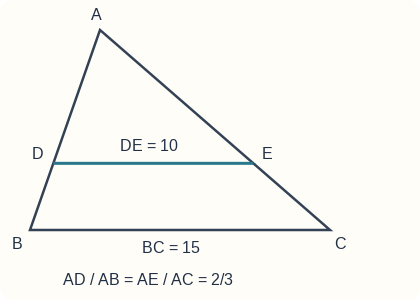
Example. In triangle , points and satisfy and . If and , find and .
Parallel lines give matching angles, so with scale factor . Lengths scale by that factor and areas by its square:
Here denotes the area of triangle .
Special Right Triangles
Section titled “Special Right Triangles”An isosceles right triangle has side ratios . Cutting an equilateral triangle in half gives a triangle with ratios , listed opposite those angles.
Example. An equilateral triangle has side length . Find its altitude and area.
Its altitude bisects the base, creating a right triangle with hypotenuse eight and short leg four. The altitude is , so the area is
When a diagram contains a perpendicular and a or angle, these ratios can avoid a longer trigonometric calculation.
Angle Bisectors and Area Ratios
Section titled “Angle Bisectors and Area Ratios”If the internal bisector of meets at , the angle bisector theorem says
To see why, compute in two ways. A shared altitude to line gives , while the sine area formula gives .
More generally, triangles with the same altitude have areas proportional to their bases. If two sides of a smaller triangle lie along two sides of a larger triangle, the shared included angle gives an area ratio equal to the product of the two side ratios.
Example. In triangle , , , and . The internal angle bisector from meets at . Find and .
The side ratio is , so and . The two smaller triangles share the altitude from , giving .
Laws of Sines and Cosines
Section titled “Laws of Sines and Cosines”The Law of Sines relates sides to opposite angles and the circumradius :
Use it when a side and its opposite angle are known. The Law of Cosines is useful for three sides or two sides and their included angle:
At a right angle, it reduces to the Pythagorean theorem.
Example. Two sides of a triangle have lengths and , with included angle . Find the third side and the area.
The Law of Cosines gives
so the third side is . Using the same included angle,
If the Law of Sines gives , both and may have that sine. Check which angles fit the triangle rather than automatically taking only the acute angle.
Area, Inradius, and Circumradius
Section titled “Area, Inradius, and Circumradius”Let and . Useful area formulas are
where is the inradius. Heron’s formula uses three side lengths. The relation comes from splitting the triangle into three triangles with common height to the sides. The circumradius formula follows by substituting into the sine area formula.
Example. A triangle has side lengths . Find its area, inradius, and circumradius.
The semiperimeter is , so Heron’s formula gives
Consequently,
Cevians and Stewart’s Theorem
Section titled “Cevians and Stewart’s Theorem”A cevian joins a vertex to a point on the opposite side. If , set , , and . Stewart’s theorem states
It follows by applying the Law of Cosines to the two triangles at ; the cosine terms cancel because the two angles at are supplementary. This is useful when a cevian is neither perpendicular nor an angle bisector.
Example. In a triangle, , , and . Find the length of the median from .
A median has . Stewart’s theorem gives
Thus and the median has length .
Projections and a Derivation of Heron’s Formula
Section titled “Projections and a Derivation of Heron’s Formula”An altitude need not land inside the opposite side. Using a signed projection avoids separate acute and obtuse cases. Place , , and . The distance equations give
The projection may be negative or exceed , but the area formula remains valid.
Squaring the area relation and substituting the projection gives
Factor the difference of squares:
Replacing these factors by produces Heron’s formula. This derivation also explains why the triangle inequalities are necessary: the semiperimeter differences must be positive for a nondegenerate triangle.
The method is useful when a side-length problem asks for both an altitude and a projection. Computing the signed projection once can supply both quantities without introducing an inverse trigonometric angle.
Angle-Bisector Lengths and External Bisectors
Section titled “Angle-Bisector Lengths and External Bisectors”The internal angle bisector from has length satisfying
To derive it, use the angle-bisector theorem to write and . Substitute these two parts into Stewart’s theorem and solve for . Another form is .
The external angle bisector divides the opposite side line externally in the same ratio . If the adjacent sides are equal, the external bisector is parallel to the opposite side and there is no finite intersection point. This is the geometric meaning of the zero denominator that would appear in an external-division formula.
Example. A triangle has . Find the internal angle-bisector length from .
Here , so
Thus . The opposite-side division ratio is , which is consistent with the side naming.
Example. In triangle , . The external angle bisector at meets extended beyond at . Find .
The external ratio gives . Since ,
so and . Using the internal relation would contradict the diagram and the external location.
Tangent Lengths and Half-Angle Formulas
Section titled “Tangent Lengths and Half-Angle Formulas”If the incircle touches the sides, tangent segments from the same vertex are equal. Solving the three side-sum equations shows that the tangent length from is , with cyclic versions at the other vertices.
The incenter and a tangency point form a right triangle, giving
Combining the cosine law with the half-angle identities also yields
Take the positive square roots because a triangle’s half-angles lie strictly between zero and ninety degrees.
Example. A triangle has side lengths thirteen, fourteen, fifteen, and is opposite the side thirteen. Find .
Its area is eighty-four and semiperimeter twenty-one, giving inradius four. The tangent length from is . Hence .
This uses the already known area and avoids solving for itself. Half-angle expressions can be simpler than the full angle.
These formulas are helpful when an angle bisector or incircle creates a half-angle that ordinary side-angle relations do not address directly.
Excircles and Signed Areas
Section titled “Excircles and Signed Areas”The -excircle is tangent to side and the extensions of the other two sides. Its center is the intersection of the internal angle bisector at with external bisectors at . If its radius is , signed area decomposition gives
The positive area on one side is offset by the two triangle pieces on the extended sides. The resulting denominator is rather than , which distinguishes an exradius from the inradius.
Thus
The reciprocal identity follows because the three numerators sum to . Heron’s formula also gives .
For sides thirteen, fourteen, fifteen, the three exradii are , whereas the inradius is four. This provides a numerical check on the reciprocal identity.
Radius and Area Inequalities
Section titled “Radius and Area Inequalities”Triangle constraints often become easier through . These are positive and satisfy . In particular,
by applying two-variable AM–GM to the three factors. Since
we obtain Euler’s inequality , with equality exactly for an equilateral triangle.
Example. Among triangles with fixed perimeter , find the largest possible area.
Heron’s formula gives with . AM–GM gives , so
Equality requires , equivalently equal side lengths. Such an equilateral triangle exists for every positive perimeter, so this is an attained maximum.
This is an optimization proof with both required parts: a universal bound and an admissible equality case. Merely guessing that symmetry makes the equilateral triangle largest would not establish the result.
Choosing a Cevian or an Area Decomposition
Section titled “Choosing a Cevian or an Area Decomposition”A diagram can suggest many auxiliary lines, but a useful construction should create a relation the problem can exploit. Draw an altitude when products of a base and height appear, an angle bisector when ratios of adjacent sides appear, and a median when equal areas or midpoint coordinates matter.
If two triangles share a vertex and their opposite bases lie on the same line, compare their areas through the shared altitude. If they share an included angle instead, compare the products of the adjacent sides. These are different area comparisons and should not be interchanged.
For a point inside , the three triangles partition the whole area. Their areas can serve as weights or coordinates. If the point approaches a side, one area tends to zero, which also explains how signed-area methods extend to exterior points.
A longer triangle problem often becomes short after computing the same area in two ways. Before expanding trigonometric expressions, list the available formulas for and check whether two of them connect exactly the quantities being asked for.
Radius Identities for Trigonometric Expressions
Section titled “Radius Identities for Trigonometric Expressions”Multiplying the three half-angle sine formulas gives
The second equality follows from Heron’s formula and . Thus .
Sum-to-product identities also give
For the thirteen-fourteen-fifteen triangle, , so its three cosines sum to . Finding each angle first would be unnecessary. Symmetric trigonometric expressions often have a simpler interpretation through radii.
The Ambiguous SSA Case
Section titled “The Ambiguous SSA Case”Two sides and a nonincluded angle may determine two triangles. A sine equation provides two supplementary angle candidates, and both may fit the remaining angle sum.
Example. A triangle has . Find every possible length of side .
Use the cosine law at :
The quadratic has roots . Both are positive, and both satisfy the triangle inequalities with seven and ten. They describe two distinct triangles.
Equivalently, the sine law gives . Both the acute and obtuse choices for leave a positive angle , explaining the two algebraic roots geometrically.
A side-angle-side specification does not have this ambiguity because its included angle fixes the third side directly. The position of the supplied angle relative to the supplied sides is therefore essential, even when the same numerical data appear.
The Sum of Squared Median Lengths
Section titled “The Sum of Squared Median Lengths”Setting the side divisions equal in Stewart’s theorem gives
Adding the three cyclic equations yields
For example, if a triangle’s medians have lengths three, four, and five, the sum of its squared side lengths is .
This type of question asks for a symmetric quantity, so solving separately for all three sides would add work. The cyclic sum cancels the asymmetric terms automatically. The formula also provides a scale check: doubling every side doubles every median, so both squared sums must multiply by four.